
Since 2012, Mali has been facing complex security and humanitarian crisis with repeated military coups and acts of terrorism perpetrated by Jihadist movements.[1] In 2018, the security situation worsened and triggered a new mass internal displacement. By July 2021, the number of internally displaced persons in the country had reached 377,781, including 240,024 children, representing 64% of the internally displaced.[2] Moreover, even as the security situation remained volatile over the last ten years (2012-2021), 83,615 refugees returned to Mali, including 35,186 children (42%).[3] This short paper asks whether the children affected by these waves of displacement in Mali are able to enjoy their right to legal identity and access to birth certificates.
Legal identity is defined as ”the basic characteristics of an individual’s identity, e.g., name, sex, place, and date of birth, conferred through registration and the issuance of a certificate by an authorized civil registration authority following the occurrence of birth”.[4] Birth registration is particularly important since it “sets the foundation for the recognition of the child as a legal persona.”[5] Indeed, “a child who is not registered does not legally exist and runs a substantial risk of falling outside of the reach of government’s protective actions towards the realization of child rights.”[6] Sustainable Development Goal (SDG) Target 16.9 requires States to “provide legal identity for all, including free birth registrations”, with progress measured by the proportion of children under five years whose births have been registered with a civil authority.[7]
The question of birth registration for displaced children in Mali is a subject of pressing concern for both practitioners and academics. A recent study on the risks of statelessness in Mali found that the majority of Malian internally displaced persons (IDPs) had lost their civil documents and would have difficulties recovering them.[8] Yet, whilst that study provides insights on the challenges that IDPs face in accessing civil documentation in Mali, it does not explicitly address questions relating to the access to birth registration by displaced children. Drawing on research carried out by the author from 2016, the present paper addresses this discrete topic. The data reflects both desk research and interviews with key institutional actors involved in civil documentation and legal assistance. In developing our understanding of IDP children and birth registration, it equally aims to redress some of the wider paucity of academic literature on internal displacement in Africa.[9]
Forced displacement in Mali
In Mali, violent conflict, associated with the emergence of the jihadist movements and intercommunal violence, has triggered mass displacement across the country since 2012.[10] The scale of internal displacement since then is shown by the Figure below.
Figure: Evolution of internal displacement in Mali [11]
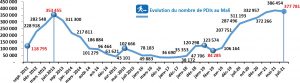
As can be seen, the first wave of displacement took place in 2012, following to the Green Beret military coup, the killing of the 97 Malian soldiers in Aguellock in the Gao region (north),[12] and violent clashes for the control of northern areas by Jihadist groups. The attack on Konna (south) and imminent possible capture of Bamako by Jihadist movements, triggered a robust military intervention on January 11, 2013 by French troops backed by the loyal army and forces from the ECOWAS-led International Support Mission to Mali (AFISMA).[13] The decrease of IDPs observed after2013 was notably linked to the Peace Process marked by negotiations and mediation initiatives concluded in Algiers with the Peace Accord signed in 2015.
However, “[t]he years 2018, 2019 and 2021 [were marked by] an upsurge in violence in the Central and Northern regions”.[14] The second wave of displacement intensified as a result of rivalries between the Jihadist groups and attacks against civilians in the Liptako Gourma area in the summer 2019 and early 2020.[15] In 2020, the Protection Cluster registered 4,036 security incidents across the country: Mopti (centre) registered 35% of the incidents against 25% in Segou (south).[16] However, even while internal displacement was increasing due to the security situation, some Malian refugees in neighboring countries returned home. In July 2021, the National Directorate of Social Development (DNDS) registered 83,615 repatriates[17] against 46,895 refugees.[18] In 2021, there was a steady increase in the number of IDPs (to 377,781 in July 2021, of whom 64% were children).[19]
Challenges to legal identity for children affected by displacement
This context of violent conflict has resulted in 240,024 internally displaced children and 35,186 repatriated refugee children (former refugees who are now back in the country with their parents) living in Mali in 2021. Living in displacement has negatively impacted their right to legal identity. Specifically, many appear to lack birth certificates, which is the result of many barriers, including distance to the nearest registration facility, lack of knowledge on how to register a child’s birth, and fees for obtaining a birth certificate,[20] and the legislation in force.
These deficiencies in birth registration exist despite treaty obligations assumed by Mali to immediately register the birth of each child, including the 1966 International Covenant on Civil and Political Rights (Article 24), the 1989 Convention on the Rights of the Child (Articles 7-8), the 2009 African Union Convention on the Protection and Assistance of Internally Displaced Persons in Africa (Article 13) and the African Charter on the Rights and Welfare of the Child (Article 6). Mali’s Constitution provides that such ‘treaties or agreements regularly ratified or approved have, upon their publication, an authority superior to [domestic] laws.’[21]
The next sub-sections analyse the legal identity challenges facing these two categories of displaced children, IDP children and repatriated refugee children.
Internally displaced children
In 2021, of the 377,781 IDPs registered by Mali, 240,024 (or 64%) were children, with 127,935 girls (34%) and 112,089 boys (30%). According to the DNDS, none of the IDP children attended the school at the time of the recent (July 2021) assessment.[22] Moreover, the majority of the IDPs (52%) in Mali are living in rural areas close to cities, 19% in landlocked rural areas, and only 29% living in urban areas.[23] The high proportion of children and rural-dwellers among the IDP population has implications for their access to birth certificates and other civil identity documents.
A study in 2020 found that 29% of IDPs in Mopti region (centre) did not have civil documents, as against 20% in Ansongo and 17% Gundam areas (Gao region north), and 11% in Niono area[24](Segou region, south). Some of the reasons why IDPs do not obtain civil documentation apparently reflect personal factors. For instance, 57% of those IDPs without civil documentation in Gao, Menaka, Mopti and Timbuktu did not know the procedure for obtaining a birth certificate, 31% did not know the procedure for securing an identity card, and 10% mentioned a lack of financial means to afford issuance of civil documentation[25].
Other reasons, though, reflect more structural factors. Thus, 39% of IDPs interviewed by the Norwegian Refugee Council (NRC) cited the closure of civil registries due to insecurity as a reason for their lack of access to such documentation, and 15% signaled the remoteness of the civil registry services.[26] Certainly, in the rural areas where most IDPs live, there are few health centres, registries or courts to facilitate access to birth registration and certificates. For instance, in the 2012 conflict, 87 Civil Status Centre (CEC) in the three regions of northern Mali were looted by armed groups and, in the regions of Gao and Menaka, only five civil registries out of 24 are functioning today. Moreover, IDPs are reluctant to travel to town to obtain civil documentation because of financial constraints, the distance, and the security environment. For instance, in Kidal, the distance to access the registry is about 66 km on average.[27] The lack of access to documents is even more acute in the northern and central regions because of insecurity, absence of authorities, insufficient registries, and other basic services.
The procedure for birth registration exacerbates these difficulties. The Article 157 of the Code of Persons and Family (CPF) requires that any birth must be declared to the civil registries of the place of birth[28] within thirty (30) days of the childbirth.[29] The 30-day time limit for child birth declaration is hard for caregivers and relatives to comply with in insecure and fragile areas. Hence, many of them have therefore missed registering their children at birth. In this scenario, when caregivers fail to comply with the 30-day limit, Article 134 of the CFP actually provides another opportunity for late registration. This requires the applicant (caregiver or relative) to obtain a certificate of non-registration of his child from the local mayor’s office, then present supporting evidence of his own legal identity including the birth certificate or national identity card to a court, which can deliver a judgment that allows the mayor’s office to register the birth and provide a birth certificate to the child. However, this supplementary procedure is not free of charge: mayors can charge $2 for the initial certificate and the court fees vary from region to region ($3.5-12 officially but up to $30 per child in practice).
The costs associated with the supplementary procedure pose a particular problem for IDPs in Mali, whom studies have shown to have lost significant amounts of durable goods (20–60 per cent) and animals (75–90 per cent) as a result of displacement.[30] Moreover, some displaced caregivers lack the necessary documents to support their children’s application for supplementary judgment procedures effectively. Studies suggest that many IDPs have lost their identity documents, or have never been registered themselves at birth,[31] such that they do not have any of the required documents to support the birth certificate application for their child in the court. The legislation does provide a mechanism for recovering lost and destroyed documents, but the legal procedure is complex and can incur considerable time and expense.[32] Further, as IDPs have been displaced to another area, many do not know people living locally who can provide testimony to the courts about the birth.
Repatriated refugee children
In July 2021, although 46,895 Malian refugees remain in neighboring countries,[33] some 83,615 Malian refugees returned to Mali, including 35,186 children (42%).[34] The situation in Mali remains unstable and, while some refugees returned home voluntarily, others returned under compulsion. Forceful returns are mainly observed in the Liptako gourma area, where the intensification of the Jihadist attacks forced Malian refugees to return to their country. Alongside the personal and structural problems facing IDP children in accessing birth certificates, the children of repatriated Malian refugees also experience additional legal identity challenges as a result of their specific situation.
As of October 2019, some 33% of repatriates (including children) did not have any legal identity document.[35] An interview with a civil servant from the National Directorate for Social Development (DNDS) suggests the problem is particularly acute for those born outside the refugee camps. The domestic legal provisions pose a considerable challenge for repatriates, as the CPF provides that Malian children born in foreign countries should either be registered in the host country’s registries or within Malian embassies/consulates.[36] When the birth certificate could not be granted as a result of lack of registry in the host country or when the document is destroyed or lost and cannot be reconstituted, a complex administrative and judicial procedure is prescribed.[37] However, the law does not provide any remedy at the domestic level if a children born in a foreign country fails to register and bring back home relevant legal documents. The law that was adopted in 2011 did not consider exceptional and humanitarian situations, such as the protracted external displacement of Malian citizens. As a result, unless the Government takes a political decision or amends the law, repatriated refugee children born in foreign countries do not have any mechanism to access even late birth registration processes.
Even those repatriated refugees who do bring foreign birth certificates for their children back to Mali must transcribe their civil document at the National Directorate of Civil Status (DNEC) special center in Bamako. “Transcription is the process by which a civil status officer copies in the registers, either a civil status certificate drawn up by another civil status centre, or a judicial decision relating to civil status”.[38] The majority of repatriates are based in the rural areas of the northern and central regions and it is complicated to reach to Bamako special center for administrative issues. The law does allow that a copy of the foreign birth certificate can be sent by mail for transcription.[39] But, in practice, the inadequate postal services and insecure context make the idea of sending the original birth certificate by post a less viable option than attendance in person at the special center in Bamako, even if the costs associated with such travel may be prohibitive for some repatriated refugees.
Mali and UNHCR have signed separate tripartite agreements with each of the three main countries hosting Malian refugees: Niger (2014), Burkina Faso (2015) and Mauritania (2016). A common provision of these agreements provides that “the Government of Mali undertakes to recognize and regularize, per the national legislation in force, the changes in the civil status of repatriates Malian refugees (births, deaths, legal guardianships, marriages and divorces) under the supervision of UNHCR”.[40] Based on this provision, there is an indication that children born in host countries who do not have birth certificates would be excluded from the Government assistance, because the legislation in force does not offer them any remedy at the domestic level to claim their right to a legal identity. The Government of Mali commits therefore to “facilitate and simplify access to civil documentation to repatriates’ children born in Mali, who do not have birth certificates, either because they had lost them during the displacement or because their birth certificates were not reported shortly before crossing the international borders”.[41] This provision reinforces somehow the exclusion of children born in host countries who were not able to be register at birth. Moreover, while the Government commits under the Tripartite agreement to facilitate the provision of birth certificates to repatriate children born in Mali before fleeing the country, limited actions have been undertaken. Indeed, legal assistance is provided at case by case basis to that category of children.
In 2018 the DNEC developed a five-year strategy that contained a strategic axis on legal institutional reform. A former UNICEF program officer and active member of the civil documentation and legal identity working group, who was interviewed by the author, explains:: “The DNEC with the support of its technical partners proposed four bills to the Government. One of them (a moratorium) aims at addressing the lack of civil documentation for all the children including repatriates”. This source stressed that, if the moratorium bill were adopted, then children, and particularly repatriated refugee children, would be able to access their birth certificates without recourse to the burdensome procedures imposed by existing legislation. Indeed, the moratorium bill proposed by the DNEC requests derogation from certain articles (133,134 and 158) of the CPF and recommends exemption from the supplementary judgment legal procedures. The objective of the moratorium is to facilitate access to legal identity documents without discrimination for children affected by the conflict and allow them to apply directly to the birth certificate without any other procedure. However, at the present date, that bill remains deadlock and no progress has been made for its adoption by the Government.
Conclusions and recommendations
The security situation in Mali is not improving, and the displacement rate has reached an unprecedented high, affecting all the main regions of the Mali. Children constitute 64% of the IDPs and 42% of the repatriates in July 2021, and their displacement has directly impacted on their enjoyment of the right to legal identity. Some practical barriers have been identified here, including distance, lack of facilities, lack of financial means for vulnerable caregivers. Yet the most critical barrier is that the domestic legislation in Mali is not adapted to the situation of humanitarian crisis. As a result, despite the efforts made by the Government and NGOs, the majority of children affected by displacement do not have birth certificates that can prove their identity. The permanent delaying and denial of this fundamental right to children will affect their citizenship and participation in public affairs and may make them an easy target for recruitment by Jihadist groups now and in the future.
The following actions are recommended to address these challenges.
The Malian Government should:
- Take necessary steps to adopt the moratorium drafted by the DNEC. The moratorium proposes the exemption of supplementary judgment procedures for two years and facilitates direct application for birth certificate to registries.
- Establish a special Commission on IDP and repatriated refugee children, composed of the Ministry of Humanitarian Affairs, UNHCR, UNICEF, DNEC, Civil Documentation Working Group and donors. The Commission would be responsible for developing a comprehensive strategy to address the situation of children affected by displacement without discrimination.
- Establish a Task Force on Legal Identity within the Commission, which would be technical operation body of the commission. The Task Force would be mandated to develop and propose an operational action plan to address the challenges of children affected by displacement and facilitate the provision of birth certificates without exclusion.
UNHCR, IOM, UNICEF, NRC and the Civil Documentation Working Group should:
- Participate in collective advocacy to push for the adoption of the bill (moratorium) proposed by the DNEC and the establishment of the special Commission and the Task Force for Legal Identity.
- Ensure that all Malian children born in refugee camps receive a birth certificate from the host country.
- Secure donor support to conduct a robust and extensive assessment to identify children born between 2012 and 2020 needing birth certificates. This assessment should consider IDP and repatriated refugee households as well as children in host communities in the central and northern regions.
Daniel Ozoukou is a Former Research Fellow Zolberg Institute on Migration and Mobility New York (USA) and previously Senior Technical Coordinator for the Norwegian Refugee Council in Mali. Email: [email protected]
[1] M. Shurkin, S. Pezard, S. R. Zimmerman, Mali’s Next Battle Improving Counterterrorism Capabilities, Santa Monica, CA:. The RAND Corporation, Research Paper Apr.2017.
[2] Direction Nationale du Développement Social du Mali (DNDS), International Organisation for Migration (IOM), Displacement Tracking Matrix Report, July 2021. Available at:https://migration.iom.int/reports/mali-%E2%80%94-rapport-sur-les-d%C3%A9placements-juillet (last visited 25 Aug.2021).
[3] Ibid.,15.
[4] United Nations Department of Economic and Social Affairs, Statistics United Nations Legal Identity Agenda. Available at: https://unstats.un.org/legal-identity-agenda/ (last visited 1 November 2021).
[5] The African Committee of Experts on the Rights and Welfare of the Child, General comment on article 6 of the African charter on the rights and welfare of the child. Available at GC-no2-on-article-6-of-the-African-charter-on-the-rights-and-welfare-of-the-child_0%20(1).pdf (last visited 1 Dec. 2021), 20.
[6] Ibid., para 43.
[7] Sustainable Development Solutions Network (SDSN) Indicators and a Monitoring Framework, Launching a data revolution for the Sustainable Development Goals. Available at: https://indicators.report/indicators/i-92/ (last visited 2 Nov. 2021).
[8] M. Offermann, Les risques d’apatridie au Mali et pour les Maliens vivant à l’étranger en application des législations et pratiques relatives à la nationalité, au Mali et dans les pays d’accueil de Maliens UNHCR report Aug. 2020, 33
[9] R. Adeola, The State of Research on Internal Displacement in Africa, Internal Displacement Research Project (IDRP) Working Paper No. 2, 2020.
[10] DNDS, IOM, Displacement Tracking Matrix Mali, executive summary.
[11] DNDS, IOM Displacement Tracking Matrix Mali, 5.
[12] M. Shurkin, S. Pezard, S. R. Zimmerman, Mali’s Next Battle Improving Counterterrorism Capabilities, 11.
[13] J. David, The regional impact of the armed conflict and French intervention in Mali, the Norwegian Peacebuilding Resource Centre, NOREF, Report Apr. 2013, 3.
[14] DNDS, IO, Displacement Tracking Matrix Report, July 2021, 5.
[15] The Liptako Gourma area, comprised bordering regions in Mali, Burkina Faso, and Niger. Since 2015, it has increasingly become one of the epicenters of violence in the Sahel, experiencing a proliferation of armed groups. During the period between 2018 and July 2020 there was an increase in the number of violent incidents and conflict-related deaths.
[16] United Nations High Commissioner for Refugees (UNHCR) Mali, Protection Cluster, Analyse annuelle de monitoring de protection Mali 2020, 21 Feb 2021. Available at: https://reliefweb.int/report/mali/analyse-annuelle-de-monitoring-de-protection-mali-2020 (last visited 25 August 2021).
[17] DNDS, IOM Displacement tracking Matrix Mali,.15.
[18] UNHCR operational data portal, Refugee Situations. Available at: https://data2.unhcr.org/en/country/mli (last visited 31 October 2021).
[19] DNDS, IOM Displacement tracking Matrix Mali, 5.
[20] United Nations Children’s Fund (UNICEF), A Snapshot of Civil Registration in Sub-Saharan Africa. Available at : Civil-Registration-English-Web-Final.pdf (last visited 1 December, 2021).
[21] Constitution of Mali N°92-073, Art. 116 (decree: 25 Feb.1992).
[22] DNDS, IOM Displacement tracking Matrix Mali, 29.
[23] Ibid., 20.
[24] Norwegian Refugee Council (NRC)’s Information Counseling and Legal Assistance (ICLA) core competency, assessment conducted between 14 September and 30 November, 2020. That assessment was conducted on a selected number of IDPs, including children in central and northern areas of Mali.
[25] Ibid.
[26] Ibid.
[27] M. Offermann, Les risques d’apatridie au Mali et pour les Maliens vivant à l’étranger en application des législations et pratiques relatives à la nationalité, au Mali et dans les pays d’accueil de Maliens, 35.
[28] Code of Persons and Family (CPF) Art. 157, Law 2011-087, (adopted on 30 December 2011).
[29] CPF Art. 158.
[30] J. Lendorfer, A. Etang-Ndip, J. Hoogeveen Socio-Economic Impact of the Crisis in Northern Mali on Displaced People Journal of Refugee Studies, Volume 29, Issue 3, Sept. 2016, 315–340.
[31] M. Offermann, Les risques d’apatridie au Mali et pour les Maliens vivant à l’étranger en application des législations et pratiques relatives à la nationalité, au Mali et dans les pays d’accueil de Maliens 33.
[32] Ibid., 33.
[33] UNHCR operational data portal Refugee situations.
[34] DNDS, IOM,Displacement Tracking Matrix Mali,15.
[35] UNHCR, Update on voluntary repatriation / situation of repatriates, presentation (Powerpoint) in course of the monthly meeting organized by the Civil documentation and legal identity Working Group in Bamako Mali, on 20 February, 2020.
[36] CPF, Arts. from 191 to 195, Law n° 2011-087. Available at : https://dnec.gouv.ml/acte-de-naissance_ext/
[37] CPF, Art. 198.
[38] CPF, Art. 149 of Law No. 2011.
[39] The procedure is explained in Arts 151, 152, 153, Law n°2011-087.
[40] M. Offermann, Les risques d’apatridie au Mali et pour les Maliens vivant à l’étranger en application des législations et pratiques relatives à la nationalité, au Mali et dans les pays d’accueil de Maliens 40.
[41] Tripartite Agreement Art. 7 (5). The Tripartite Agreement (TA) is an accord signed between three parties, the country of origin, host country and UNHCR for voluntary repatriation of refugees.