
A rare consensual point
This article examines the widely-accepted idea that the vast majority of human movements related to climate change will happen within countries. This idea is notable as one of few points of consensus in the literature investigating the relationship between climate change and human movement. Indeed, the evidence for it is solid. The IPCC Working Group II has concluded with “high confidence” based on “robust evidence” that “most climate-related displacement and migration occur within national boundaries, with international movements occurring primarily between countries with contiguous borders” (see TS.B.6, p.52 and the cross-chapter box on migration in Chapter 7, pp.1080-1083).
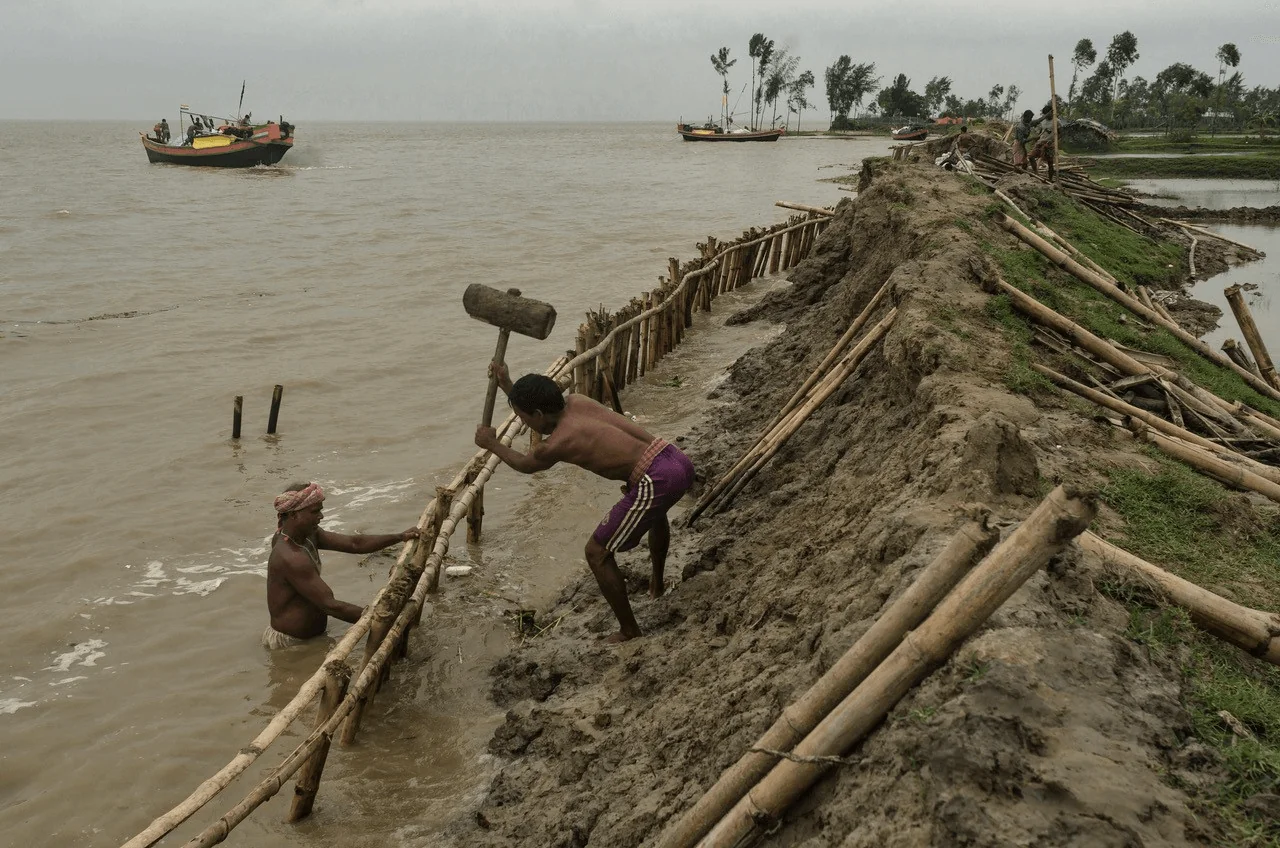
My purpose is not to challenge the factual basis of this widely-accepted scientific finding. Instead, I examine the idea that “most climate-related movements of people happen within countries” as a discourse. First, I chart the rise of internal climate migration in academic and policy discourse, as a reaction to prior predictions that so-called “climate refugees” would move massively and internationally from “climate hotspots” in Africa, Latin America, and South Asia to Australia, Europe, and North America. Such narratives are problematic because they do not reflect the reality of human movement in the context of climate change, but also because they cast “climate migration” as a security threat to the Global North, thereby inviting harmful, xenophobic policy responses aimed at containing migration. Against this, focusing on peoples’ movements within countries is generally considered an effective way to counter the securitisation of climate migration by policy actors in the Global North. This part of the story is well known, and is likely familiar to many readers.
What may be less familiar is the second part of my argument. I show that the widespread acceptance that most climate mobilities occur within countries is broadly adopted for reasons beyond its factual truthfulness. What’s more, focusing on internal movements has its own political and policy implications. It can be a convenient narrative for stakeholders in the Global North who would previously have adopted a securitised lens or are otherwise reluctant to provide protection to migrants. This narrative is convenient for them because it maintains climate mobilities as a distant phenomenon. This distance limits any sense of urgency to action and significantly downplays the forced and unwanted nature of many such movements, while complicating the question of responsibility for helping people whose decisions to migrate can be attributed to climate change. Recognising this spatial distancing effect is important because it provides crucial context for evaluating the prospects of different proposals for action on climate mobilities. Ultimately, I show that the widespread agreement that climate mobilities are mostly internal to other countries poses serious, if often unintended, obstacles to projects that could avert, minimise, or address the negative consequences.
Two notes: on terminology and on the scope of my argument
Before delving into the details of my argument, a note about the use of the terms “displacement”, “migration”, and “mobilities” as they are used in relation to climate change. The term displacement refers to processes by which people are forced to move away from their homes. This can be across borders, or within their own country, in which case people fit under the category of internally displaced persons (IDPs), defined in the Guiding Principles on Internal Displacement as “persons or groups of persons who have been forced or obliged to flee or to leave their homes or places of habitual residence, in particular as a result of or in order to avoid the effects of armed conflict, situations of generalized violence, violations of human rights or natural or human-made disasters, and who have not crossed an internationally recognized state border”. Migration, on the other hand, is typically defined as a more voluntary process, although in practice any decision to migrate sits on a spectrum from forced to voluntary. The terms “climate displacement” and “climate migration” emphasise the role of climate change as a major contributing factor to either process. The term “climate mobilities” is broader. It encompasses the full spectrum of human movement in the context of climate change, highlighting variations in distance, duration, and degree of voluntariness, including cases where people are unable to leave or choose to stay where they are.
It is worth noting that these definitions, though rooted in well-established international frameworks, policy, and academic discussions, are not universally adopted or set in stone when it comes to public and political discourse. My research in France demonstrated a great deal of confusion about definitions, so that terms became interchangeable or used in imprecise and contradictory ways. I mention this to make a broader point. There is a tendency in the field of climate mobilities to seek a consensus on terms and their definitions, but experience shows this remain elusive. Sometimes, this is due to partial knowledge or ignorance of technical definitions, but more generally this difficulty in finding consensus arises because terms are always open to interpretation and debate. Some may be suitable to some political contexts or communication strategies but not others. The much-contested term “climate refugee” persists in the press and some NGO circles in large part because it is considered clearer and more effective at communicating to the general public than any alternative. Introducing the language of “climate im/mobilities” into policy discussions may or may not be useful, depending on the context, even if the term is productive from an academic perspective. That debates about terms are happening in many languages other than English only compounds this issue. Rather than seek stable definitions, it is important to define terms for a context and a purpose, to make one’s reasoning clear, and to accept that definitions may have to change when the discussion moves to other places.
The second point to note is that the perspectives related here are primarily from the vantage point of policy stakeholders in Europe, and more specifically France. These are the debates I am most familiar with. I base many of the examples on a French case study drawn from my PhD thesis, for which I spoke to 50+ people in international development cooperation administrations, migrant solidarity organisations, the press, and academia. I complement this with my reading of reviews of climate migration and displacement policy efforts discussed in European countries and at the European Union. The analysis is necessarily partial, including within Europe. Nevertheless, some of the points may find echo, or be usefully contrasted with, discussions taking place elsewhere around the world. I hope they can stimulate further discussion of the reasons for and implications of the widespread focus on internal climate displacement.
The decline of international climate migration
Understanding how researchers and policymakers have come to a near-consensus that the vast majority of climate-related human movement will take place within national borders is essential to understanding its political and practical consequences. Its authoritative status arises not just from the scientific evidence in its favour, but also because it challenges problematic political aspects of previous predictions of mass international migration. Indeed, the re-emergence of interest in the environment as a driver of migration in the 1980s involved predictions of impending cross-border movements numbered in the tens and hundreds of millions of people. Particularly influential were much-repeated estimates by ecologist Norman Myers, predicting 150, 200, or 250 million “environmental refugees” worldwide by 2050. Such predictions were already challenged by Myers’ contemporaries because of their dubious methodological basis: assuming automatic and linear international out-migration from large areas affected by drought, desertification, or sea-level rise. By the author’s own admission, these were “heroic extrapolations.”
More concerning to critics, however, is the tendency of such large numeric predictions to contribute to an apocalyptic understanding of climate mobilities, which in turn leads to securitised measures of policing and limiting the movements of migrants across borders. Given that the securitisation of migration is harmful to migrants and counterproductive to the development of safe migration pathways, academics and policymakers have sought to counter the perception of a climate migration “threat” to European and other rich Western countries. With this in mind, some have gone further, arguing that the focus on climate change as the cause of human movement is inherently problematic and should therefore be avoided altogether. Giovanni Bettini summarised this view when he described climate migration as “a flawed and noxious concept that, regardless of all the headlines it can gain, can hardly provide any contribution to progressive agendas on climate and migration and in support of those vulnerable to climate impacts”.
Many people reject this suggestion that the concept of “climate migration” should be abandoned, even if they agree with the underlying analytical and political concerns. The idea of climate mobilities appears at first glance so intuitive that it has entered public perception and is here to stay. So, climate mobilities research continues apace – as evidenced by a steady increase in academic publications – while policymakers and media outlets regularly ask questions on what to expect, and what to do in response. It is therefore crucial that academics and policymakers with relevant expertise find productive ways to speak to growing concern about the changing climate’s impact on human mobilities, with the ultimate aim of improving the lives of people on the move.
The rise of internal climate displacement
The critique of international climate migration has contributed to a narrative shift towards greater focus on internal climate displacement. Indeed, alarmist predictions of mass climate migration are mostly absent from the literature produced by academics and think tanks today, with most policymakers following suit. When the Institute for Economics and Peace (IEP) claimed that “Europe has ecological threat hotspots to its south and east. These hotspots have a combined population of 841 million people. Large displacements of people from these hotspots could affect the European continent, especially in terms of social cohesion and political stability” (Ecological Threat Register 2020) – they were quickly challenged. Subsequent editions of the Ecological Threat Register, in 2021 and 2022, while still citing large numbers of people facing “catastrophic ecological threat” in contexts of “low socio-economic resilience”, toned down the language of international displacement and avoided the suggestions that Western countries could be destabilised. For the most part, academics and policy makers have now adopted rhetorical strategies to talk about climate mobilities that avoid encouraging securitisation and xenophobia through alarmism. Chief among these is to highlight that most mobilities, irrespective of cause, occur within countries and to argue that the same would apply to any climate-related movement. Such conclusions are widely disseminated in policy-oriented reviews, such as the “Omnibus Overview” on the topic by the Center for Global Development and the Expert Council on Integration and Migration’s annual report, which in 2023 reviewed options for German policymakers to act on climate change and migration.
I see two trends in recent modelling studies reflecting this shift away from international and towards internal climate mobilities. The first trend is a shift towards studies focused on modelling internal mobilities. Many modelling studies focus on single case study countries. Multi-country, multi-region models – such as those underpinning the World Bank’s Groundswell reports and Global Centre for Climate Mobilities’ African Shifts report – also provide estimates for internal mobilities only. The second trend is observable in the way study results are presented. The norm in climate mobilities research today has shifted away from unsubstantiated claims of mass international migration towards a greater and welcome cautiousness in the presentation of modelling results. I see this, for example, in the way the African Shifts report has been discussed and presented. Interviewed about the report, Global Center for Climate Mobility director Sarah Rosengärtner emphasised the internal nature of movements predicted, stating that “more than 90%” of the migration modelled would occur within African countries. That is the point that made the headline. Another recent study investigating “how different types of climate events and individual/household characteristics interact in influencing intra-state migration” concludes with a “caution against sweeping predictions that future climate-related events will be accompanied by widespread migration”.
Internal to which countries?
The recognition of internal displacement as the predominant pattern of climate mobilities is not applied equally to all world regions. World Bank press releases about the Groundswell report, to take that prominent example again, conclude that “no region is immune to the potential of climate-induced migration.” And yet, such statements obscure an important exclusion from the analysis. While the study models internal climate displacement in six world regions (Sub-Saharan Africa, South Asia, and Latin America, East Asia and the Pacific, North Africa, and Eastern Europe and Central Asia), most high-income countries are excluded. Crucially, this means no estimates are provided for the USA and Canada, most of Western and Central Europe, and Australia and New Zealand. The report provides no explicit reason for this methodological choice – treating it as self-evident – whereas it details and justifies its exclusion of small island developing states (SIDS) and countries in the Middle East and Central Europe. It is also worth noting that as a side-effect of such choices, internal–international migration linkages remain under-explored. As Schewel and colleagues note in their review of climate-related migration forecasting models: “future research would benefit from exploring how internal and international migration act as complements or substitutes”. The possibility of cross-border migration, though much lower than internal displacement, should not entirely be ignored and may still be relevant in specific contexts affected by the impacts of climate change.
This focus on internal displacement is not just a feature of Groundswell. A systematic review of the CliMig database has demonstrated that the vast majority of case studies focus on countries in the so-called Global South. At the same time, it shows that the vast majority of study authors are affiliated to and funded by institutions in Australia, Europe, and the USA. At one time, this imbalance could be interpreted primarily as the reflection of securitisation concerns – with research conducted to evaluate the true scale of the international climate migration “threat”. The shift in focus to climate mobilities within countries has partially neutralised some of the worst expressions of this securitised conception of migration – in research circles at least – but it has not yet led to any significant changes in research focus. One explanation is that this pattern in knowledge production reflects another widely agreed idea, that climate displacement does not concern high-income countries. I return to this question at the end of the article, as this may be changing. For now, the main point is that the asymmetry visible in the CliMig database demonstrates that the pattern in knowledge production persists despite the shift away from securitised concerns about climate migration. There is an implicit qualifier to the dominant narrative of internal climate displacement among Global North stakeholders: that it happens inside other countries, in the Global South.
Options for action on climate displacement (from the Global North)
I was struck in my own research in France by the absence of projects designed or described as direct, concrete actions on climate displacement. A 2023 review of member state contributions to the European Migration Network suggests this is not a problem for France alone. It concluded that while climate mobilities is recognised as a topic of interest and concern by parliamentarians and diverse government administrations, “no EMN Member State has specific legislation on climate-related migration and displacement, nor any specific measures in place to host third-country nationals that might be affected by climate change or climate disasters”. Yet, from a European point of view, several options are available to act on climate displacement within countries of the Global South.
A first set of options is to address internal climate displacement in other countries via international development and humanitarian projects. The International Organisation for Migration (IOM) proposes three categories to classify such development projects, those that help people stay where they are, help people move, and help people on the move. However, a preliminary review of projects by development banks by the Migration Policy Institute (MPI) found that few projects in these three categories have an explicit climate change component. Those that do are new and small in scale.
A second approach is to promote “migration as adaptation”. In brief, this approach consists in the facilitation of labour migration (internally or regionally) for some people, with the explicit objective that these migrants can transfer the financial resources, skills, social and political capital thus acquired to their home communities, thereby allowing others to adapt to stay and for the migrants to eventually return. The evidence, however, shows that despite frequent academic and policy discussions of migration as adaptation, “there is very limited evidence that states are adopting migration as adaptation policies”.
A third set of options is to develop new pathways for safe and regular migration to the Global North, or adapting existing pathways. Such policies could be understood as providing opportunities for cross-border migration to people who would otherwise be displaced internally or trapped where they are as a result of climate impacts. This can involve new policies – such as a “climate passport” – or the adaptation of existing policy instruments to include a greater diversity of people – such as changes to the conditions for work visas. Several think tanks and expert committees have made recommendations for such approaches, but again, there have so far been no concrete initiatives implemented by European states.
There are many other opportunities for integrating climate mobilities into various policy frameworks (disaster risk reduction, adaptation, human rights) currently being pursued. Some proposals focus on altering existing labour migration laws. Others suggest making use of the EU’s mechanism for temporary protection of displaced persons, from which many Ukrainians recently benefited – although this appears unlikely given the explicit requirement of “exceptional circumstances of mass influx” into Europe. My objective here is not to offer an exhaustive review of these possible paths forward or to make my own proposals. Instead, I highlight some of the obstacles to action I have observed concerning the three approaches highlighted above –based on my study of French stakeholders – to invite further reflection on how they may be overcome.
Obstacles to action on climate displacement from the Global North
Limited operational potential
All stakeholders recognise that mobilities are multi-causal. As a result, it is very difficult for them to confidently identify people as displaced by climate change – rather than a complex combination of political, economic, cultural, and environmental drivers. This has important practical implications. Ideally, development projects require clearly-identified beneficiaries, to be reached by well-defined activities, the effects of which can be measured. Most of the development actors I spoke to in France reported that “climate displacement” is extremely difficult to operationalise in this way. Concretely: they struggled to identify “climate displaced people” as a distinct group. As a result, the climate mobilities-related activities I observed at the Agence Francaise de Développement (AFD) between 2020 and 2022 were all ad hoc research and networking projects – discussions about terminology and technical workshops on academic questions – leading to brief position statements and academic publications with little direct applicability for projects “on the ground”.
In addition, my French interlocutors often argued that the cause of displacement is rarely pertinent to most international development projects. One interviewee said that the “reception [of migrants] will be standardised as much as possible”, with all new arrivals treated in the same way regardless of “whether [they] left their country for reasons linked to climate disasters or armed conflict.” In most projects, the priority is to meet peoples’ needs regardless of why they move. In this view, the climate (as a cause of displacement) becomes essentially irrelevant to the operational design of development or humanitarian projects, since the focus is on providing access to essential services, housing, and job opportunities, while promoting integration with host communities.
Many of my interlocutors added that it was possible for them to downplay the importance of why people move to operational design only because the human movements in question do not involve Europe as a destination. When talking about cross-border migration to France and Europe more generally, this argument is more difficult to make because of the dominant political discourse which insists on discriminating between the supposedly legitimate political migrants and supposedly illegitimate economic migrants. Nonetheless, the downplaying of migration drivers is notable because it goes explicitly against a powerful narrative that calls for “addressing the root causes” of migration – which in France remains particularly strong in national political discourse, for example in parliamentary discussions. This is the idea that development projects not only can but should enable people to stay where they are. Though of course an important component of development and humanitarian work, there is a “sedentary bias” in the assumption that people in these contexts necessarily want to stay, when in fact development projects often increase opportunities for people to fulfil their aspirations to move.
Relatedly, my French interlocutors also stated that they did not see how a “climate mobilities” project would fundamentally differ from more usual climate adaptation or sustainable livelihoods projects. This led some of them to see action on climate mobilities as primarily a question of framing – a conscious political decision to recognise “climate mobilities” as a meaningful category for action. This question of framing is also visible in the aforementioned analysis by the MPI, which says that “a wide range of activities in the broader climate realm could indirectly help manage climate mobility, even if not described as doing so” (my emphasis). It is possible, in other words, to act on climate mobilities without fundamentally changing existing projects. A shift in framing can – of course – be useful and necessary. Indeed, many stakeholders push for more projects explicitly targeting climate mobilities because they believe it can meaningfully expand international cooperation practice to provide much needed support to a wider range of people. The question then becomes whether Western governments are prepared to promote action on climate mobilities – taking some responsibility for climate change impacts on population movements happening outside their borders.
Unwillingness to take responsibility for climate change impacts
For European countries to act on climate displacement in the Global South requires that they accept and take on a degree of responsibility for the negative impacts of climate change on human mobilities: in short, meaningfully committing to “climate justice”. This question is true of international development projects abroad but becomes even more prominent when considering approaches that may involve the facilitation of migration towards Europe, through new safe and regular pathways or cross-border migration as adaptation schemes. As one recent article examining potential European Union responses notes, this would be “difficult to reconcile with contemporary migration politics at home”, focused as EU migration policy is on controls, securitisation, and border externalisation. In this regard, it is far more common to see proposals for “regional solutions”, within East Africa for example, rather than intercontinental ones involving migration to Europe.
This is where some of the consequences of the narrative that emphasises that climate mobilities are mainly internal to countries become evident. It leaves very little space to propose cross-border solutions – such as migration as adaptation and other new migration pathways – that could involve Europe as a destination. I see this tension, for example, in the conception of environmental and climate justice at the AFD. According to an interviewee with direct knowledge of internal discussions, it “excludes questions of responsibility of one country towards another, of polluter-pays, etc.”. This was also apparent in the AFD’s brief note on the topic, which presents a narrow reading of what environmental justice means in development practice. The actions listed are limited to capacity-building for drafting national environmental law, encouraging citizen participation in regulatory processes, and awareness raising campaigns, all in other countries. The concept of climate justice is here in no way connected to losses and damages or to broader considerations of France’s historical responsibility for climate change and its current mobility impacts.
Acting on climate displacement in Europe?
A final way in which the Global North may act on climate displacement is if it occurs “at home”. Efforts to “bringing climate migration home” are meant to increase awareness and concern among policy makers and the general public that severe climate impacts, potentially leading to displacement, can also happen in Europe. By extension, it is hoped that such a shift in narrative would not only lead to action at home but also create empathy and solidarity with other people affected elsewhere. According to one French journalist, the idea is “maybe if people are touched by what happens to us here and now, they’ll be a little more interested, maybe, in the peasants of Bangladesh.” Most of my interlocutors, however, typically held on to several key distinctions which undermined these efforts. These were the ideas that (mainland) France remains less affected, that it is well equipped to adapt to emerging threats, and that even in the case of disasters, the consequences are never permanent and can be solved. Indeed, this attempted narrative shift goes against dominant climate change discourse. This is in line with the common idea that high-income countries are largely “immune” to disaster displacement, as Ana Mosneaga notes in a previous blog post, What’s more, when disasters do occur, they are usually framed as exceptional, inevitable events, while the people affected are rarely referred to as internally displaced persons (IDPs), as they would be for similar events in the Global South. Ultimately, I could find no serious proposal for applying a concept such as “climate displacement” to French citizens.
For now, my research in France and overview of similar debates in Europe suggest that the narrative of climate displacement “at home” is of increasing concern, if not yet widely convincing. The last few years have been marked by increasingly frequent and severe heatwaves, drought, widespread fires, worryingly low rivers, large-scale floods, and significant glacier loss. The IDMC’s 2023 Global Report on Internal Displacement finds that disasters already displaced 107,000 Europeans in 2022 (and 276,000 in 2021), mostly due to floods and fires. France stood out as one of the countries with the highest number of new disaster displacements, numbering 45,000. These may be comparatively low numbers compared to other world regions, but they are significant nonetheless and likely to rise. Indeed, the European State of the Climate 2022 report notes that “Europe has been warming faster than any other continent in recent decades, with temperatures increasing at twice the global average rate”. The question of climate displacement internal to Europe appears as a gap in need of attention, raising many familiar questions about operational potential, responsibility, and appropriate policy mechanisms.
Conclusion
In the past three decades, claims of impending mass international climate migrations have regularly been issued with the intention to push European policymakers into action to help affected people. This strategy was criticised as ultimately leading to problematic security-focused responses. To counter that, a new narrative has emerged, emphasising that the vast majority of climate-related movements will be internal displacement. This narrative has been very successful, and is now dominant in most active policy discourses. While supported by strong evidence, the widespread adoption of this idea by European policy stakeholders can also be explained by the political context. It is in many respects a convenient narrative, allowing policy stakeholders to discuss climate mobilities as happening at a distance, to be addressed via international development cooperation, “migration as adaptation” measures, and other mechanisms that maintain climate mobilities as a faraway phenomenon.
Many policy stakeholders are thinking hard on how to ensure discussions on adaptation, losses & damages, disaster risk reduction, and human rights all take human mobilities into account. Even then, an ACT Alliance / Brot für die Welt analysis demonstrates that a significant “protection gap” remains in international frameworks. Moreover, operational uptake in international development practice by European national development organisations is rare and highly tentative. It is also not clear what operational implications the focus on climate change (as a driver of human mobilities) should have on development projects. As a result, the shift to projects that address “climate mobilities” are likely to do so in a mostly rhetorical manner: changing the framing of projects rather than altering the activities involved in adaptation, disaster reduction, or support for livelihoods or reinstallation. Discussions of human mobility have admittedly increased in various international fora, but have not yet led to fundamentally new projects or financing mechanisms with clearly identified beneficiaries who have been displaced by climate change. Moreover, the narrative that focuses on climate mobilities as predominantly internal to countries compounds the reluctance of many European stakeholders to meaningfully embrace responsibilities for the impacts of climate change abroad. In particular, the focus on internal displacement reduces the pressure on policy actors to create new safe and regular pathways for migration to Europe even in cases where this is a pertinent and desirable solution. These debates are likely to evolve, especially as the question internal climate displacement may be “brought home” to Europe by the increasing frequency of disasters attributable to climate change on the continent. Still, one should anticipate persistent challenges to this policy agenda, as questions concerning responsibility for action and the operational usefulness of “climate mobilities” as a standalone category are likely to persist and apply in many contexts.
KEYWORDS: Climate mobilities, IDPs, internal displacement, migration, France
David Durand-Delacre is a senior researcher at the UN University for Environment and Human Security (UNU-EHS) in Bonn, Germany, in the Environment and Migration: Interactions and Choices (EMIC) division. His research focuses on the controversies in research, politics, and cultural representation arising from growing concern about climate change’s impact on human mobilities.