
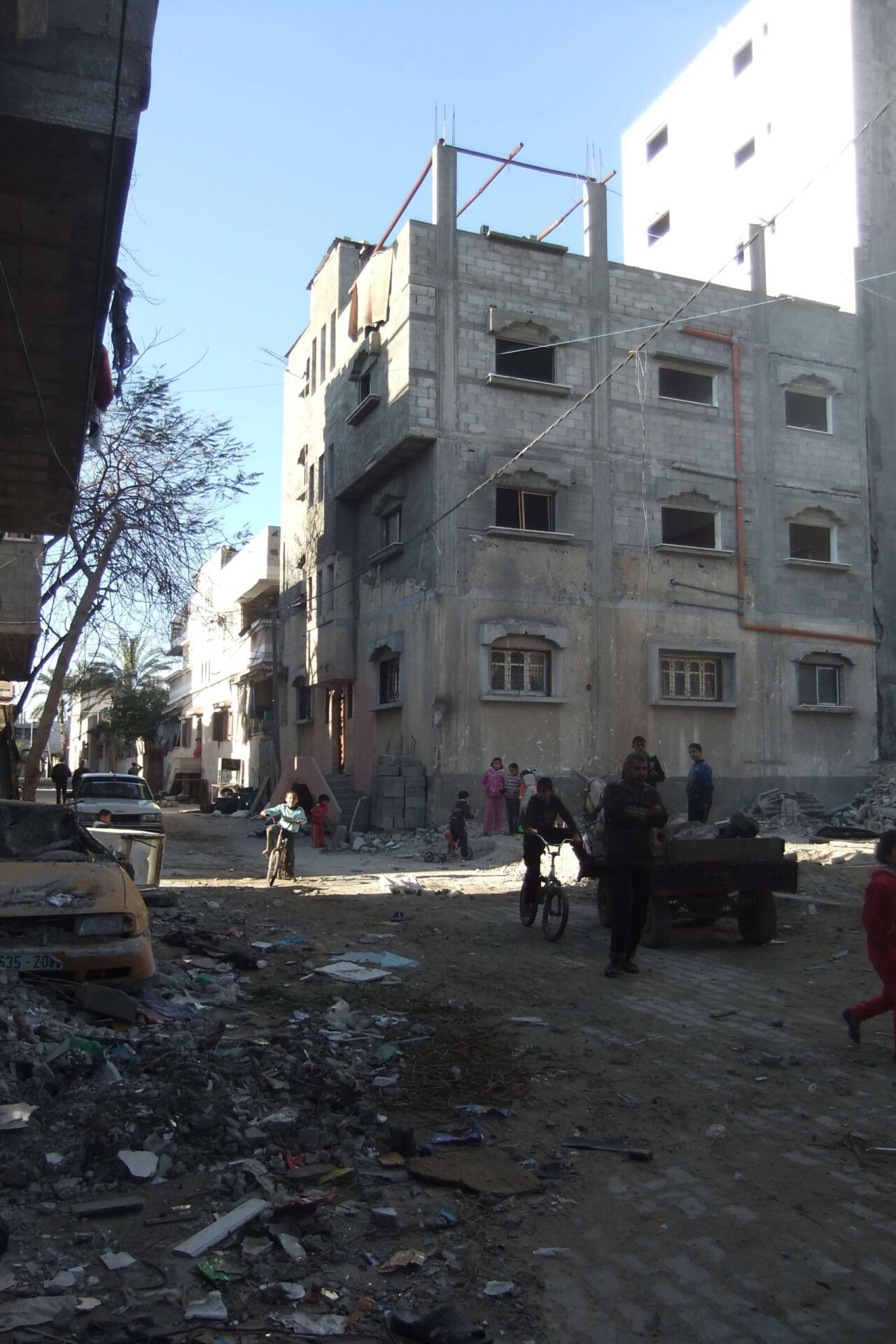
In a global context where protracted displacement continues to prevail, the 2021 report by the UN High-Level Panel on Internal Displacement – “Shining a Light on Internal Displacement: A Vision for the Future” – calls for a “development-oriented approach” to durable solutions. Signalled as a “fundamental change”, this is an important recognition of the need to move beyond addressing displacement as a primarily humanitarian issue and a focus on short-term needs.
What is also promising is how such a “development-oriented approach” is envisaged: nationally-owned, yet supported by international solidarity; strengthening public capacities in a structural manner; and recognizing the rights and agency of IDPs, with due attention to specific vulnerabilities and marginalization, as well as host communities’ situations. Overall, this supports a focus on “creating the conditions for voluntary, safe and dignified solutions in line with established norms”, with political will in this regard to be mobilized by both incentives and accountability measures.
This vision appears to align with a human rights-based approach (HRBA), which has previously been indicated as offering the “best, fairest and most sustainable results” in resolving displacement (Leckie: 2003, 397).
As understood within the UN system in the context of development, a HRBA sees human rights as central to both the objectives and processes of programmes and policies, which should aim to strengthen the capacities of duty-bearers and rights-holders. Beyond references to strengthening public capacities and recognizing IDPs’ rights, many aspects of the “development-oriented approach” to durable solutions can be linked back to the PANEL principles (participation, accountability, non-discrimination and equality, empowerment, and legality), which are a key reference point for HRBA more generally and have also been deemed important in displacement situations (see, e.g., Orchard: 2020, on accountability; Aubin et al: 2018, on participation; Purkey, 2014 on empowerment).
The High-Level Panel’s endorsement of a “development-oriented approach” to durable solutions for internal displacement provides an important boost for advocacy of these principles in related processes. Linking a development-oriented approach to the HRBA framework may be instrumental for IDP advocates in building support for these principles, given the HRBA’s broad acceptance within the UN, as well as by other major development actors such as the EU and its member states. It may also assist in giving greater weight to displaced people’s rights and voluntary choices where other normative frameworks related to economic development, such as international investment agreements, run contrary to them (see, e.g. Prieto-Rios et al, 2022).
The grounding of the HRBA in international human rights obligations (i.e. the ‘L’ for legality in the PANEL principles, aligning with the High-Level Panel’s reference to solutions “in line with established norms”) is particularly important in advocating for the accountability of the territorial state, which is the primary duty-bearer for ensuring durable solutions to internal displacement. International human rights obligations (and HRBA principles more broadly) are indeed reflected in the soft law instruments that most closely address durable solutions, i.e. the IASC Framework on Durable Solutions, the Guiding Principles on Internal Displacement (GPID) and the Pinheiro Principles. The content of these instruments has also been incorporated into national law in a number of countries faced with internal displacement situations (see Adeola & Orchard, 2020; Ferris, 2020).
However, it is proposed that underlying binding human rights obligations may nevertheless offer leverage where incorporation of soft law norms into national law has not (or only partially) taken place, or where regional treaties that address durable solutions in more detail (e.g. the Kampala Convention or the Great Lakes Pact) have not (yet) been ratified. This will also be the case where it becomes necessary to proceed beyond the national level to seek accountability, e.g. before regional or international human rights fora.
Depending on the context, relevant rights may include the rights to freedom of movement and residence, an adequate standard of living (including housing), non-interference with the home, and/or development. In this sense, numerous examples exist of international or regional human rights bodies interpreting and applying these rights in displacement situations (more than 70 of which are systematically analyzed in my doctoral research). These authoritative interpretations – many of which directly or indirectly support IDPs’ right to make a voluntary choice of solution – may strengthen advocacy in national contexts beyond those to which these decisions were originally addressed.
Through the right to a remedy, international human rights law also offers a broadly applicable normative basis for displaced people to claim reparation for their loss of housing, land and property, as well as other displacement-related violations. The IASC Framework and GPID both consider access to such remedies as integral to durable solutions. Indeed, such questions of justice are deemed key to “mov[ing] the conversation about rights-based approaches to displacement beyond examination of the delivery of aid to a consideration of displaced persons as rights-holding agents who must be treated with dignity—a proposition that requires taking seriously the violations that forced them from their homes and that hinder their efforts to reclaim or create new ones.” (Bradley & Duthie, 2014: 168 – 169).
Where effective remedies for these violations are unavailable at national level, human rights treaties may offer direct access to international or regional fora where displaced people may seek justice – such as regional human rights courts/commissions or the UN treaty bodies – which may further aid in catalysing political will for durable solutions more broadly.
Beyond the state’s primary responsibility, international human rights law may also be relevant for determining potential secondary responsibilities of third states, international organizations or non-state actors in ensuring or facilitating durable solutions, particularly in view of the High-Level Panel’s calls for international solidarity, UN accountability, and greater private sector involvement in this regard.
While discussions on the human rights responsibilities of actors other than the territorial state have largely focused on accountability for violations, the potential positive obligations of these actors – e.g. in working towards durable solutions – have been far less articulated. In this sense, the duty to cooperate to realize human rights – rooted in the UN Charter, and increasingly interpreted with reference to intersecting principles of environmental law – may offer inspiration for further normative interpretation and development (see e.g. Skogly, 2022; Wewerinke-Singh, 2021).
At the same time, adopting a HRBA to durable solutions does not mean that applicable human rights law needs to be considered in isolation from other contextually relevant norms which may strengthen its application and interpretation. For example, in conflict contexts, overlapping rules of customary international humanitarian law (e.g. on displaced persons’ right to voluntary return and respect for their property) may provide a strong basis for engaging the accountability of the territorial state and/or non-state armed groups, as well as the cooperation of third states (e.g. in exerting their influence against prevention of voluntary return).
In contexts of displacement or relocation related to disasters, development projects and/or climate change, thematic soft law instruments which also integrate key HRBA elements – such as the Basic Principles and Guidelines On Development-Based Evictions and Displacement, the Sendai Framework and the Peninsula Principles – may help to further concretize the rights of IDPs and the obligations of states and other actors in facilitating durable solutions. Thus, “knowing all of the law, all of the time” (Gilbert, 2021) may not only strengthen efforts towards the protection of displaced people, but also the processes and conditions which support them in seeking durable solutions.
Deborah Casalin is a doctoral researcher in the Law and Development Research Group at the University of Antwerp Faculty of Law, Belgium. Her doctoral research – soon to be publicly defended – focuses on the role of international judicial and quasi-judicial human rights mechanisms in ensuring reparation for arbitrary displacement. Previously, she worked for eight years in the humanitarian and development sectors, primarily on advocacy based on international humanitarian and human rights law. She holds an LLM from the Geneva Academy of International Humanitarian Law and Human Rights, a Master of Laws from the Vrije Universiteit Brussel and an LLB from the Nelson Mandela University, South Africa, where she is a research associate. Deborah is a research affiliate of the RLI’s Internal Displacement Research Programme.