
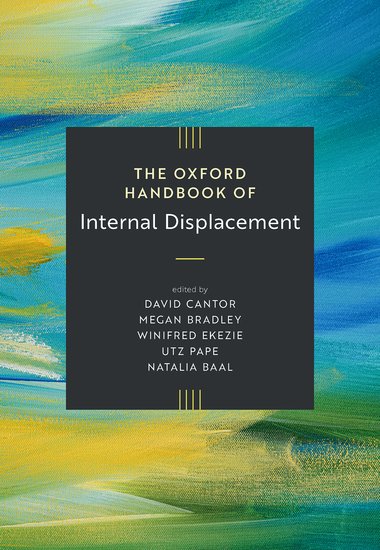
This comprehensive handbook provides an interdisciplinary examination of internal displacement, bringing together scholarship from history, economics, sociology, law, public health, geography, humanitarian studies, development and peacebuilding, among others. It offers clearer conceptualisations of internal displacement and relates internal displacement to other types of displacement. The handbook develops scholarship from the Global South as well as North, providing new theoretical approaches and insights.
The handbook was edited by Prof David Cantor, Prof Megan Bradley, Dr Winifred Ekezie, Dr Utz Pape, and Ms Natalia Baal and includes contributions from scholars, practitioners, policy makers and other experts from across the globe.
Abstract
“The displacement of people within their own countries because of crises such as conflicts, disasters, and the effects of climate change is a major contemporary challenge, eliciting global concern about how to protect the displaced. The vast scale of this ‘internal displacement’ poses far-reaching questions for key debates around humanitarian aid, development, migration, sovereignty, rights, citizenship, identity, and social change. Yet knowledge of the issue is fragmented and highly dispersed across a range of academic and policy domains. Bringing together 45 contributions by leading researchers and practitioners, the Oxford Handbook of Internal Displacement provides an essential point of reference for advancing these debates and raising the profile of internal displacement as a vital concern for research and policy agendas.”
Prof Cantor, David, and others (eds), The Oxford Handbook of Internal Displacement, Oxford Handbooks (Oxford, 2026; online edn, Oxford Academic, 3 Apr. 2026).
Publisher
Contact the publisher, Oxford University Press, for more information on the Oxford Handbook of Internal Displacement, including how to purchase the handbook or access it through your institution.
Contents and Contributors
Browse the complete table of contents here, where you'll also find the names of all contributors to the handbook.
The Handbook addresses eight major areas of debate in this field of research and practice. Part I presents different conceptual understandings of internal displacement from a range of the most relevant disciplinary perspectives, including philosophy and political theory, history, law, geography, and forced migration studies. Part II of the Handbook explores the different drivers of internal displacement, embedding them in their broader social, political, and historical context. Part III addresses major internal displacement dynamics and population trends in different regions of the world. Part IV highlights the material, social and economic consequences of displacement, in terms of poverty, health, education, and housing land for the displaced. Part V addresses lived experiences of internal displacement, underscoring the agency of displaced persons in making sense of and dealing with internal displacement. Part VI of the Handbook addresses key aspects of IDP assistance and protection, including legal and policy frameworks, institutional responses, and policy and operational issues arising in this response. Part VII addresses the 'end' of internal displacement and so-called 'durable solutions' for internally displaced persons, offering compelling insights into how long-term solutions have been handled and hindered in practice. Finally, Part VIII outlines the crucial role of data in understanding and responding to internal displacement.
Reviews
"This Handbook makes an invaluable contribution by examining the normative, policy, and operational dimensions of internal displacement across diverse contexts. Its chapters offer rigorous analyses, comparative insights, and lessons from the field, highlighting what works-and what still needs to change. Above all, it exemplifies the collaboration between scholars and practitioners, that is essential to addressing the complexities of internal displacement today. Readers - whether policy makers, researchers or field practitioners- will find in these pages not only evidence and analyses, but also inspiration to continue to improve the lives of those internally displaced and the communities that host them." - Ruvendrini Menikdiwela, Assistant High Commissioner for Protection, United Nations High Commissioner for Refugees
"Tens of millions of people remain internally displaced globally, often living in situations of extreme vulnerability and without adequate responses to identify their needs and uphold their rights. This handbook is a welcome contribution to better understanding the complexity of the phenomenon of internal displacement, with a view to protecting those that are internally displaced and finding eventual solutions to their plight." - Dr Volker Türk, High Commissioner for Human Rights, United Nations
"This is a timely and authoritative treatment of a form of displacement often underappreciated in research, policy and practice. Through a rich and nuanced examination of the many dimensions of internal displacement, and by assembling such a powerful group of contributors, the Handbook of Internal Displacement helps guide the reader through both the significance and the scope of this critical topic. This collection will be important reading for those who are both new to the topic of internal displacement and who have working on forced migration issues for years." - James Milner, Professor of Political Science, Carleton University
"The Oxford Handbook of Internal Displacement is an invaluable tool, required reading and reference guide for people like myself working on displacement at the intersection of research, evidence and analysis on one side, and policy development on the other. The Handbook makes a very convincing case for internal displacement as a field of research and practice and provides us with cutting-edge insights, knowledge, data and concepts that can guide and drive policy development and understanding in the years to come. It reads very well like an inter-disciplinary state-of-the-art 'Compendium' with contributions from leading researchers and practitioners, highlighting gaps and suggesting what is needed in the future, both in terms of knowledge, policy and practice." - Atle Solberg, Head of the Secretariat, Platform on Disaster Displacement
"The Oxford Handbook of Internal Displacement is a welcome addition to a growing body of research on internal displacement. It focuses on an important issue: How internal movements of people should be treated as a field of research and practice. The lead co-editors are amongst the most expert scholars on internal displacement. The handbook covers just about everything one might want to know about its subject, from the causes to the solutions to displacement. It will be useful not only for scholars but also practitioners working with displaced persons." - Susan Martin, Donald G. Herzberg Professor Emerita, Georgetown University
"This Handbook is genuinely transformative for the study of internal displacement as field of inquiry and site of practice. Despite the empirical prominence and normative significance of this phenomenon, work on internal displacement has been neglected and fragmented across several disciplines, too often the poor relation of other fields of inquiry. No more! This comprehensive volume offers a multi-disciplinary integration of existing research across theoretical and practical registers that provides both a cohesive foundation for internal displacement studies and a cogent demonstration of the urgent need for it. It is a remarkable and timely achievement." - David Owen, Professor in Politics, University of Southhampton
"The Oxford Handbook of Internal Displacement is a timely and important contribution to the global discourse on forced migration and displacement. By bringing together leading scholars and practitioners across disciplines, the volume provides a comprehensive and much-needed reference that situates internal displacement within its wider social, political, and health contexts. At a moment when internal displacement is both expanding in scale and complexity, this Handbook will serve as a vital resource for researchers, policymakers, and practitioners committed to advancing protection, health, and durable solutions for internally displaced populations." - Dr Santino SEVERONI, Director of Health and Migration, World Health Organization
"In an inward-turning world where human mobility and forced movements are ever-increasing this book provides welcome guidance and motivation for all seeking to understand the need for increased global attention to internal displacement and its consequences. The handbook provides a comprehensive and historically grounded overview of research, policy development and practice on internal displacement whether from a conflict, climate, disaster or development-induced angle." - Peter de Clercq, Senior Advisor on Internal Displacement, United Nations Development Programme
"The Handbook of Internal Displacement provides a robust foundation for understanding what happens to the hundred million people displaced within their own countries by conflict, environmental change, development or disaster. The Handbook contains a wealth of perspectives and insights from scholars and practitioners, many of whom write meaningfully about their own countries." - Karen Jacobsen, Henry J. Leir Professor in Global Migration, Fletcher School of Law and Diplomacy at Tufts University
"This Handbook foregrounds the issues, experience, and responses to internal displacement across the world. As a scholar who spent more than two decades conducting research in and on conflict zones with people affected by violence and displacement, I wish I had had access to such a rich and comprehensive reference as this. The Handbook is at once a vital reference for concepts related to internal displacement but also offers critical approaches to the categories employed and the lexicon in use....The editors and authors have gone to great lengths to both define the drivers of internal displacement and thoughtfully reflect on the concepts they include. This work is a must-have for all scholars of human displacement." - Jennifer Hyndman, Professor, Centre for Refugee Studies, York University
"The Oxford Handbook of Internal Displacement arrives at a decisive moment. Worldwide, more than 80 million people remain displaced, yet responses too often remain fragmented across regions. The lessons from the Colombian Constitutional Court's Special Chamber... show that effective responses demand the convergence of law, policy, and data with the participation of affected communities. It is precisely this type of multidimensional approach that this much needed Handbook advances, bringing together a broad range of perspectives, while also illuminating pathways toward durable solutions." - Justice Natalia Angel-Cabo, President, Special Chamber for Monitoring Compliance with Judgment T-025 of 2004, Constitutional Court of Colombia
"The scholarship and knowledge production on internal displacement which have burgeoned in the thirty years since the works by its pioneering doyens Francis Deng, Roberta Cohen and Walter Kälin have seen a vital adumbration of its keystone taxonomies from definition and conceptualization to exponentiality, causes, typologies, consequences, law and response. Against this background, Oxford's new Handbook will be a very welcome addition to the rich provenance upon which it builds as its 45 articles consolidate." - George Okoth-Obbo, Head of the Secretariat, UN Secretary-General's High Level on Internal Displacement, 2020-2021