
Coordination Team
Researching Internal Displacement
DRC. Kigonze displacement camp 2023 © UNHCR/Joel. Z. Smith
The Researching Internal Displacement Platform is managed by the leads of the networks that it hosts, working jointly with the platform’s editors.
Current website editors:
〉 Steven Miron - Joint Editor-in-Chief
〉 Prof. David Cantor - Joint Editor-in-Chief
〉 Annette Andrews - Editor
〉 Ekaterina (Kate) Pesegova - Editor
〉 Dr María Lorena Suárez Ostos - Editor
Current network leads:
〉 Obonyo Francis Alponse - GENIDA
〉 Dr Beatriz Eugenia Sánchez Mojica - LANID
〉 Dr Hana Asfour - MERNID
〉 Dr Winifred Ekezie- HIDN
〉 Professor David Cantor - IDRP
FUNDING
The website was initially supported by the UKRI GCRF INDCaP project grant.


LATEST NEWS

For our readership, we invite original contributions on internal displacement.
EVENTS

New RID Series: “Towards Dignified Climate Relocation: Community Perspectives from around the Globe”
Researching Internal Displacement (RID) and the Coalition on Dignified Climate Relocation (CDCR) are pleased to announce a forthcoming miniseries, Towards Dignified Climate Relocation: Community Perspectives from around the Globe. RID will publish the first article in the series on 1 October 2026, with the remaining articles to follow in the coming weeks, paving the way towards COP31 where, like every year, topics such as displacement and planned relocation in the context of climate change are on the agenda.
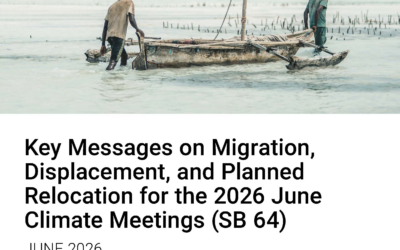
This document, prepared by the Advisory Group on Climate Change and Human Mobility and the Loss and Damage and the Challenges of Human Mobility and Displacement Working Group, provides key messages on migration, displacement, and planned relocation, for key agenda items, workstreams and events at the 2026 June Climate Meetings.
The messages have been endorsed by over 110 organisations and individuals, including civil society organisations, United Nations agencies, academics and experts. In addition to the messages, the groups have provided an advocacy reference document which unpacks in greater detail the entry points on human mobility for each relevant agenda item, providing context and longer messages.
Links may be found below.