
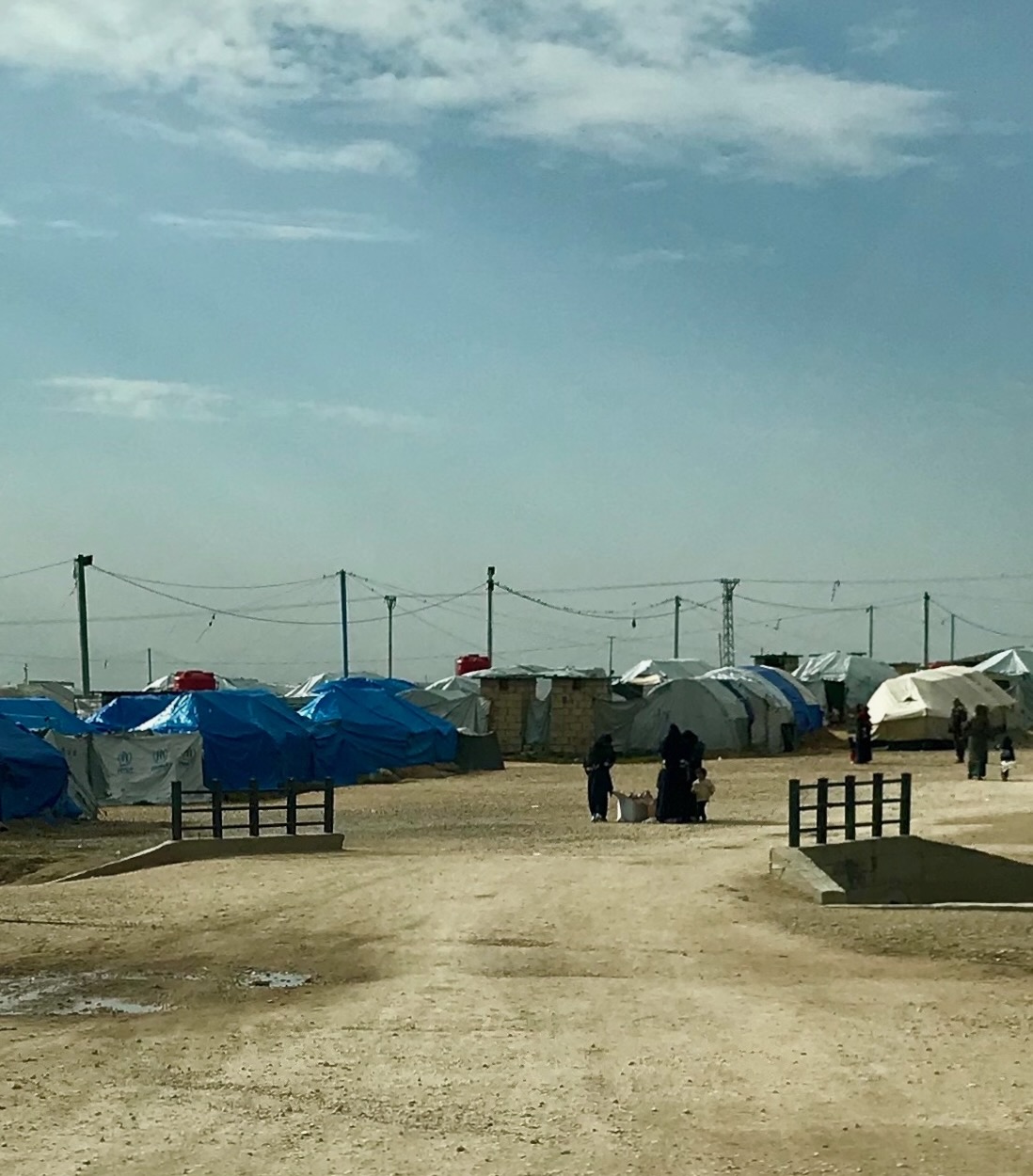
The liberal international order is shifting. What impact could this have on policy responses to internal displacement? In this piece, we shed light on this question by describing state policies on internal displacement since the end of the Cold War, revealing patterns in how and when governments have responded to displacement crises.
The end of the Cold War ushered in a liberal global order that strengthened international institutions, challenged traditional notions of state sovereignty, and expanded human rights and humanitarian norms. All of these changes made the treatment of displaced and other war-affected populations within a given country an issue of international concern.
The internally displaced comprised a massive proportion of those affected by wars. In the late 1980s, domestic and international organizations started to collect and report data on IDPs in a systematic way. These efforts revealed that the number of IDPs surpassed the number of cross-border refugees and asylum-seekers globally. This was even before the end of the Cold War sparked civil wars that contributed to a further rise in internal displacement.
Domestic responses to internal displacement were rare before the post-Cold War era. Croatia was one of the first countries to adopt a law on internal displacement in 1992, and Colombia followed in 1997 with a national policy that included humanitarian assistance. However, most policies have been adopted since 1998, when the UN Commission on Human Rights adopted the Guiding Principles on Internal Displacement.
The Guiding Principles served as a template for domestic policy responses. The U.N. Refugee Agency created its IDP Advisory Team in 2006, and adopted the Policy Framework and Implementation Strategy for IDPs in 2007. The UNHCR Office of IDP Law & Policy followed. Two of the key roles of this office has been to lobby governments to adopt policies related to internal displacement, and to document those laws and policies adopted by states.
State Policies on Internal Displacement
Last year, the IDP Law and Policy Dashboard was released on the UNHCR Rights Mapping and Analysis (RiMAP) platform. With a team of research assistants, we coded the policies and laws collected in the dashboard, creating a dataset we call State Policies on Internal Displacement. It includes 588 policies in 86 countries that have been adopted between 1989 and 2022. 268 (46 percent) are IDP-specific policies, and 320 (54 percent) are IDP-inclusive policies.
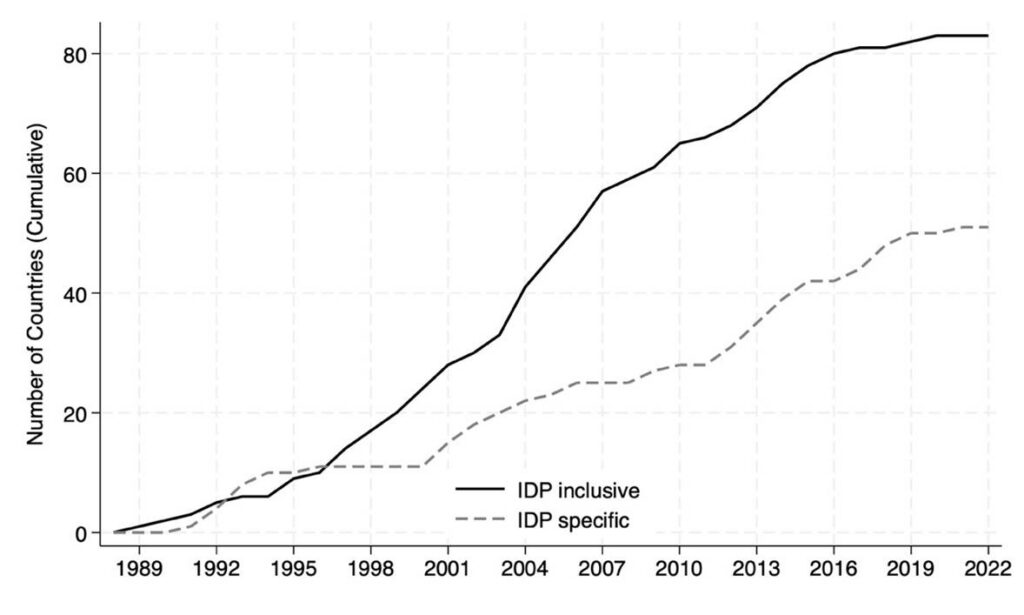
How widespread are IDP policies? While 83 countries have enacted IDP-inclusive policies, fewer than two-thirds (53) have developed IDP-specific policies (Figure 1). This suggests that many governments address internal displacement indirectly, through broader frameworks for vulnerable populations rather than targeted responses.
Figure 1: Number of IDP policies and countries adopting IDP policies
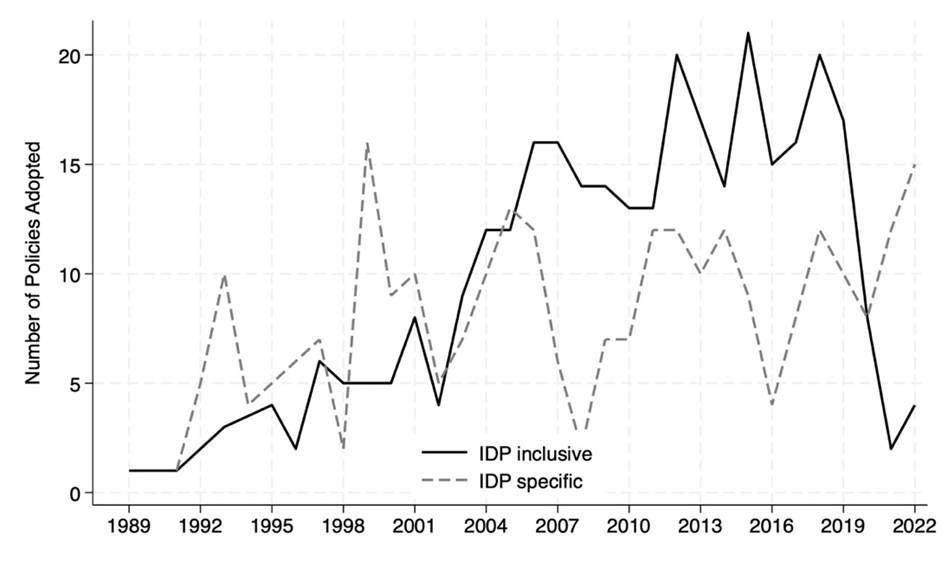

When have states adopted IDP policies? Policy adoption has followed two distinct waves (Figure 1). The first peaked in the early to mid-1990s, driven by massive displacement from the war in former Yugoslavia. The second, larger wave emerged in the 2000s in response to displacement crises in the Great Lakes region of Africa, Afghanistan, and Iraq. The second wave coincided with – and was likely reinforced by – the development of key international frameworks. In 2006, the Great Lakes region adopted the Kampala Convention, an IDP protocol requiring member states to ‘establish adequate national legal frameworks.’ Four years later, the U.N. Inter-Agency Standing Committee finalized its Framework on Durable Solutions for Internally Displaced Persons, providing concrete guidance on supporting IDPs’ return or voluntarily resettlement. Accordingly, between 2003 and 2015 alone, the number of countries with IDP-specific policies doubled from 20 to more than 40 (Figure 2). This rapid expansion suggests that international diffusion mechanisms – including the Kampala Convention, the IASC Framework, and sustained advocacy by international organizations – played a crucial role in encouraging policy adoption during this period.
Figure 2: Cumulative IDP policies, 1989-2022
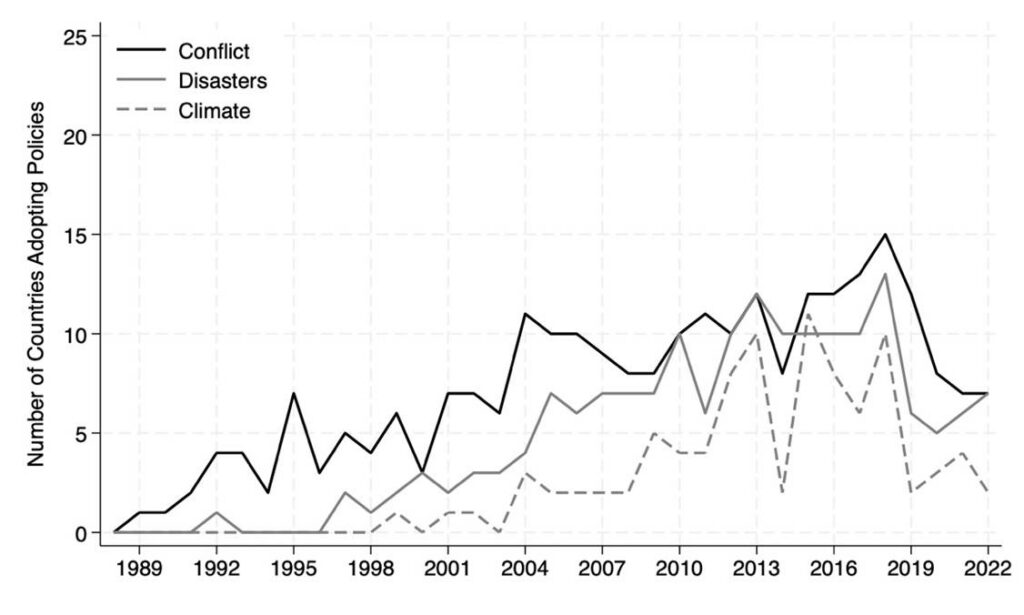
But policy adoption is only part of the story. The types of displacement these policies address reveal important drivers – and shifts – in how governments conceptualize the IDP challenge. Of the countries with policies that specifically target IDPs, a vast majority (42, or 82 percent) experienced at least one armed conflict since 1989. More than two-thirds (77 percent) of IDP-specific policies address conflict-induced displacement, while only 28 percent recognize displacement caused by natural disasters and 11 percent recognize displacement related to climate change. Policies covering disaster- and climate-related displacement have been a more recent phenomenon, with more countries adopting them after 2009 (Figure 3). The focus of these policies also varies by region: policies in Africa and Asia have been much more likely to recognize disaster- and climate-induced displacement than those in other regions. This likely reflects both the geographic distribution of climate-related disasters and differential engagement with climate migration issues across regions.
Figure 3: IDP policies by type of displacement
Shifting provisions: what policies actually say
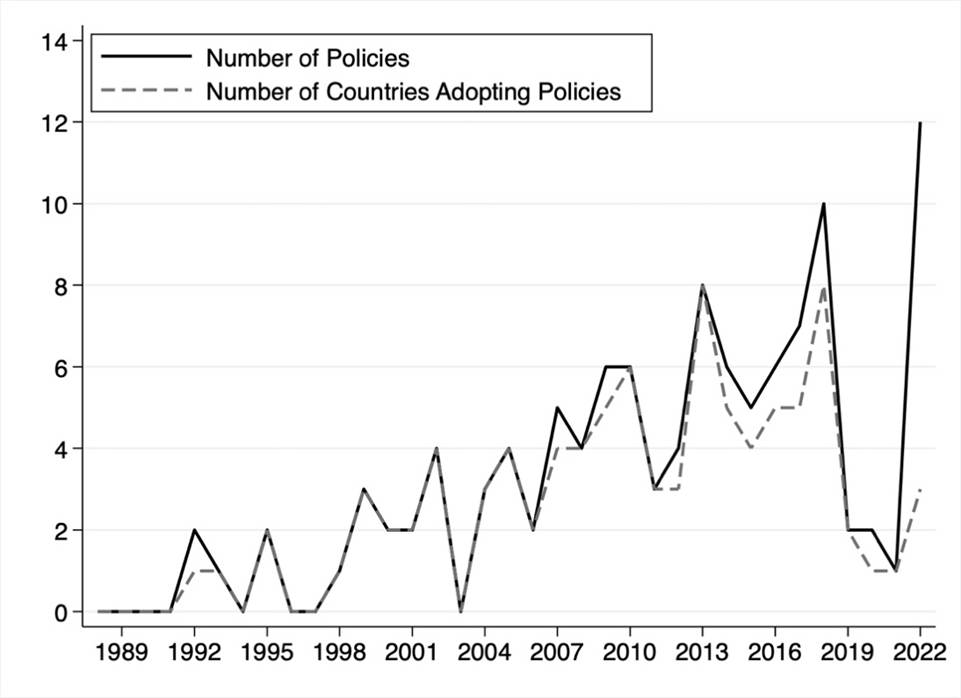
Looking at specific policy provisions illustrates how the content of IDP policies has shifted over time. One striking trend is encampment: the number of countries enacting policies that explicitly establish camps for IDPs steadily increased over time, and then dropped off around 2018. This may at least partly be the result of efforts by international organizations to discourage the creation of camps and ensure the free movement of the displaced.
Figure 4: Policies establishing IDP camps
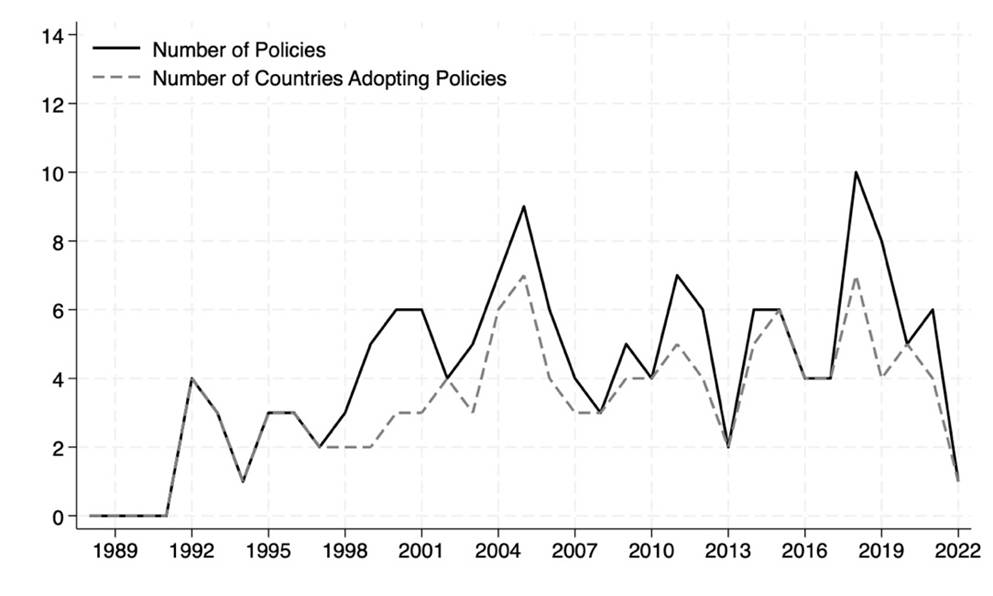
Status designation shows similar volatility. The number of countries and policies that grant IDP status have also declined since 2018. One concern with granting status is how IDPs would transition from it: when would an ‘official’ internally displaced person cease to be an IDP?
Figure 5: Policies granting IDP status
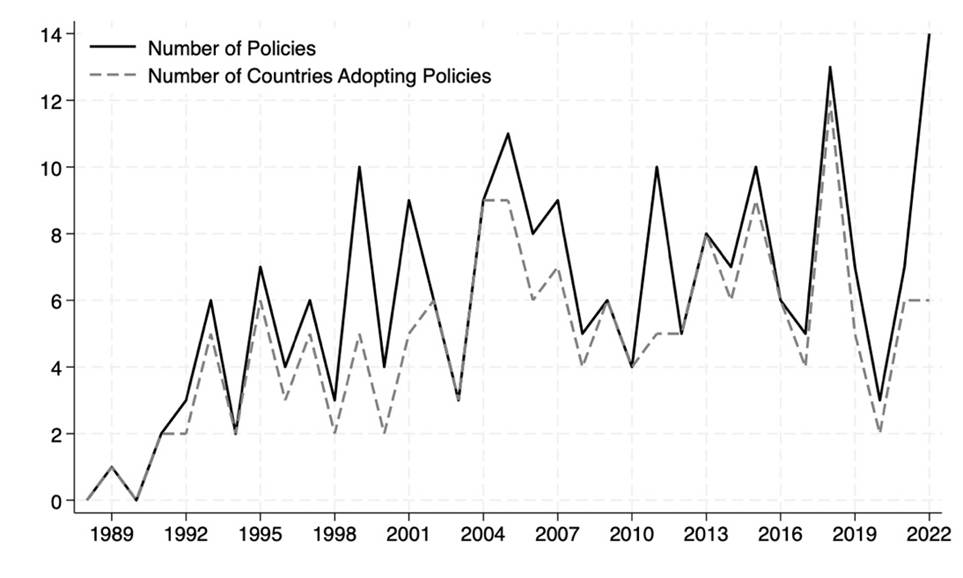
In contrast, provisions explicitly including a right for IDPs to return to their homes have remained more stable. The 2022 Global Report on IDP Law and Policy notes that in policy discussions, the emphasis on return ‘[...] seems to have given way to more nuanced ones recognizing the importance of all settlement options being open to IDPs in line with their freedom of movement and choice of residence (whether return, local integration or settlement elsewhere) [...]’ (27). Still, the number of policies and states adopting them has fluctuated around a steady average since the early 2000s (Figure 6).
Figure 6: Policies establishing IDPs’ right to return
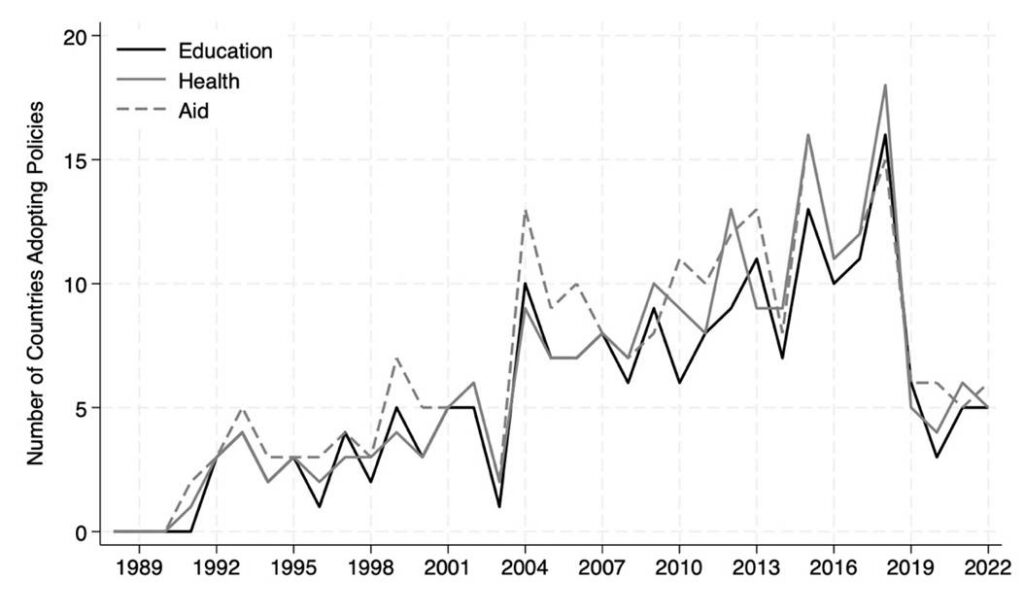
The clearest growth area has been in service provision to IDPs. Policies that grant or guarantee IDPs access to education, health, and humanitarian assistance increased dramatically between 2003 and 2018 (Figure 7). These provisions may be related to state-building efforts by conflict-affected countries as part of broader efforts to end these conflicts and ensure sustainable peace.
Figure 7: Policies on access to services, by service and Year
What’s next for IDP policies in a changing global order?
Our analysis reveals that IDP policy adoption surged during the 2000s and 2010s – a period when the liberal international order was at its peak. Three patterns from this era are particularly relevant as the global order shifts.
First, the close correspondence between policy adoption and major displacement crises suggests that international attention and pressure matter. As great powers become less interested in humanitarian interventions and foreign assistance, will policy adoption slow? Second, the recent decline in policies establishing camps and granting formal status shows that international norms can influence domestic policy content. Will normative consensus erode without strong international institutions? Third, the growth in service provision policies may reflect state-building efforts in conflict-affected countries. These provisions could prove more durable than others, as they align with broader development and social assistance goals.
Policy adoption is not a cure-all for the humanitarian and human rights challenges that are associated with internal displacement. Many states struggle to implement the policies they adopt or are inconsistent in when and how they apply their policies. Others have political incentives not to implement their policies, or even seek to undermine them through informal practices. For governments aiming to curry international favor, attract aid, or signal credibility, pursing these policies could be a form of ‘cheap talk.’
But one important legacy of this period of policy adoption is that domestic actors, like human rights advocates and IDPs themselves, can pressure governments to implement the policies they have adopted, and to enforce their own laws. These policies are therefore potentially valuable tools in an international context full of uncertainty, great power rivalry, and reduced budgets for international organizations.
Adam Lichtenheld is Assistant Professor of Peace Studies, Conflict Resolution, and International Relations at the Institute of Security and Global Affairs at Leiden University. His research explores the dynamics of forced displacement, conflict, political violence, and peacebuilding, and he has worked with governments, donors, and NGOs to design and evaluate humanitarian and development programs in a dozen countries. His book, Guilt by Location: Forced Displacement and Population Sorting in Civil Wars, received the 2025 Conflict Research Society Book of the Year Prize and the 2026 Distinguished Book Award from the Ethnicity, Nationalism, and Migration section of the International Studies Association.
Abbey Steele is Associate Professor of Political Science at the University of Amsterdam. She researches the politics of violence, displacement, and responses to it by civilians and states, with a regional focus in Latin America. Her book Democracy and Displacement in Colombia’s Civil War argues that democratic reforms led armed groups to engage in political cleansing, leading to the first waves of internally displaced people in Colombia.
The authors would like to thank Marianne Billon, Evelina Camenscic, Gustav Eggers, Alejandra López, Danylo Malchevskyi, Janna Mohamed, Martina Rebora, Hailey Rochin, Bérénice Sanchez-Duval, Emilie Truelsen, Châu Yên Nhi Võ, and Sigrid Weber for their excellent research assistance.
This topical paper is part of the special series on ‘Internal Displacement in a Changing World Order’, led by the Internal Displacement Research Programmeat the RLI. The experts contributing to this series assess how rapid shifts in contemporary politics, plummeting levels of humanitarian aid and escalating global crises are impacting displacement-affected communities. The series ties into the launch in April 2026 of a 45-chapter “Handbook of Internal Displacement” that comprehensively addresses this issue.
KEYWORDS: Internal Displacement, IDPs, conflict, trends
'Selected Bibliography
Blair, Christopher W, Guy Grossman and Jeremy M Weinstein. 2022. “Forced displacement and asylum policy in the developing world.” International Organization 76(2):337–378.
Cardona-Fox, Gabriel. 2019. Exile within Borders: A Global Look at the Commitment to the International Regime to Protect Internally Displaced Persons. Brill Nijhoff.
Ibáñez, Ana María, Andrés Moya and Andrea Velásquez. 2022. “Promoting recovery and resilience for internally displaced persons: lessons from Colombia.” Oxford Review of Economic Policy 38(3):595–624.
Lichtenheld, Adam. 2024. Guilt by Location: Forced Displacement and Population Sorting in Civil Wars. Cambridge University Press.
Nicolau, Ileana and Anaïs Pagot. 2018. “Laws and policies on internal displacement: global adoption and gaps.” Forced Migration Review (59):9.
Orchard, Phil. 2018. “Implementing the Guiding Principles at the domestic level.” Forced Migration Review (59):10–12.
Steele, Abbey. 2019. “Civilian resettlement patterns in civil war.” Journal of Peace Research 56(1):28–41. Publisher: SAGE Publications Ltd. URL: https://doi.org/10.1177/0022343318820576