
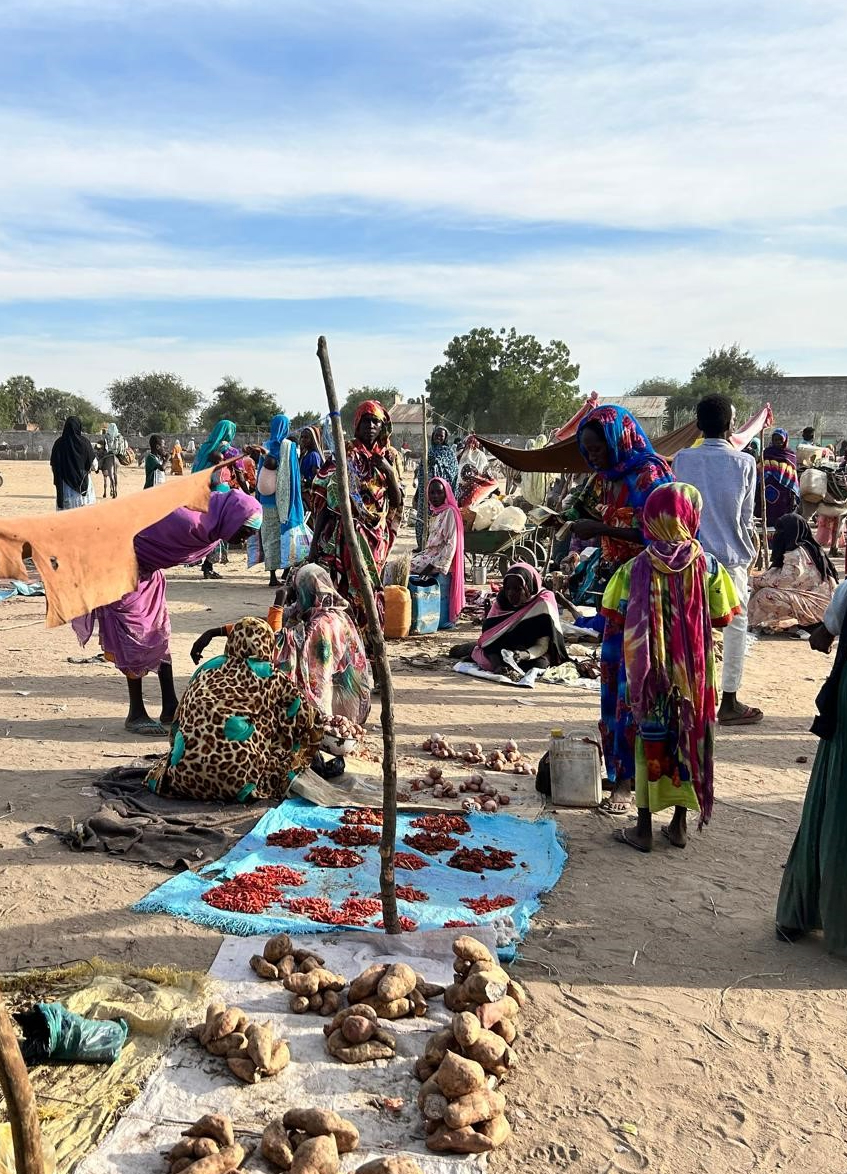
Why do markets matter to internally displaced persons (IDPs)?
When populations are forcibly displaced—whether by conflict or natural disasters—local markets and the goods and services they provide often become a vital lifeline. Frequently, markets recover and resume operations before humanitarian agencies can reach affected communities. For example, after the Myanmar earthquake in 2025, local traders quickly reopened stalls and began selling essential items, enabling displaced people to purchase food, water, and household goods whilst aid agencies planned responses. Humanitarian organizations increasingly choose to use markets and support this resilience by injecting cash-based assistance into the area, allowing internally displaced persons (IDPs) to meet their needs through local markets rather than waiting for in-kind aid. A similar dynamic has been observed during the recent displacement crises in the Eastern Democratic Republic of the Congo (DRC), where markets continued to function even amid ongoing instability. In these contexts, many IDPs themselves express a preference for cash assistance, which allows them to make choices that best suit their circumstances and supports local economic recovery, and can even increase social integration.
The reliance on markets and the preference for cash assistance by displaced populations is often driven by the loss of access to farmland and traditional income sources. Without the ability to grow their own food, IDPs depend on local markets to purchase necessities. Additionally, they must seek new ways to earn income, often turning to labor markets and informal work opportunities in their host communities. The sustainable livelihoods approach, first developed in the 1990s and promoted by agencies like DFID, highlights that livelihoods are multidimensional and built on a combination of assets—both tangible, such as land or cash, and intangible, such as social capital. IDPs will move location with a combination of assets, and many of these assets require markets. Markets can provide physical tools, seeds and other inputs needed for food and income. Further, markets play a critical role in helping IDPs to integrate during displacement through access to labor markets and employment, and the establishment of small businesses. These help build social networks, trust, and relationships within the community. Displaced individuals often leverage skills acquired before displacement—such as tailoring, carpentry, or trading—to adapt to their new environments. IDPs can therefore meet their essential needs and rebuild livelihoods, contribute to local economies, and move toward sustainable integration in their host communities through engaging with markets.
What is market-based programming (MBP)?
Just like populations, markets are impacted by conflict and natural disasters; they may break down entirely or be temporarily disrupted. Market-based programming (MBP) is an approach that recognizes that markets continue to function before, during, and after crises, and that engaging with them can speed up assistance, reduce costs and support economic recovery for populations – whilst protecting dignity by giving people choice in how they meet their needs. MBP ensures humanitarian and development actors understand how markets themselves are affected by crises and that activities undertaken in crisis contexts accord with how markets function, avoid harming local economies and support recovery and resilience.
MBP refers to a range of activities and strategies that use, support, or develop existing local markets to deliver humanitarian and development assistance. Examples include providing cash or vouchers instead of direct goods or giving grants to traders to help them recover their businesses. This approach is now widely endorsed by donors and practitioners working in crisis contexts.
The most common form of MBP is Cash and Voucher Assistance (CVA). When feasible and appropriate, CVA can be an effective way to meet the needs of IDPs. IDPs often share their funds within their host families or communities, which empowers choice, boosts local economies, and improves livelihoods. If CVA is designed with a clear understanding of market dynamics, it does not usually cause inflation or shortages. Providing cash to IDPs also boosts local markets. Because of these benefits, many donors now ask practitioners, “Why not cash?”, when approving funding proposals to support those affected by crises. Agencies like CRS have pioneered using CVA in emergencies as an effective form of MBP. In Haiti, post-Hurricane Matthew, evaluations showed that displaced populations spent CVA locally in their communities when their houses were destroyed, giving people a choice on how to rebuild and meet basic needs, whilst also boosting markets and vendor networks.
Practitioner communities such as the Markets in Crisis Community of Practice, established in 2013, were formed to share ideas, experiences, resources, and learning around MBP. These efforts are rooted in the belief that all IDPs have the right to decent work, shelter, food, health, education, protection, water, and sanitation. Markets are seen as a vital means to ensure access to these essentials during emergencies and throughout post-crisis recovery.
MBP in protracted crises: What the Markets in Crisis (MiC) community knows
Displacement, however, is often not temporary. Currently, the average duration of displacement exceeds a decade, and some contexts are now multigenerational, which can hinder opportunities for integration and meaningful economic contribution. As rapid-onset crises become more protracted, approaches that focus on improving livelihood opportunities for internally displaced persons become more appropriate. Drawing from market systems development approaches can further enhance these efforts. During long-term IDP crises, therefore, we know that Market-Based Programming (MBP) is particularly impactful.
Many donors have been experimenting with cash assistance in a variety of protracted displacement contexts for more than 30 years, with some now explicitly citing the potential of market-based programming not only to meet needs, but as a driver to enhance social cohesion between IDPs and host communities in contexts of forced displacement. In the Markets in Crisis practitioners’ community, as implementers, we know through years of documented experience, sharing and learning, that market assessments, analysis and programming can ultimately benefit long-term displaced populations and the markets they rely on.
In Iraq in 2015, when Mosul fell and ISIS attacks pushed more than 730,000 Iraqis to flee to Kurdistan, it was clear that the IDP population was likely to remain displaced for some time. In a stagnant economy, many humanitarian actors sought longer-term, market-based solutions for IDP livelihoods programming. The Danish Refugee Council commissioned a market study to assess opportunities in livelihoods generation and access to income for Syrian refugees and IDPs living in and outside of camps. The construction and service sectors were selected as critical market systems, and the study focused on the sub-sectors with the greatest potential to employ the target groups, hospitality and retail. This allowed the whole sector to design programs which facilitated longer-term access to labor markets for IDPs and refugees.
Systems-based recovery and development programs can also promote long-term, scalable market solutions which are inclusive of forcibly displaced people, as demonstrated by recent research on IDPs and host communities. This research argued for segmenting displaced and host populations to identify their distinct needs, opportunities, and levels of market readiness. Longer-term MBP for IDPs may require addressing unique challenges such as legal restrictions, access to finance and psychosocial support, avoiding one-size-fits-all approaches, and sometimes partnering with non-traditional actors who are trusted by displaced communities. In Somalia, for instance, IDP renters in urban Mogadishu were supported with rental subsidies by the Integration Rental Services Program, alongside tailored livelihoods programming and assistance to obtain legal IDs and written lease contracts. IDPs could also connect to an online portal to access pro-bono legal services from lawyers who understand the specific issues IDPs face to access housing.
Similarly, in the DRC, studies have argued that displaced people can enrich host economies through entrepreneurship and products from their communities of origin, improving local attitudes and integration rather than burdening resources. An ‘upward spiral of integration’ for entrepreneurial IDPs can be supported by access to markets, in contexts where social networks are weak and humanitarian assistance is absent.
Focus on MBP in the Sudan context
In the present day, over two years of war means that Sudan now represents the largest recorded and fastest unfolding displacement crisis in the world. Over 12 million people are internally displaced, and 30.4 million people—more than half of Sudan’s population—are in need of humanitarian support. Market-based programming has been important in this crisis, drawing on years of experience from other IDP contexts to address needs effectively and quickly. Sudanese markets are vital to providing food and income as this conflict continues, yet they, themselves, have been targeted by drone attacks and badly impacted by the ongoing hostilities.
Markets in Sudan are incredibly resilient. They adapt by reversing trade flows to meet increased supply from neighboring countries for key goods and, despite significant challenges in terms of liquidity, insecurity and bureaucracy, they continue to function, in some cases even under active conflict. A recent study by the SPARC project on the impact of conflict on rural markets in Sudan showed that out of 484 identified rural markets nationwide, only 9 had ceased functioning due to the onset of conflict. This means displaced populations can continue to use markets to access food and income, and humanitarian and development practitioners have come up with some innovative ways to program in this regard, ensuring households can access assistance with dignity and local economies are supported. Agencies like the Norwegian Refugee Council (NRC) are offering market-based support to local bakeries in areas impacted by influxes of IDPs. NRC has distributed cash grants to subsidize production costs, leading to the price of bread halving for displaced populations, significantly easing the financial burden on families facing skyrocketing food prices.
Humanitarian and development practitioners are increasingly partnering with institutions or individuals who offer financial services (e.g. banks, microfinance institutions, mobile money), commonly referred to as Financial Service Providers (FSPs) for market-based programming. In Sudan, many agencies are confident in using FSPs to deliver cash assistance directly to IDPs, even in high-risk locations such as North Darfur, where conflict around El Fasher recently displaced upwards of 89,000 people.
Community based MBP has also flourished, via the emergence of mutual aid groups who have been the recipients of group cash transfers in many instances, where cash is distributed to already formed, self-mobilizing groups to help IDPs and host communities. Finally, with such a high percentage of the Sudanese population dependent on agriculture, agencies are also working to ensure agricultural input markets can be effectively supported to boost local production to contain the spiraling food crisis.
Such innovative, market-based approaches in the world’s most acute displacement crisis demonstrate how MBP can not only help meet immediate needs in Sudan but also lay the groundwork for greater resilience and hope for displaced communities facing ongoing uncertainty.
The Sudan crisis further illustrates key considerations regarding the effectiveness of market-based programming for internally displaced persons affected by crises globally. Market-driven strategies can provide both quick assistance and lasting opportunities, enabling people and communities to restore their livelihoods. MBP can not only help sustain food security and income generation but also contribute to social integration and economic recovery, underscoring the vital role of markets in supporting displaced people during periods of significant uncertainty.
Corrie Sissons is the Food Security and Markets Lead at Catholic Relief Services. She holds an MSc in Arabic and Development Studies from SOAS, University of London, and has worked across Africa, the Middle East, Latin America and Asia on humanitarian food security, cash, and livelihoods programs for more than 15 years. She is based in the UK.
KEYWORDS: Internal Displacement, IDPs, Market-based programming, Livelihoods, Sudan
Selected biography
Catholic Relief Services (2019). HAITI Cash-Based Interventions in Shelter: The Vendor Effect Case Study. https://www.crs.org/our-work/research-publications/vendor-effect-hurricane-matthew-response
Davies, A. (2012). IDPs in host families and host communities: Assistance for hosting arrangements. UN High Commissioner for Refugees (UNHCR). https://www.refworld.org/reference/research/unhcr/2012/en/86634
Directorate-General for European Civil Protection and Humanitarian Aid Operations. (2022). Thematic policy document No. 3: Cash transfers. https://ec.europa.eu/echo/files/policies/sectoral/thematic_policy_document_no_3_cash_transfers_en.pdf
Jacobs, C., Lubala Kubiha, S., & Sifa Katembera, R. (2020). The upward spiral towards local integration of IDPs: Agency and economics in the Democratic Republic of the Congo. Refugee Survey Quarterly, 39(4), 537–543. https://doi.org/10.1093/rsq/hdaa022
Majale, M. (2002). Towards pro-poor regulatory guidelines for urban upgrading: A review of papers presented at the International Workshop on Regulatory Guidelines for Urban Upgrading, Bourton-On-Dunsmore, May 17-18, 2001. Intermediate Technology Development Group (ITDG). http://www.itdg.org
Refugee Self-Reliance Initiative. (2024). Can market systems approaches catalyze self-reliance for forcibly displaced and host populations? Key considerations and strategies. https://marketsincrises.net/wp-content/uploads/2024/12/CanMarketSystemsApproachesCatalyzeSelf-RelianceforForciblyDisplacedandHostPopulations_FINAL.pdf
Yasukawa, L. (2020). The Impacts of Internal Displacement on Local Communities: Examples from Ethiopia and Somalia. Refugee Survey Quarterly, 39(4), 544–551. https://www.jstor.org/stable/48644868