
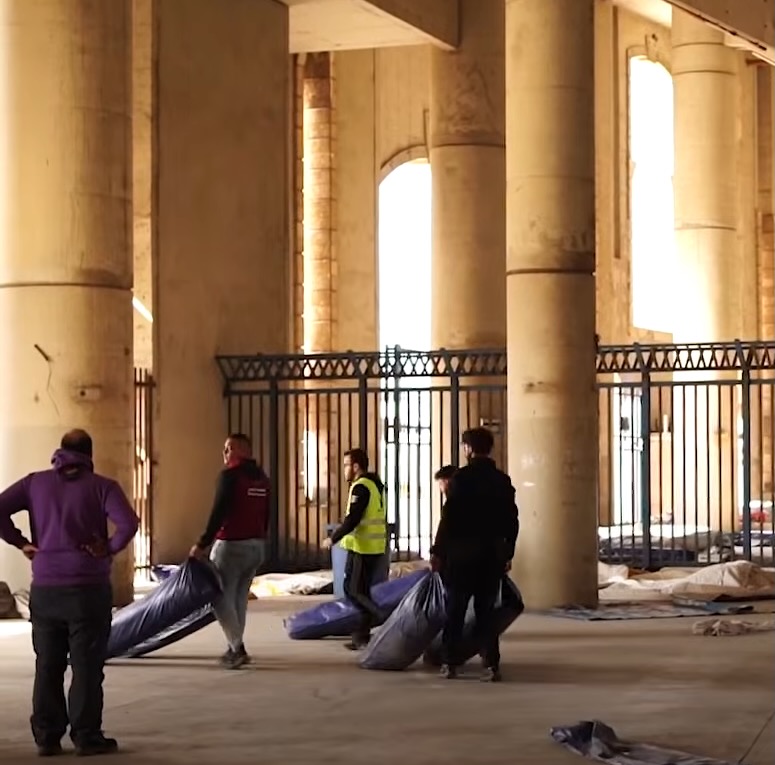
In March 2026, Israeli evacuation orders forced more than one million people from their homes across southern Lebanon, the Bekaa Valley, and Beirut’s southern suburbs (OHCHR, 2026). The scenes were painfully familiar: roads choked with cars, schools and streets turned into makeshift shelters, and families returning to the search for safe spaces to house them. Beyond the loss of life, what stands out is the repetition not of events alone, but of displacement itself.
Lebanon has long been shaped by cycles of flight: the civil war (Paul, Christopher, et al., 2013). The 1982 invasion, the July 2006 war (Irani, 2007), the 2024 escalation (Suleiman, 2024) , and now 2026 (Baroud, 2026) are better understood not as a new conflict, but rather a continuation. Each time, the same communities are forced from the same places, only to return briefly before being displaced again. In Lebanon, displacement is not an event with a clear beginning and an end. Nor is it simply a recurring cycle. For people impacted by displacement, it is an ongoing condition. What distinguishes this form of displacement from protracted displacement elsewhere is not duration alone, but repetition without resolution. Between September and November 2024, more than 1.2 million people were displaced (Suleiman, 2024). A ceasefire allowed partial return, but this “return” was fragile: homes were only partially repaired, livelihoods barely resumed, and daily life remained suspended under the expectation of renewed violence. When evacuation orders were issued again in March 2026, more than one million people were displaced once more, with fewer resources, weaker social networks, and diminished legal documentation. In addition, available pathways outside the country, like that of Syria or through Syria to further locations such as Iraq, which was possible in the 2024 war, became conditionally available, limited to certain groups that were deemed acceptable by the newly installed Syrian regime.
This piece, therefore, argues that internal displacement in Lebanon is best understood as circular displacement: a cyclical and cumulative process in which people are displaced, return incompletely, and are displaced again, often before any durable recovery is possible. Crucially, this condition does not affect all populations equally; for Lebanon’s stateless populations, each displacement deepens an already precarious legal existence.
As noted by Diab (2026) in an article for the Tahrir Institute, many said they had “never fully unpacked” before being displaced again, a phrase that captures both the literal state of their homes and the impossibility of treating the ceasefire as peace. The ceasefire was experienced not as peace, but as a suspension of war. People returned to geography, not to stability. Circularity here is not mere repetition; it is a condition of non-return, where each regressive cycle begins from a position of further depletion.
The Guiding Principles on Internal Displacement envisage durable solutions, including safe return, local integration, and resettlement. Yet these frameworks assume a stable legal identity, a nationality, a set of documents, and a recognised place within a state. For Lebanon’s stateless populations, this assumption does not hold. Their legal status is already fragile, and displacement further corrodes it.
Lebanon hosts one of the most complex contexts of statelessness globally, with different categories of stateless groups experiencing distinct realities. There are Palestinian refugees who have been stateless for generations, “Lebanese” under study stateless groups, Palestinian refugees from Syria, as well as the Dom and Bedouin stateless communities; all remain excluded from full legal and economic participation. Palestinian refugees from Syria arrived already displaced and stateless. Tens of thousands of Lebanese remain unregistered or classified as “under study”, also known in administrative Arabic as Qayd Al Dares, referring to individuals whose civil status remains pending (Intersos, 2023) and thus exist only partially within the legal system (Intersos, 2023). Syrian refugees, many lacking documentation, face similar precarity. Lebanon is not a signatory to the 1954 or 1961 statelessness conventions (UNHCR, 2014) and has no formal determination procedure. This is not a neutral legal environment into which displacement occurs; it is one already marked by exclusion.
For citizens, displacement disrupts a life anchored in a legal identity that survives the event. For stateless individuals, that anchor is absent. They are displaced within a country that does not fully recognize them, unable to access formal protection systems, unable to easily restore documentation, and unable to leave. They are caught in a cycle produced not only by conflict but also by legal exclusion.
For stateless populations, belonging is not national but relational and spatial. It is anchored not in citizenship, but in intimate geographies, neighbourhoods, streets, and networks through which everyday survival is negotiated. These localised forms of belonging function as a substitute for absent legal recognition. Circular displacement, however, repeatedly fractures these fragile anchors, producing a form of dislocation that is not only physical but relational, eroding the very structures through which survival has been sustained.
Circular displacement, therefore, does more than repeat harm; it compounds it. Coping mechanisms erode, savings are depleted, networks fragment, and informal protection systems weaken. For stateless populations, this compounding of harm operates with particular force. Documentation painstakingly secured over years can be lost overnight, and the time and institutional access required to restore it are rarely available before the next displacement occurs.
There is also a generational dimension. Statelessness in Lebanon has persisted for decades. Circular displacement intensifies this risk children born during periods of displacement are unregistered, extending legal invisibility across generations. Displacement thus becomes not only spatial but legal, with each cycle pushing individuals further from recognition.
Existing frameworks are ill-equipped to capture this intersection. The Guiding Principles assume eventual state-based resolution; statelessness frameworks assume relative stability. Lebanon presents a different reality: a convergence of cyclical displacement and entrenched legal exclusion. Addressing this requires both conceptual and practical shifts from emergency documentation mechanisms to legal reforms, including the establishment of a statelessness determination procedure.
More fundamentally, it requires rethinking how we describe the crisis “Displacement” suggests temporality; however, in Lebanon, for some populations, it is a condition of sustained exposure. Circularity is not incidental; it is structural, and for the stateless, it does not return them to where they began; it pushes them further into precarity, generation after generation.
Duaa Nooreddine is a PhD researcher in Political and Social Sciences at the European University Institute. With a background in social work and a Master’s in Migration Studies, her research examines statelessness, legal precarity, and protection dynamics in Lebanon, with a particular focus on how gender shapes access to rights and services. Her work engages with issues of internal displacement and access to protection in fragile and conflict-affected contexts. She has professional experience in protection and health-related programming in Lebanon, including gender-based violence programming and capacity development with NGOs.
KEYWORDS: Lebanon, Diisplacement, Statelessness, IDPs, Conflict
Selected bibliography
Intersos. (2023). Plight of the rightless: Mapping statelessness in Beirut and Mount Lebanon. Intersos. https://www.intersos.org/wp-content/uploads/2023/12/Mapping-Statelessness-in-Beirut-and-Mount-Lebanon_Siren_INTERSOS_2023_EN-1.pdf
Irani, G. (2007). The July 2006 war in Lebanon. Middle East Review of International Affairs, 11(1), 1–15. https://ciaotest.cc.columbia.edu/olj/meria/meria_mar07/index.html
Paul, C., Clarke, C. P., Grill, B., & Dunigan, M. (2013). Paths to victory: Detailed insurgency case studies. RAND Corporation. https://www.rand.org/pubs/research_reports/RR291z2.html
UNHCR. (2014). Statelessness in Lebanon. UNHCR.