
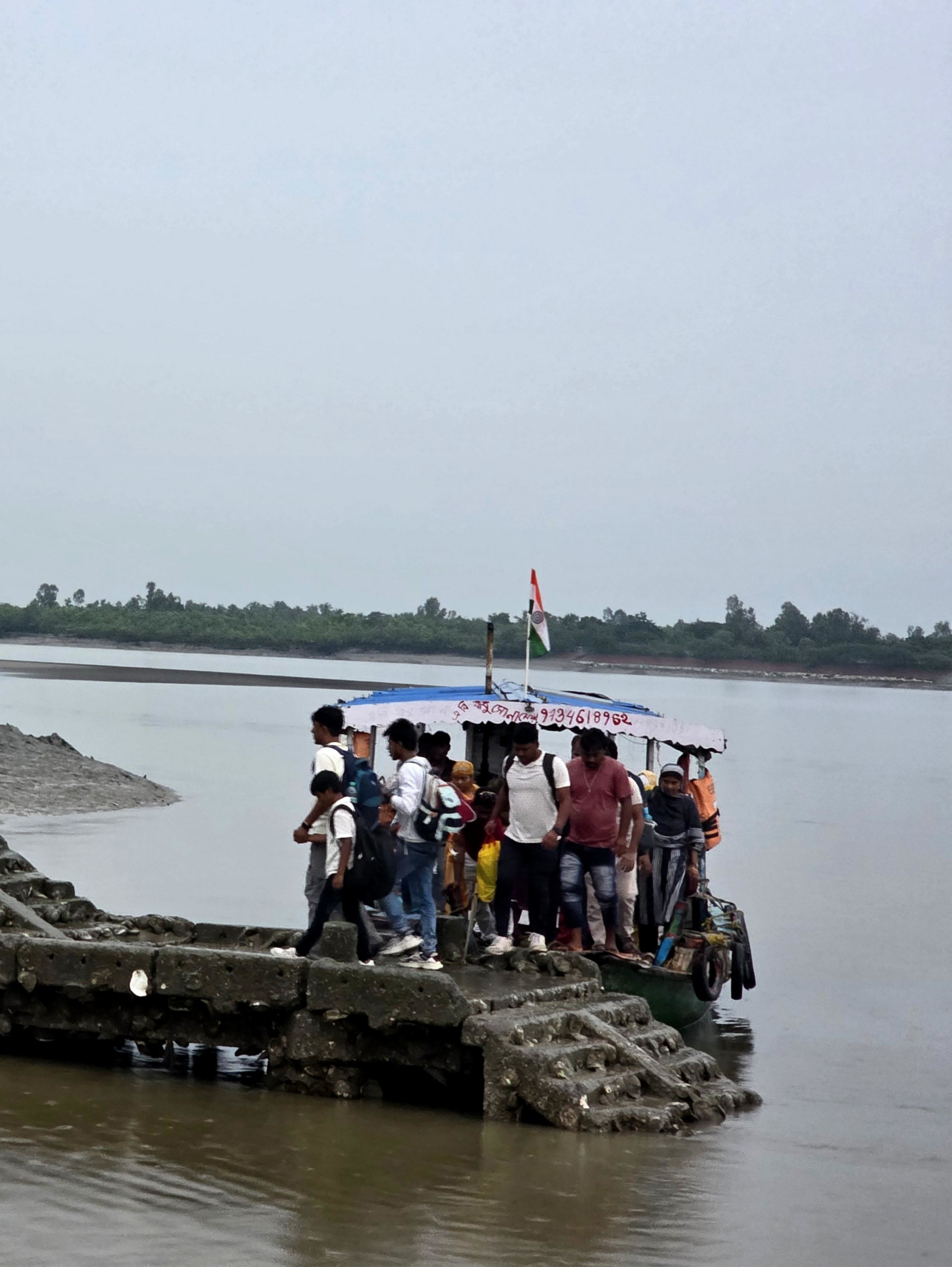
Recently, during a climate meeting organised by the Youth4Water-India campaign at Bhubaneswar, India, I met a group of youths from the Bagapatia relocation colony, where one of India’s initial lots of climate-displaced people had been resettled by the government. I frequently meet youths from this location, and I have been doing so for about three decades now. These displaced youths are victims of sea-level rise caused by climate change and are grappling with an illusion called a "safe and secure lasting solution." Even if some of them earn a livelihood by migrating out to other states and nearby locations, there are certain scars that don’t ever heal.
Whenever the sea swallows a village, we tend to record economic losses such as the loss of houses, boats, and agricultural yields. But we need to develop metrics that capture the loss of a young person’s identity, the severing of their cultural roots, or the slow erosion of their mental health. As the climate crisis accelerates, the discourse heavily favors what can be quantified and possibly compensated. Yet, for the youth on the frontlines of climate change—from the receding coastlines of Odisha to the sinking atolls of the Pacific—the most devastating impacts are those that cannot be priced.
These are “non-economic losses and damages" (NELD), defined in the United Nations Framework Convention's (UNFCCC) Loss and Damage mechanism, and they are reshaping a generation. NELD is an accepted technical term in climate negotiations and finance mechanisms. To me, however, it’s much more than non-economic. For many climate-vulnerable people, their entire world can be lost in situations like this. To understand the profound depth of NELD, one has only to look at the youth of coastal Odisha, whose lives are being fundamentally rewired by rising seas and extreme weather. Their experiences offer a stark warning: if our disaster management policies and National Adaptation Plans (NAPs) do not immediately recognize and address these intangible losses, we risk losing an entire generation to displacement, trauma, and disenfranchisement.
Erased geographies and fractured identities
For a young person growing up in Kendrapada’s Rajnagar block, the reality of climate change is not a distant scientific projection; it is the physical disappearance of their homeland. In places like Satabhaya, a cluster of seven villages, entire villages have been lost to coastal erosion, forcing people to relocate. Young people have seen their own geography taking revenge on them. Encountering geographical vulnerabilities has meant complete dispossession insofar as their identity, culture, and nature-based lives and livelihoods are concerned. Some youth told me, funnily: "Our originality is gone; we live with a duplicate identity." When a community is displaced, the loss extends far beyond physical shelter. Displacement breaks kinship networks and community bonds.
There is an intricate relationship between geography and cultural heritage. The erasure of the first takes away the second with it. Although relocation sites can do something about recrafting infrastructure and helping people continue their religious and cultural practices, it is not the same, at least for those who have been through the relocation process. The youth of Satabhaya told me how they and, most importantly, their parents and some of the grandparents who are still alive, cannot really relate to the newly constructed Panchubarahi temple. The temple has been built here in the relocation colony, and rituals are performed by the people. However, in the people’s ancestral way of life, the deities and the temple were more linked to the geographies in which they were traditionally situated. This one, built in the relocation colony, is still a new temple in many people’s minds. The old one, which was linked to old stories of the villages that are now under the sea, always attributed Panchubarahi to a seascape, recalling how sailors and fisherfolk had to seek blessings of the deities before and after being at sea. Panchubarahi literally means “five wild boars.” The faces of the five deities worshipped there are carved on this basis, and there is a natural relationship between the deities and the local mangrove forests. With the shifting of the habitation, the people’s natural rights and access to the mangroves are also gone. That’s a double blow!
Youth in these vulnerable zones are witnessing the loss of ancestral sites, such as the Panchubarahi Temple, as well as burial and cremation grounds, and fear that their children will never have the same relationship with these deities and places as the elders did. In Podampetta of Ganjam district, another vulnerable zone where an entire fisherfolk village has been displaced and resettled, communities are forced to cremate their dead near the sea, in violation of their traditional norms. When intergenerational knowledge — such as traditional net weaving, local ecological knowledge, and weather forecasting — is disrupted, young people lose their tether to their ancestors.
This phenomenon is not unique to India’s eroding coastal zones along the Bay of Bengal. In Pacific Island nations like Tuvalu and Fiji, youth face the existential dread of entire sovereign nations becoming uninhabitable. There, the loss of land means the loss of vanua, a Fijian concept encompassing land, culture, and identity. For a young Pacific Islander or an Odia youth from a coastal village, the future is buried in the past. They are basically staring into a void where their heritage used to be. A thread disconnected, a future alien to the past. The resulting trauma from displacement, the loss of land, and pervasive uncertainty trigger profound mental health challenges, including chronic stress, anxiety, and a deep-seated loss of identity.
The trap of distress migration
When the ocean claims the land, it also claims the future. Recurrent cyclones, beach erosion, flooding, river erosion, and salinity have made land partially uninhabitable in areas like Puri’s Astaranga and Gop, forcing the displaced youth to detach from their traditional geographies. Local traditional economies—which have been primarily based on the mixed strength of agriculture and fishing—are weakening fast. For young men, the societal pressure to earn becomes a crushing weight. Because alternative non-agricultural and non-fishing jobs have not been created in these climate-affected places, the majority of young men are forced to migrate to far-off places, often encountering and falling prey to predatory actors and exploitative conditions along a migration "harm chain".
A recent interaction with migrant workers—most of whom are youths—from these locations in the Puri district revealed that this distress migration is rarely a journey toward prosperity; it is a desperate flight for survival. Youth who migrate often face identity loss and abuse in their new settlements. We see exact parallels in neighboring Bangladesh, where sea-level rise and salinity intrusion in the Sundarbans routinely push thousands of young people into the crowded, informal slums of Dhaka and elsewhere. They transition from being stakeholders in a delicate ecological system to invisible laborers in urban sprawls. In fact, some of the youths in Puri district told me that their newfound status upgradation—a term used because they earn more cash than they would have earned by staying back—does not do much good. "No one wants to get their daughters married to us," said some of them.
The NELD experienced by young women and girls is distinctly harrowing. While young men migrate, most young women may not be able to do so and may instead be forced into early marriage. Even for girls who remain and pursue education, the reality is bleak. Adolescent girls may attend colleges, but they know there are no jobs in their villages, and social restrictions or security concerns prevent them from traveling far. Education fails to translate into employment, and the education system and vocational training programs do not suit the needs of the youth in the contexts in which they live. They are effectively trapped in a shrinking geography with no viable exit strategy. What the youth truly need is a rehabilitation scheme that takes care of all such challenges.
How youth "feel" non-economic loss and damage
How do youth feel these losses? After a series of interactions and personal chats with hundreds of youths, I have tried to map this.
First, they feel it as a profound mental health crisis. The triple burden of "loss of home, displacement and calamity" combined with financial insecurity sharply increases mental health issues. The pressure to earn, the non-availability of jobs, increasing detachment from traditional ways of life, and the issues associated with migration—anxiety in handling new situations and predatory practices, the lack of basic facilities and services, and the potential for abuse from various corners—all compound to create a psychological pressure cooker. These youth are primarily not moving with high aspirations but because of compulsions created by situations that have already made them mentally aggrieved and helpless. Such conditions may even contribute to a worsening of their symptoms. The problem is that there is no system for registering these challenges. Youths and their family members tend to normalize and rationalize these as “fate.”
Secondly, they experience NELD as a loss of agency and rights. In a desperate scramble for daily survival, long-term civic engagement vanishes. Youth, more concerned about immediate survival, prioritize cash income over possible government entitlements and protections. This survivalist mindset has the dangerous potential to erode their sense of rights and entitlements in the future. When you are fighting just to eat and find safe drinking water—an increasing challenge as severe salinity intrusion contaminates groundwater across coastal villages—the concept of demanding equitable climate policy feels like an impossible luxury. In such a situation, policymaking should not only recognize the NELD-related problems but also create platforms for the involvement of youth in the development and implementation of solutions to their displacement. I have often argued for cash entitlements and/or local employment opportunities for periods when the youth want to stay back in their villages to take care of their families and farms. The local Disaster Management Committees should go beyond drills and exercises to prepare people for rescue and evacuation, and also make such Climate Action Plans at the grassroots, where youth can voice their concerns and submit their issues to the governance structures. The State Level Climate Action Plans should have institutional engagement arrangements for youth and community members on a regular basis so that issues can be addressed in a regular and dynamic manner.
Categorizing NELD for policymakers
If we are to protect this generation as citizens who can contribute their lives and wellbeing to sustainable livelihood opportunities and conservation of local natural resources to build climate resilience, then policymakers, funders, practitioners and researchers must expand their vocabularies. NELD cannot be a catch-all footnote in climate reports. It must be categorized systematically so that specific, actionable policies can be developed. Those working in the field of Loss and Damage should urgently consider the following types of NELD:
- Mental and psychological toll: The chronic anxiety, trauma from displacement or living under the fear of displacement, and compounding mental health issues faced by youth.
- Loss of cultural heritage and identity: The destruction of ancestral lands, temples, and the severing of intergenerational cultural and ecological knowledge.
- Erosion of social cohesion: The breaking of kinship networks, traditional support systems, and community bonds due to forced displacement and migration.
- Loss of agency and human rights: The loss of independence, forced early marriages, and the erosion of a young person's sense of rights and civic entitlements.
- Educational and aspirational loss: The reality where education does not translate to employment, and vocational systems fail to meet contextual needs, effectively robbing youth of their futures.
- Health and physiological toll: For example, the rise in water-borne diseases, hysterectomies, and compromised menstrual hygiene due to salinity intrusion and damaged sanitation infrastructure.
Reimagining policy: A call for NAPs and disaster management
Current disaster management frameworks need to consider addressing NELD. National action plans and state-level policies often focus entirely on hard infrastructure—building seawalls, cyclone shelters, and issuing financial compensation for lost crops. Ecological conservation measures are also considered, but these actions take time to rebuild the ecosystems that can restore hope for all the communities. Reassuring the youth through strategic awareness and other action plans will help protect their mental health and keep families from disintegration. More must be done to protect cultural heritage than simply issuing checks to rebuild infrastructure; efforts to keep communities together – even when youth have to migrate – are essential.
National Adaptation Plans (NAPs) and disaster management policies must urgently pivot to give better, specialized focus to youth from vulnerable communities.
First, adaptation plans must overhaul education and vocational training. If traditional livelihoods are no longer viable due to climate impacts, NAPs must fund context-specific skill-building that prepares youth for the modern, resilient economy, rather than leaving them with training that does not suit the context in which they live.
Second, policies must address the human cost of distress migration. Rather than treating migration purely as a failure of adaptation, policies should recognize it as an ongoing reality and establish safe, secure mobility corridors. Youth migrating to urban centers must be protected from the identity loss and abuse they currently face in new settlements.
Third, climate policy must integrate robust mental health and psychosocial support. Disaster response can no longer end when the floodwaters recede. Long-term counseling and community-building programs must be funded to address the trauma of displacement and the chronic stress of livelihood insecurity.
Finally, policy formulation must be participatory. Youth must have a seat at the table. If they are the ones inheriting these fractured landscapes, they must be the architects of their own recovery.
The youth of coastal Odisha, much like their peers in Bangladesh and the Pacific, are carrying the heaviest, though often silent, burdens of the climate crisis. Their losses don't register on a stock exchange or in a national GDP calculation. But a nation's true wealth is its youth. If our climate policies continue to ignore non-economic losses and damages, we are not just failing to adapt to a changing climate—we are actively failing our future. It is time to measure what matters, and it is time to act before these invisible scars become permanent.
Ranjan Panda, a well-known water and climate practitioner and expert from India, convenes the informal yet active networks Water Initiatives, India and Combat Climate Change Network, India. His work on climate migration, displacement, loss & damage and related aspects spans local to global levels. He is a Steering Group Member of the Climate Migration & Displacement Platform (CMDP), a global advisory committee member of the Platform on Disaster Displacement (PDD), and a Steering Group member at the Coalition on Dignified Climate Relocation (CDCR), among others.
KEYWORDS: Youth, Displacement, Climate change, Loss and Damage, India
Selected References
Fankhauser, S., Dietz, S. and Gradwell, P., 2014, Non-economic Losses in the Context of the UNFCCC Work Programme on Loss and Damage, Centre for Climate Change Economics and Policy, and Grantham Research Institute on Climate Change and the Environment
Government of Odisha, 2020, Odisha Climate Change Action Plan 2021-30, Odisha Climate Change Action Plan 2021-30
Gupta, D. et al., 2025, Climate-Induced Migration in India and Bangladesh: A Systematic Review of Drivers, Impacts, and Adaptation Mechanisms, 2, Climate, Volume 13, Issue 4
Kalinga, K., 2019, Introspecting Climate Change from the Lens of Feminism, Journal of Energy Research and Environmental Technology, Volume 6, Issue 3
National Disaster Management Authority, Government of India, 2019, National Disaster Management Plan, National Disaster Management Plan.
Panda, R, 2022, Going under: Coastal Odisha under existential threat, Down To Earth, 30 June, 2022.
Pandve, H., 2009, India's National Action Plan on Climate Change, Indian J Occup Environ Med, Volume 13, Issue 1.
Yee, M. et al, 2022, The role of Vanua in climate-related voluntary immobility in Fiji, Frontiers in Climate, Volume 4, 2022.