
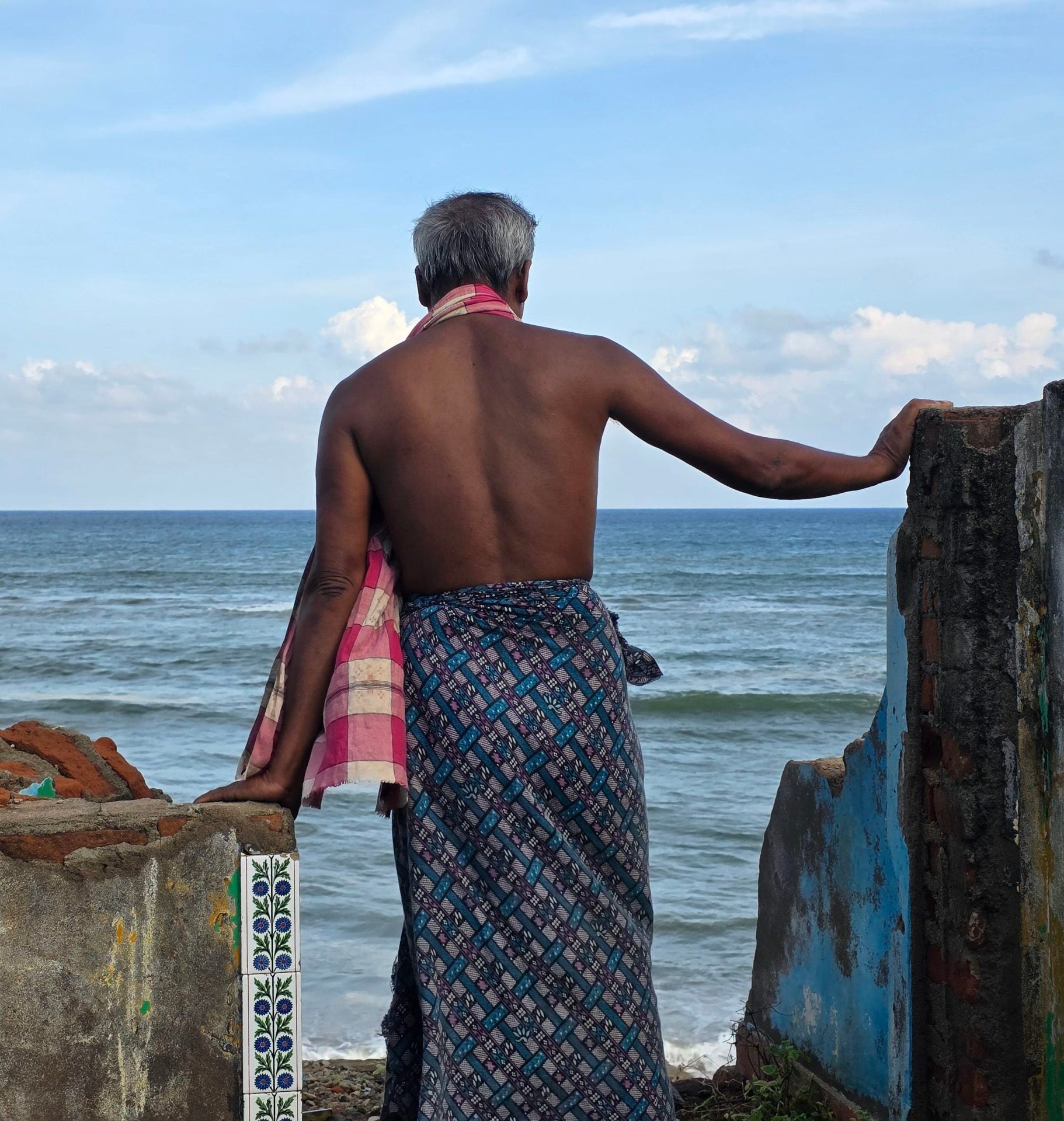
As extreme weather events grow in frequency and intensity, and as coastal ecosystems collapse, local geographies reach adaptation limits – both soft and hard – and human populations are being forced to move. Mobility in the context of climate change is not experienced equally across geographies and communities or subsets of communities. This article shines a light on how an aging global population is impacted by accelerating climate hazards in one unique form of climate mobility – the planned relocation of entire communities out of harm’s way.
In the Bay of Bengal, particularly in the Indian coastal state of Odisha, where the authors have been working with impacted communities for more than three and a half decades, the climate crisis and its impacts on the elderly are acutely visible. Our experience as leaders of the network Water Initiatives has made us see firsthand how marginalized farming and fishing communities are experiencing the destruction of their livelihoods, homes, and cultural identities. During planned relocations, they are forced to leave their homes, geographies where sea-level rise has already put hundreds of thousands of poor people under tremendous pressure. By examining the lived realities of the elderly during planned relocations in Odisha, we can understand the immense economic, physical, and psychosocial tolls of climate displacement.
The Bay of Bengal's Disappearing Coastlines
The coastal state of Odisha sits on the frontlines of climate change and is highly vulnerable to sea-level rise, cyclones, floods, and related disasters. The scale of the threat is immense. Nearly 30% of Odisha’s coastline is affected by erosion. For these communities, whose lives and livelihoods are intricately and historically linked to local natural resources, this environmental degradation translates directly to existential peril. Seawater has already entirely submerged 16 villages in the region, while another 247 villages may need to be relocated due to rising seas.
Villages such as Podampeta and Satabhaya have already seen their entire populations relocated to resettlement areas like New Podampeta and Bagapatia. Meanwhile, villages like Tandahar and Chhenua are severely impacted by relentless coastal erosion but have not yet been relocated. The villagers have been demanding to be relocated to safer sites for several years now. The following table gives a brief overview of the two relocation sites that have been covered under this article. The two cases reveal very different models of climate-related planned relocation.
Table: A snapshot comparison between two relocation sites in the state of Odisha
| Satabhaya → Bagapatia | Podampeta → New Podampeta/other sites | |
| District | Kendrapara | Ganjam |
| Main livelihood | Farming + fishing + livestock | Primarily fishing |
| First relocation decision | 1992 | Mainly 2010–11 |
| Main relocation process | From 2008 | From 2011 |
| Major trigger | Long-term coastal erosion/sea ingress | Rapid erosion + high tides + Cyclone Phailin |
| Main destination | Bagapatia, ~12 km inland | Multiple sites ~3–6 km away |
| Main institutional framework | Odisha R&R Policy | Odisha Disaster Recovery Project/ODRP |
| Main relocation phase | 2017–18 | 2011–2015/18, in stages |
| Approx. number of families | 571 | ~463, with different counts in different records |
| Relocation model | Relatively consolidated | Fragmented |
| Livelihood consequence | Severe loss of agricultural/pastoral/fishing access | Continued dependence on fishing but increased travel |
| Cultural issue | Panchubarahi temple/deities relocated | Community fragmented across settlements |
| Relocation completed? | No — even in 2025 some families remained/awaited relocation | Largely yes, but residual households and fragmented families remained |
| New vulnerabilities | Waterlogging, poor services, livelihood loss | Water, roads, livelihood distance, social fragmentation |
Importantly, as can be seen from the table, neither relocation was a single event but can rather be described as processes. And in both cases, the physical movement of houses happened much faster than the reconstruction of other aspects of people's lives in the new site.
The impact of the inundations by the once friendly ocean has different meanings for different parts of the population now faced with planned relocation. For the elderly population of these villages, climate change is not an abstract scientific concept anymore; it is an immediate, daily struggle. They possess a keen awareness of jalabayu paribartana (climate change), though they often interpret it through its devastating symptoms rather than its atmospheric causes. For them, climate change is the untimely weather, the oppressive heat, the incessant rains, and an ocean that has crept inland to swallow their ancestral homes whole. This understanding has implications for relocation planning because the elderly, even though they would like to stay in their ancestral homes because of their strong place attachment, feel helpless as they are relocated due to an invading sea. Relocation is the last resort, they understand, and want a much better future for the younger generations. They want a permanent solution to the problem so that they do not have to move again.
The Economic Upheaval and Loss of Livelihoods
The affected communities of coastal Odisha are traditionally dependent on a mix of agriculture and fishing. These sectors are highly vulnerable to climate change impacts. As sea level rise expands the impacts of coastal erosion and tidal inundation, people face a systematic reduction in the available land for farming and destruction of existing crops. The fisherfolk also face numerous challenges including loss of their traditional rights to fishing in known territories, forcing them to fend for a good catch in unknown and uncertain water zones.
In the face of threat of inundation from the sea, when communities like Podampeta and Satabhaya can no longer be protected by temporary evacuations or building barriers, planned relocation becomes unavoidable as a measure of last resort. This process essentially involves rebuilding housing, public infrastructure, basic services, and local livelihoods at a new destination.
The degradation of arable lands due to saltwater intrusion along with extreme weather events such as heat and rain spells, leads to complete disruption of agricultural activities and decaying livelihoods. Similarly, changes in the coastal ecosystem are decimating the fishing economy. These changes affect men and women differently. Women are intricately engaged with the agriculture and fishing activities, yet their labour largely goes unrecognized by state actors and policy makers, leading to their exclusion from welfare and compensation schemes. Relocation processes barely address these issues, meaning that people can no longer access the ecosystems they used to, in their original homes.
Given its main objective of bringing people to new places where they can settle safely and sustainably when adaptation limits have been reached in their village, planned relocation is fraught with challenges. Communities often struggle to re-establish jobs, food sources, and economic stability in the new locations. But the loss of ancestral lands and activities not only affects economic viability, it also leads to severed cultural ties and impacts social cohesion. Land rights in new locations in Odisha are not easy to secure, thus pushing communities towards economic instability and poverty. All these difficulties are compounded in case of women; gendered vulnerabilities are a stark reality both before and after relocation to new sites.
The same is true for the elderly population. For older people, lack of secure land rights can turn relocation from a physical move into a prolonged condition of insecurity. International guidance on climate-related planned relocation specifically calls for secure tenure at relocation sites and attention to the particular needs of older people and other vulnerable groups. For an elderly person, land is not merely an economic asset; it is often the family's only long-term security. If the new house is not accompanied by a legally recognised title (patta), there can be continuing fear of eviction, dispute or exclusion from future entitlements.
Planned Relocation and Unsuitable Infrastructure
When coastal lands become completely uninhabitable, governments often initiate planned relocations. However, these tend to have a narrow focus on physical infrastructure, neglecting the specific physiological and cultural needs of the elderly.
In Odisha, communities in Satabhaya had to move twelve kilometres away, to Bagapatia, and those of Old Podampeta were moved three kilometres away. Both of these communities faced different challenges and were covered under different schemes. Their local governments have been trying to help them with better facilities; however, challenges remain.
Access to basic amenities such as drinking water remains problematic, even though a lot of progress has been made. The communities at Bagapatia face severe waterlogging during storms and heavy rainfall events. The villagers of Tandahar, who have not moved out yet, despite a rapid sea-ingress, face groundwater contamination because of sea-level rise. Cyclonic storms also affect their surface waters. The challenge gets tougher for older residents who do not have younger people at their homes. The government supplies tanker water from time to time but fetching it becomes a challenge for them. Buying potable water is a huge burden on their family finances and not a sustainable solution either.
The lack of clean water is not just a health hazard; it causes deep psychosocial distress. The inability to offer fresh water to guests damages social standing, and the infamy of the village's water situation even deters marriage prospects for the youth. Women from nearby villages, according to villagers who spoke with us, are unwilling to marry into the families of this particular village since they will most likely be burdened with collecting and managing household water at great cost to their health, education, safety, and economic independence.
‘Solastalgia’ and Non-Economic Loss and Damage (NELD)
While agriculture and livelihood losses are visible, and mostly impact the younger generations, the invisible losses are more pronounced yet go unrecognised for the elder generation during planned relocation. All segments of the population face Non-Economic Losses and Damages (NELD), which refers to the intangible losses that cannot be quantified in financial terms: the loss of cultural heritage, traditional knowledge, social cohesion, and the profound psychological grief of losing one's homeland. This is perhaps the most devastating, yet least measured, impact of climate related planned relocations on the elderly and their families.
For the aging populations in coastal Odisha, this trauma is profound. They are experiencing ‘solastalgia — the acute distress and melancholia caused by the environmental degradation of one's home environment. Relocated communities grieve for the homelands where their ancestors lived, where they were born, and where their identities were forged in relation to the sea.
The Erasure of Cultural Identity and Sacred Spaces
The ever-invasive sea takes away sacred and ancestral geography. What people see through their own eyes is the erasure of homes and crop fields, but what the people actually lose is their long-standing relationship with the nature with which they lived for ages. Older people are usually more affected by this. In Satabhaya, a centuries-old temple that served as a vital cultural and religious anchor for the community was swallowed by the sea, becoming a source of immense ongoing distress for the elderly. A new temple was constructed and the deities were moved, but the relationship was deeply rooted with the old geography. Time may heal this, and even more so for the younger generations, but for the older ones, the loss is going to stay in their memory as long as they live.
Relocation sites often lack adequate cultural infrastructure. In New Podampeta, the absence of a proper cremation ground has meant that families have had to conduct last rites near the sea, a practice that conflicts with deeply rooted cultural norms and values. For older people, such losses can be particularly profound. The cremation ground is not merely a physical space for disposing of the dead; it is part of the community’s cultural landscape, where generations have performed rituals, mourned their loved ones and maintained their relationship with ancestors.
When such spaces disappear after relocation, older people can experience a profound sense of cultural dislocation. They carry memories of how funerals were conducted, where ancestors were cremated, which rituals were followed and how the community came together during death and mourning. When these practices can no longer be performed in familiar and culturally appropriate ways, they may feel that they are not merely losing a place but losing a part of the social and cultural world they helped create.
Loss of Traditional Knowledge Systems
Traditional knowledge systems are lived experiences formed into knowledge over centuries and more. When the elderly are separated from their native environments through planned relocation, their vast repositories of traditional ecological knowledge not only become obsolete but also fade over time. What the elders fear is the erosion of these knowledge systems because intergenerational knowledge transfer does not happen when they are relocated to a new site and the younger generations migrate for jobs as local ecosystems reach adaptation limits. In Odisha, the older generation possesses an intimate understanding of the sea, the seasonal availability of fish, the precise netting required for specific catches, and the complex processes of weaving and mending nets. Similarly, older farmers hold generational knowledge about soil types, crop suitability in different microclimates, and seed storage. Relocation can cause a breakdown in the transfer of this knowledge critical for survival and cultural techniques, creating a deep generational rift and a severe loss of community identity.
Health Impacts and the Erosion of Social Support Networks
Elderly people face more physical vulnerabilities to environmental stressors before and during planned relocation processes than others. Their ability to cope and recover from climate hazards is limited compared to others. When they do not get policy and programme support tailored to their needs, things get further problematic for them. In coastal Odisha, communities report a stark increase in health problems following relocation. During our interactions with the communities from many villages, people have made complaints of suffering from diabetes and high blood pressure due to local environmental degradation, stress and water contamination. Some people have faced sudden paralytic attacks, and there has not been any study so far to understand the reason. Some local medics suggest that this could be due to excessive saline water and some local dietary habits, including the consumption of ‘salty fish.’ There have been cases of severe skin irritation and dermatological issues caused by bathing in highly saline water.
Compounding these physical ailments is the collapse of traditional social support systems in the new sites. The loss of local livelihoods drives young people to migrate away in search of jobs. The elderly are left behind in impoverished conditions in the relocation sites, unable to travel for economic opportunities, and highly dependent on erratic government welfare schemes or remittances.
The fact that the young generation are leaving both the traditional villages and the relocation sites increases the physical and psychological burden on people who are left behind. Older people are left in the relocation sites to manage the household, deal with complex bureaucratic hurdles for food entitlements and pensions, and fend for themselves during extreme weather events like cyclones and torrential rains. The diminishing support system strains a population already overwhelmed by age, chronic illness, acute climatic changes, and the sheer exhaustion of having to rebuild their lives in unfamiliar conditions. The strain of limited resources constantly threatens the solidarity of the community, and psychosocial issues like increased alcoholism among men have been reported post-relocation.
Moving Toward an Inclusive, Age-Sensitive Relocation
When climate change makes it increasingly difficult and unsafe to stay, planned relocation of communities happens at the initiative of the communities themselves in some cases and the government in others. Planned relocation and adaptation frameworks still have a major bias towards infrastructure, technology, and quantifiable economic recovery. They pay insufficient attention to the social, cultural, psychological, and care-related dimensions of climate vulnerability.
What we learn from the lived experiences of the elderly in coastal Odisha and across the globe gives rise to the need for a serious debate on relocation and adaptation strategies, including those related to the health and well-being of the aged population globally. But research remains limited to a few pockets and has not reached mainstream research or relevant policy discussions. The severe geographic research imbalance, which often neglects low- and middle-income settings in South Asia and sub-Saharan Africa, has led to policies that are entirely disconnected from grassroots realities. Care has to be taken to not only rebuild livelihoods but also human relationships and a sense of belonging within the context of the new place. Opportunities to maintain culture and traditions help communities develop a sense of belonging and rebuild and thrive in the new place.
What the world actually needs, if it is to protect its aging and vulnerable populations, is climate resilience planning that adopts a rights-based, age-sensitive approach. When deciding whether to stay or relocate to new sites, the elderly should also have a say.
Lessons for Future Planned Relocations in India and Globally
An inclusive relocation strategy should go beyond providing house-building assistance to include secure access to land, livelihood opportunities, essential amenities, rights to natural resources and social and cultural infrastructure. Governments must formulate integrated rehabilitation schemes because existing policy measures often fail to adequately address the losses of people whose history, geography, livelihoods and cultural identities have been systematically eroded by the sea or gradually disrupted through the relocation process.
Effective rehabilitation policy therefore requires learning from the experiences of planned relocations in Odisha and ensuring that the new settlement becomes a viable and dignified place to live, rather than merely a site where houses are constructed. This requires attention to the following, among other themes:
Secure Land and Resource Rights: Relocation planning must begin with the identification of safe and suitable land, with adequate space for housing as well as livelihoods and community needs. Where possible, the new location should retain important geographical and ecological features of the original settlement. Mechanisms such as decentralised land banks could help identify and reserve suitable land in advance while ensuring clear and legally secure land and property rights for relocated families.
Climate-Resilient, Age-Appropriate Housing: Homes should be designed with the specific needs of elderly people in mind, including thermal comfort, ventilation, accessibility and safety. Relocation sites must also provide reliable access to potable water, sanitation, healthcare, and other essential services, particularly in the context of increasing heat and climate extremes.
Inclusive Decision-Making: Elderly persons must be actively included in decisions concerning whether, when, where and how relocation takes place. They carry invaluable historical and ecological knowledge, including knowledge of local ecosystems, water sources, disaster coping mechanisms, cultural practices and community networks. Such knowledge should inform the design of the new settlement rather than being lost through relocation.
Livelihood and Social Support: Rehabilitation must address the economic and social consequences of displacement. This should include robust social protection, healthcare facilities, old-age pensions and livelihood opportunities that do not depend on intense physical labour, particularly under conditions of increasing heat. Equally important are community spaces and social networks that can reduce isolation and help older people maintain their dignity, relationships and sense of belonging.
Ultimately, rehabilitation should be judged not by the number of houses constructed or families physically relocated, but by whether people – particularly older and vulnerable residents – are able to rebuild secure, dignified and meaningful lives in their new location.
Conclusion
Almost 138 million people over the age of 60 are currently exposed to significant climate risks globally. These people face unique vulnerabilities due to age-related physical limitations, chronic illnesses, social isolation, and a high dependence on local ecosystems and community networks. In the context of planned relocation, these vulnerabilities can become even more pronounced. Relocation should not be seen merely as the physical movement of people from a high-risk area to a safer site; the wellbeing and dignity of older people must be protected both before relocation and after they are settled in new locations.
Our work and observations from the coastal districts of Odisha and elsewhere in coastal Bay of Bengal show that planned relocation, while intended to reduce exposure to sea-level rise, heat stress and other climate risks, can create new and interconnected vulnerabilities for older people when their needs and attachments to place are overlooked. They endure not only the economic losses associated with failing agriculture and decimated fishing grounds, but also the profound, often silent trauma of solastalgia. For many, relocation means leaving behind ancestral lands, homes, sacred sites, traditional livelihoods, and the ecosystems that sustained their lives and knowledge for generations. When resettlement sites are located away from these familiar landscapes and community networks, older people can find themselves socially isolated and physically disconnected from the places that gave meaning to their lives, while their children may migrate away, leaving them in isolated and often unsuitable concrete resettlement colonies.
Governments and international bodies must recognize that elderly populations need more than just physical relocation. Planned relocation initiatives must consider connecting environmental protection with sustainable livelihoods, robust public health infrastructure, and fierce cultural preservation.
The Government of Odisha has just proposed ARISE (Adaptive Resilience Investment in Coastal Systems on Economics), a project aimed at promulgating a comprehensive and long-term strategy for protecting Odisha’s coastline, enhancing climate resilience and promoting sustainable economic development in coastal Odisha. Protecting coastal ecosystems can reduce disaster risks, but we must go beyond economic interventions and infrastructural resilience; the state and others must equally prioritise the dignified preservation of the human ecosystems that rely upon them. As the tides continue to rise across the Bay of Bengal and the world, acknowledging, respecting, and addressing the nuanced lived experiences of the elderly is not just a policy recommendation – it is a moral imperative for building a humane, equitable, and resilient future. Planned relocation initiatives must take note.
Ranjan K Panda is the Convenor of Water Initiatives, India that has been working with coastal communities and other communities facing climate displacement and migration for more than three decades now. He is also a Steering Group member of the Coalition on Dignified Climate Relocation (CDCR) besides being actively engaged in several other global platforms working on climate migration, displacement, relocation and related initiatives.
Dr. Sankalpa Satapathy is an Assistant Professor at the Institute of Public Health Kalyani, West Bengal. She has also been associated with the Water Initiatives, India and its work on climate migration, displacement and relocation for about two years.
Sarah Koeltzow and Erica Bower, co-facilitators of the Coalition on Dignified Climate Relocation, are guest editors of this miniseries: Towards Dignified Climate Relocation: Community Perspectives from around the Globe. The series brings together the experiences of relocating community leaders, researchers, advocates and practitioners from across the Coalition to examine diverse case studies and identify lessons about what rights-respecting, community-led relocation looks like in practice and how national policy should enable it.
The Coalition on Dignified Climate Relocation [climaterelocation.org] was formed in 2025 to work towards two goals: foster knowledge and experience exchange across contexts, and advocate for countries to develop and implement rights-respecting policy frameworks on planned relocation that put communities at the center.
KEYWORDS: Planned relocation, climate change, human rights, displacement, India
References
Galappaththi, E. K., Ford, J. D., Bennett, E. M., & Berkes, F. (2019). Climate change and community fisheries in the arctic: A case study from Pangnirtung, Canada. Journal of Environmental Management, 250, 109534.
HelpAge International (2023). Climate Justice in an ageing world.
Panda, R. K. (2025). Ensuring Justice for Climate Displaced People. In Changing Tides (pp 157-176). Routledge.
World Health Organization (2023). Climate Change.