
Curated at the Institute of Geography of the University of Neuchâtel (Switzerland), the CliMig database is the first comprehensive collection of bibliographic references specifically focused on displacement, migration and other forms of human mobility, the environment and climate change. The database consists of a fully searchable bibliography that is continuously updated with new publications. It serves as a free major hub for researchers on this important topic.
CliMig has been used in numerous systematic reviews and meta-studies on environmental migration – for example, Balgah and Kimengsi’s literature review of non-migration decision making in Africa (2022) & Borderon et al.’s systematic review of empirical findings on migration influenced by environmental change (2019). The CliMig typology of empirical studies, described below, has also be used as a starting point to more theoretical overviews such as a recent publication by de Sherbinin and colleagues on migration theory in climate mobility research (2022). Finally, CliMig served as the dataset for a much-cited analysis of the geography of climate migration research, which revealed how funding and other dynamics had contributed to a Northern bias in climate adaptation research (Piguet, Kaenzig and Guélat 2018).
Although the CliMig database uses the most advanced bibliographic research technologies to identify new scientific publications, article selection, bibliographic entries and keyword attributions are all researcher-curated, ensuring accuracy and coherence. The team works in collaboration with the Swiss Forum for Migration and Population (SFM). SFM uploads potential articles for CliMig via Diigo. CliMig colleagues then select articles that meet our criteria with a specific focus on case studies.
CliMig is product of the collective efforts of a team of researchers focused on the climate migration nexus across numerous research subdisciplines. Two PhD students, one Professor and one professional documentalist make up the team. Each paper tagged in CliMig is read by at least one team member. Their knowledge of the field ensures that the typology of methods and keyword attribution accurately reflect the content.
Stages of Curation
CliMig is the output of a four-stage data gathering process:
- Literature monitoring
Traditional sources are used for monitoring the scientific literature – publishers’ catalogs, e-alerts, group lists and discussions, newsletters, etc.. Tools such as Google Scholar alerts, The Old Reader, Update Scanner and editors’ alerts are also an important part of our monitoring workflow, particularly for identifying relevant grey literature (reports, working-papers, conference proceedings, etc.). In order to identify publications that might be included in CliMig, we cross-reference potential articles against the keywords listed in Annex 2. The CliMig curation team also welcomes authors, publishers and colleagues to submit published materials directly.
- Selection of topics
To ensure coherence and exhaustiveness, references are included only if they significantly address or bring insights to the following topics relevant to internal displacement:
- Population displacement potentially caused by environmental change
- Displacement as coping strategies for environmental change
- Perception/representation of the migration/environment nexus
- Policies and legal issues related to migration and environmental change
In principle, the database does not include references focused on the following areas: studies of temporary mobilities conducted in the context of post-disaster relief (e.g., studies using cell phone data of displaced persons); the impact of migration on the environment; the link between conflict and the environment; displacement linked to development/infrastructure projects; amenity migration (e.g,, when environmental considerations serve as pull factors); attitudes towards “climate change migrants”; and, more generally, climate-related vulnerability if not linked to human displacement. However, articles containing such themes are sometimes selected if they overlap with CliMig thematic areas.
- Selection of relevant types of literature
The CliMig database is focused on original research material, primarily peer-reviewed publications. However, in specific cases, grey literature such as governmental and NGO reports, contribute significantly to knowledge. Inspired by the IPCC, CliMig therefore includes grey literature if it brings substantial empirical ‘value-add’ that does not overlap with published peer-reviewed material. The following types of publications are included in CliMig:
- Articles in scientific (peer-reviewed) journals (tagged ‘#journal’).
- Books published by scientific publishers (‘#book’).
- Chapters of edited books published by scientific publishers (‘#book chapter’).
- Reports from scientific (peer-reviewed) research projects and dissertations (theses) if they contribute significantly to the knowledge base (‘#report’).
- Working papers based on scientific (peer-reviewed) research projects (‘#report’).
- Synthesis or research reports by inter-governmental, governmental and non-governmental organizations if they are based on original empirical work or represent a synthesis of knowledge and data not available elsewhere (‘#report’).
- Special selections from large public journals (e.g., Scientific American) or encyclopedias (e.g., Oxford Research Encyclopedia of Natural Hazard Science) can also be included in the database if they bring additional insights.
The database does not include magazine and newspaper articles, leaflets, advocacy documents, websites, blogs, entries in smaller topical encyclopedias/dictionaries and reviews that do not contribute original information or insights.
- Implementation of specific keywords
CliMig assigns its own keywords on the basis of a formalized curatorial workflow managed by the CliMig team. The use of keywords allows researchers to look for precise bibliographic entries on specific topics related to climate change-induced migration (see the annexed keywords list).
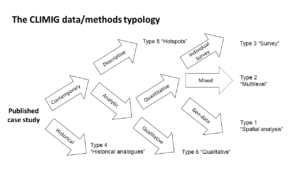
Specific attention is devoted to research methods. CliMig distinguishes six families of research methods on the basis of chronology and data typification, according to the following scheme:
Cross-tabulated searches are possible, enabling the user to easily spot the publications that have, for example, conducted surveys on environmental migration in Bangladesh during the last five years or qualitative studies in Africa focused on gender issues in the context of environmental change.
It should be noted that what sets CliMig apart from the more generic bibliographic databases such as Scopus, Google Scholar or the Web of Science is the ‘harmonization’ of key words for each chosen article. Take, for example, a researcher trying to identify all empirical studies on “environmental migration” employing “surveys”: a Scopus search might miss studies utilizing “questionnaires” but would include studies on the migration of birds. In CliMig, all relevant studies employing questionnaires, surveys, and so on are tagged with the “Type 3” methodological keyword and are retrievable within seconds. The CliMig database search is therefore more exhaustive and avoids “false positive” matches. Comparative tests have demonstrated that CliMig produces much more comprehensive search results than keyword searches on Scopus or the Web of Science (Piguet 2022).
Try it!
You can see an example of CliMig here https://climig.com in WordPress format, but this is only a demo version that is not updated, offering limited search possibilities. If you want to use the most up-to-date database to perform advanced research by keywords, type of hazards, etc., the CliMig team is happy to share a complete open access file in EndNote format for free. The file is easily converted to other citation management software formats such as Zotero, RefWorks, and Mendeley.
Contact us at Climig@unine.ch!
KEYWORDS: Internal displacement, migration, climate change, database
Etienne Piguet is professor at the Institute of Geography, University of Neuchâtel and has been researching the environment-mobility nexus for over 20 years.
Chiara Bernasconi is a PhD Student at the University of Neuchâtel. Her research focuses on mobility-related climate change adaptation strategies in Cuba.
Issa Mballo is a doctoral student working on perceptions of climate change and mobility intentionality in Senegal.
Bibliography
Balgah, R. A. & J. N. Kimengsi (2022) A review of drivers of environmental non-migration decisions in Africa. Regional Environmental Change, 22, 125.
Borderon, M., P. Sakdapolrak, R. Muttarak, E. Kebede, R. Pagogna & E. Sporer (2019) Migration influenced by environmental change in Africa: A systematic review of empirical evidence. Demographic Research, 41, 491-544.
de Sherbinin, A., K. Grace, S. McDermid, K. van der Geest, M. J. Puma & A. Bell (2022) Migration Theory in Climate Mobility Research. Frontiers in Climate, 4.
Piguet, E. (2022) Linking climate change, environmental degradation, and migration: An update after 10 years. WIREs Climate Change, 13, e746.
Piguet, E., R. Kaenzig & J. Guélat (2018) The uneven geography of research on “environmental migration”. Population and Environment, 39, 357-383.
Annex 1: The CliMig Keywords
Area
CliMig assigns location keywords – for Continent, Area, Ecoregion, Country or, in certain cases, City.
Type
- Overview is used for syntheses or reviews of topics.
- Law is related to papers specifically dealing with legal issues and/or policies.
For empirical studies, CliMig has developed a specific typology:
Type 1: “Spatial analysis”: statistical models based on area characteristics (aggregated geographical data)
Type 2: “Multilevel”: multilevel analysis based on area and individual characteristics (combination of geographical and individual data)
Type 3: “Survey”: analysis of individual data based on sample surveys (n >100)
Type 4: “Historical analogues”: analysis based upon historical environmental change and migration (various types of data, most often archives)
Type 5: “Hot spots”: indexes of vulnerability, scenarios, regional descriptive case studies
Type 6: “Qualitative”: qualitative field case studies using ethnographic data and methods
Environmental hazard
- Flood: flooding, flash flood, rainfall variability, etc.
- Hurricane: typhoon, cyclone, storm, etc.
- SLR: sea level rise, slr, coastal erosion, etc.
- Drought: desertification, heat waves, dry, rainfall variability, land degradation, etc.
Focus
- DRR / EWS:disaster risk reduction / early-warning system in environmental migration
- Gender:studies dealing environmental migration with a special focus on gender issues
- Migadapt:migration as an adaptation response, as a strategy to cope with environmental degradations
- Perception:representations and perceptions of actors on climate change
- Statelessness:climate change induced statelessness
- Trapped:studies dealing with immobility and trapped populations
- Conflict: studies linking environmental migrations and conflicts
Annex 2: Keywords used at step 1 (Literature monitoring) to identify potential entries in CliMig
climate migration
climate migrants
climate migrant
climate refugees
climate refugee
environmental migrant
environmental migrants
forced environmental migrant
environmental-refugee-to-be
environmental emergency migrant
environmental emergency migrants
environmental forced migrant
environmental forced migrants
environmental displacees
eco-refugee
eco-refugees
ecologically displaced person
ecologically displaced people
environmentally motivated migrant
environmentally motivated migrants
environmentally motivated refugee
environmentally motivated refugees
climate change refugee
environmental motivated migrant
environmental motivated migrants
climigration
ecomigration
climate migration
climate change refugees
environmental displaced person
disaster refugee
disaster refugees
environmental displacee
climate-induced migration
environment migration
klimaflüchtling
klimaflüchtlinge
klimawandel
klimaflucht
ökologisch motivierte flucht
klimazwangsmigranten
klimazwangsmigrant
umweltvertriebene
klimabedingte migration
klimawandelmigration
umweltbedingte migration
klimamigranten
klimamigrant
migrations climatiques
migration climatique
migrants climatiques
migrant climatique
réfugié climatique
réfugié environnemental
migrants environnementaux
migrant environnemental
réfugié de l’environnement
réfugiés de l’environnement
réfugiés climatiques
réfugié climatique
écoréfugié
écoréfugiés
réfugiés environnementaux
migrations du climat
migration du climat
réfugié écologique
réfugiés écologiques