
States are currently engaged in negotiating what is likely to become the first-ever global treaty on the Protection of Persons in the Event of Disasters (PPED treaty). Building on the International Law Commission’s (ILC) 2016 Draft Articles with the same name, the treaty aims to fill a longstanding gap in international law by establishing a comprehensive legal framework to enhance the protection of people affected by disasters, including through greater international cooperation and disaster risk reduction (DRR).
With adoption envisaged at a diplomatic conference in early 2027 in the Philippines, negotiations are now entering a critical phase. As part of the negotiating process, States were invited to submit written proposals for amendments to the text of the Draft Articles by the end of 2025. Thirty governments, the European Union and the International Federation of Red Cross and Red Crescent Societies (IFRC) responded to this call. These proposals were discussed at a session of a special Working Group of the UN General Assembly’s Sixth Committee from 6 to 10 April 2026 in New York City, with a view to informing the preparation of a consolidated draft text by September 2026. Around 20 States participated in the session; not all States that submitted proposals of amendments were in attendance.
While the meeting offered valuable insights into States’ priorities and concerns, it also revealed a striking omission: despite its risks and incidence, disaster-related displacement remains only minimally reflected in the treaty’s text.
Key Themes from the Sixth Committee Discussions
The Working Group discussed States’ proposals in six thematic clusters: (1) general provisions (preamble and draft articles 1, 2, 3 and 18); (2) core obligations (draft articles 4, 5, 6 and 9); (3) international cooperation (draft articles 7, 8, 12); (4) the affected State (draft articles 10, 11, 13 and 14); (5) facilitation of external assistance (draft articles 15, 16 and 17); and (6) proposals for additional provisions.
Overall, the discussions revealed broad support for the existing structure and content of the Draft Articles as a template for the PPED treaty. States reaffirmed that the treaty’s overarching purposes would be to facilitate an adequate and effective response to disasters, and to reduce disaster risk (draft article 2). They reiterated the importance of certain core principles, including respect for human rights and human dignity (draft articles 4 and 5) and the provision of assistance in accordance with humanitarian principles (draft article 6). Several delegations also underscored the continued importance of State sovereignty and the principle of non-intervention as foundational to disaster cooperation.
At the same time, there was also strong recognition that the treaty should not be confined to the disaster response phase alone. Several States, such as Italy, the Philippines and the United Kingdom, emphasised that the treaty’s scope must extend to disaster risk reduction, reflecting the growing understanding that prevention, preparedness and resilience-building are integral to effective protection.
The definition of ‘disaster’ (draft article 3(a)) did arise in the discussions. States expressed support for explicitly excluding situations of armed conflict from the scope of the treaty, but proposals to more fundamentally revise the definition were not discussed. Several proposals, including those of Germany, Chile and the IFRC, advocated that the definition used by the United Nations Office for Disaster Risk Reduction (UNDRR) should be adopted instead. It defines disasters as ‘a serious disruption of the functioning of a community or a society at any scale due to hazardous events interacting with conditions of exposure, vulnerability and capacity, leading to one or more of the following: human, material, economic and environmental losses and impacts’. While this definition reflects contemporary understandings of disaster risk, including its underlying drivers, States did not engage in sustained debate on the issue during the session.
A further recurring theme was the position of developing countries. A number of States, including Cameroon (on behalf of the African Group), China, Iran, Nigeria, the Philippines, as well as the United Kingdom, stressed their particular vulnerability to disasters—especially in the context of climate change—and called for enhanced provisions on international cooperation. This included support for more explicit references to technology transfer, capacity building, and the sharing of technical expertise and early warning systems. Although not specifically mentioned, this could potentially include assistance with evacuations.
Yet, the obligations of affected States in relation to external assistance continue to be sensitive. While there was agreement that the affected State bears primary responsibility for protecting persons within its territory, several delegations resisted framing the duty of the affected State to seek external assistance as a binding legal obligation (draft article 11), favouring instead softer formulations of a ‘strong encouragement’ or ‘expectation’ to seek assistance when its response capacity is overwhelmed. Similarly, concerns were raised regarding the provision that consent to external assistance must not be withheld ‘arbitrarily’ (draft article 13(2)), with some States questioning its clarity and its alignment with existing State practice.
The Missing Piece: Displacement
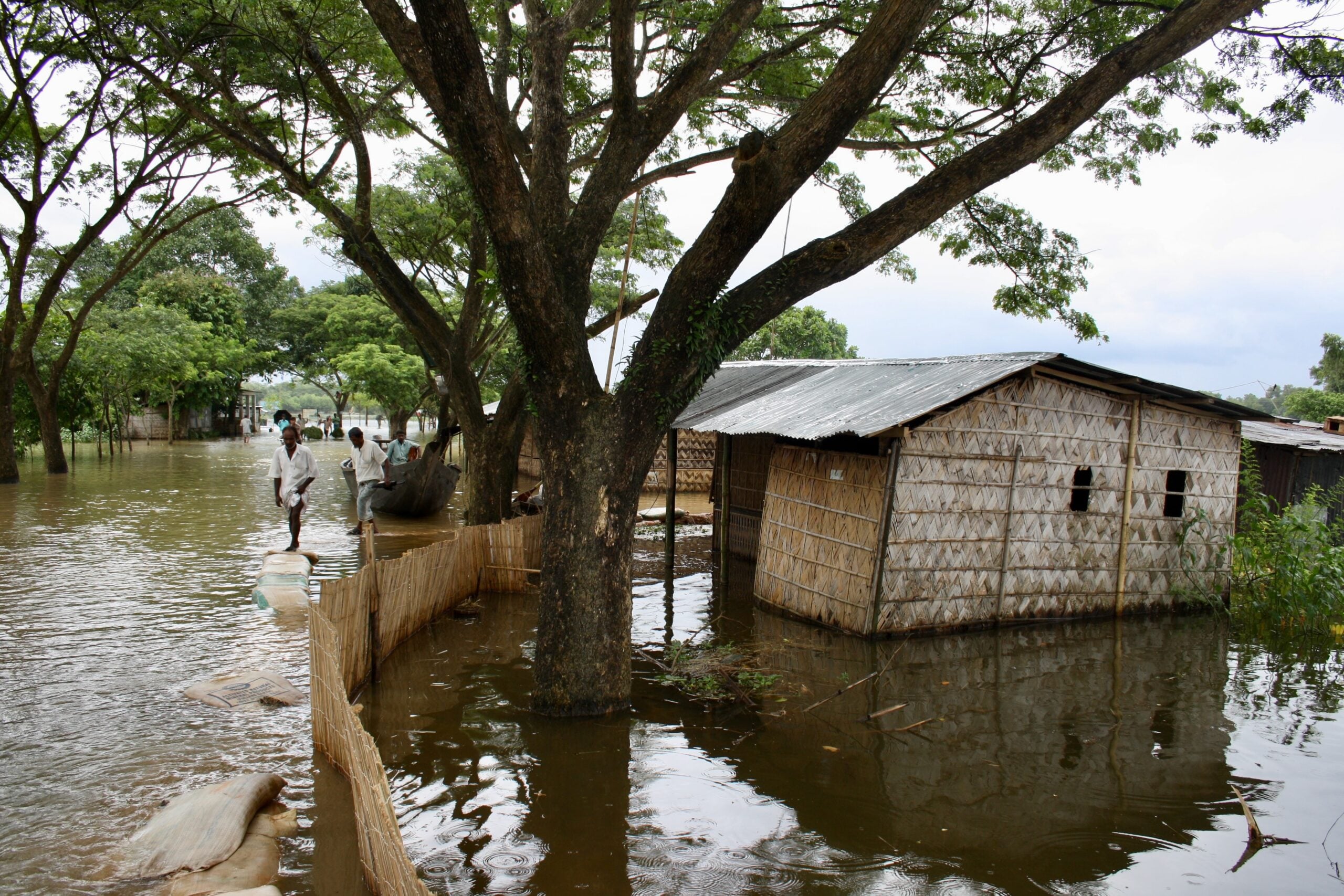
Against this backdrop, the continued absence of displacement from substantive discussions is difficult to ignore. This omission is particularly striking given the scale and significance of disaster-related displacement globally. Nearly every second, somewhere in the world, a person is displaced by a disaster. In 2024 alone, an estimated 65.8 million internal displacements were recorded, with almost 70 per cent triggered by disasters rather than conflict. Recent events illustrate the risks and incidence of disaster-related displacement. Large-scale flooding across Southeast Asia in late 2025 forced millions of people from their homes, while cyclones and floods in Mozambique triggered widespread and recurrent displacement. These events are not exceptional—they are emblematic of a broader global pattern in which disasters increasingly translate into large-scale human mobility.
Since the adoption of the Draft Articles in 2016, there has been a marked evolution in both State practice and regional frameworks, which increasingly recognise displacement as a central feature of disasters, especially in the context of intensifying climate-related hazards. Across multiple regions, governments have begun to integrate disaster-related mobility into legal and policy frameworks. In the Pacific, States have committed to incorporating climate mobility into disaster risk reduction planning, reflecting the acute exposure of many communities to sea-level rise and extreme weather. Similar approaches can be seen in regional action plans implementing the Sendai Framework for Disaster Risk Reduction, which increasingly address displacement and human mobility. In Latin America, for example, the Cartagena +40 process includes operational programmes focused on disaster displacement, while in Africa, States have endorsed strengthened cooperation on this issue through the Kampala Ministerial Declaration.
States including Brazil, South Africa, Nigeria, Indonesia and Switzerland have previously drawn attention to the scale and implications of disaster-related displacement in the context of the PPED treaty. For instance, Indonesia expressed support for any efforts to refine the text ‘to address evolving realities—including climate-induced and transboundary disasters and the growing challenge of displacement.’
Yet, these concerns were largely absent from the most recent discussions in April 2026. The sole reference came from Portugal, which observed that displacement is mentioned only in passing in the definition of disaster and is otherwise overlooked. Even this limited reference is now at risk: proposals to align the treaty’s definition of disaster with that of the UNDRR could result in the removal of any mention of displacement altogether.
This silence is not merely a technical oversight. It risks sidelining one of the most common and consequential impacts of disasters at precisely the moment when States are shaping the legal framework intended to address them.
Why Displacement Matters for the PPED Treaty
In a 2025 Policy Brief, we outlined a series of targeted amendments that would better recognise displacement in the PPED treaty. These amendments do not seek to expand the treaty’s scope, but rather to clarify and strengthen its existing provisions in light of established practice. They include:
- incorporating references to displacement in the preamble;
- recognising evacuations and planned relocations as forms of disaster risk reduction; and
- clarifying that international cooperation may encompass evacuation assistance and access to humanitarian visas.
Such measures would reflect what many States are already doing in practice. Authorities regularly carry out evacuations in anticipation of or response to disasters, and an increasing number of countries have undertaken planned relocations in areas exposed to recurrent hazards such as flooding and coastal erosion.
Explicitly acknowledging the risks and incidence of displacement in the treaty could yield several benefits. It would provide clearer normative guidance for States, supporting the development of more consistent legal and policy frameworks at the regional and national level. This includes standards for evacuation planning, shelter management and long-term recovery, areas where significant gaps remain. It could also enhance coordination in international responses and influence funding priorities, encouraging donors and States to invest in inclusive DRR strategies that take displacement into account.
More fundamentally, recognising displacement would reinforce the treaty’s central objective: the protection of persons in the event of disasters. Displacement is not a peripheral consequence of disasters; it is often one of the primary ways in which people experience their impacts.
Looking Ahead
As the PPED treaty negotiations process moves forward, there is still a window of opportunity to address the displacement gap. The relative absence of displacement in the Working Group discussions suggests that it is not currently front of mind for many States. Yet, this is precisely why it warrants renewed attention.
If the treaty is to provide a meaningful and forward-looking framework for the protection of persons affected by disasters, it must engage more directly with the realities of displacement. Failing to do so risks entrenching a treaty that overlooks one of the defining features—and challenges—of disasters.
The inclusion of displacement is not an optional add-on. It is a core component of effective disaster preparedness, response and recovery—and, ultimately, of the protection that this treaty seeks to ensure.
Thomas Mulder is a Laureate Postdoctoral Fellow at the Evacuations Research Hub, Kaldor Centre for International Refugee Law, UNSW Sydney. His research focuses on humanitarian and human rights issues related to evacuations, with particular expertise in international disaster law, international humanitarian law and human rights law. He examines how States and non-State actors share responsibilities for protecting individuals in times of emergency.
Jane McAdam AO is an Australian Research Council Laureate Fellow and Scientia Professor of Law at the Kaldor Centre for International Refugee Law, UNSW Sydney, where she leads the Evacuations Research Hub. She publishes widely in the areas of international refugee law and forced migration, with a particular focus on evacuations and mobility in the context of climate change and disasters.
KEYWORDS: Treaty on the Protection of Persons in the Event of Disasters, Displacement, Evacuations, Climate Change, International Cooperation
Selected bibliography
Report of the United Nations Secretary General, Compilation of Proposals for Amendments to the Draft Articles on the Protection of Persons in the Event of Disasters, UN doc A/80/610 (2026)
Jane McAdam and Thomas Mulder, Foregrounding Displacement and Evacuations in the Proposed Treaty on the Protection of Persons in the event of Disasters (Kaldor Centre for International Refugee Law, Policy Brief 17, May 2025)
Jane McAdam, ‘Incorporating Displacement into the Treaty on the Protection of Persons in the Event of Disasters’ (Technical Briefing, Geneva, 23 March 2026)
IFRC Disaster Law webpage, Treaty on the Protection of Persons in the Event of Disasters