
Introduction
The recent polls by the Public Opinion Foundation, a Russian organisation conducting weekly sociological research since 1992, demonstrate an increase in the anxiety level of people living in Russia, reaching 57% on July 29, 2026 (Public Opinion Foundation, July 2026) compared to a low of 38% in late January and early February of 2026. This change is quite understandable, given the latest news from Russia.
Planned as “a three-day special military operation,” the 2022 Russian invasion has lasted for more than 1600 days and has become a full-blown war, in which Ukraine seem to have turned the tide. The ongoing Ukrainian attacks on Russian military infrastructure and oil refineries aim to damage the Russian economy, which may eventually persuade Russia to stop the aggression. The top exports, gas and oil, account for a quarter of the Russian economy, but even before the ongoing Ukrainian attacks on the oil infrastructure, revenue from gas and oil sales had declined significantly (Reuters, 2026). The current near-daily attacks have led to fuel rationing in 56 regions in Russia by June 26, 2026, and in 88 regions[1] by June 30, 2026. The fuel crisis continues.
In addition to the attacks, the sanctions imposed on Russia, and the length of the Russo-Ukrainian war, which has already outlasted WWI and the Great Patriotic War,[2] are taking their toll on Russians, especially on internally displaced persons (IDPs). The vulnerability of Russian IDPs is exacerbated by the lack of protection due to the absence of the term “internally displaced person” in the Russian legal system, as discussed at length in a 2025 article I wrote on unwanted and unrecognised displaced people. Since then, no new policies on IDPs have been adopted, but the war has escalated and spread deeper into Russian territory, leading to a gradually increasing number of IDPs and creating unexpected complications for the government. This article will analyse internal displacement in Belgorod, Bryansk, and Kursk, which, due to their proximity to the Ukrainian border, are the regions in Russia most impacted by the ongoing armed conflict and how the authorities address the issue since the war came to Russian soil.
Belgorod Region
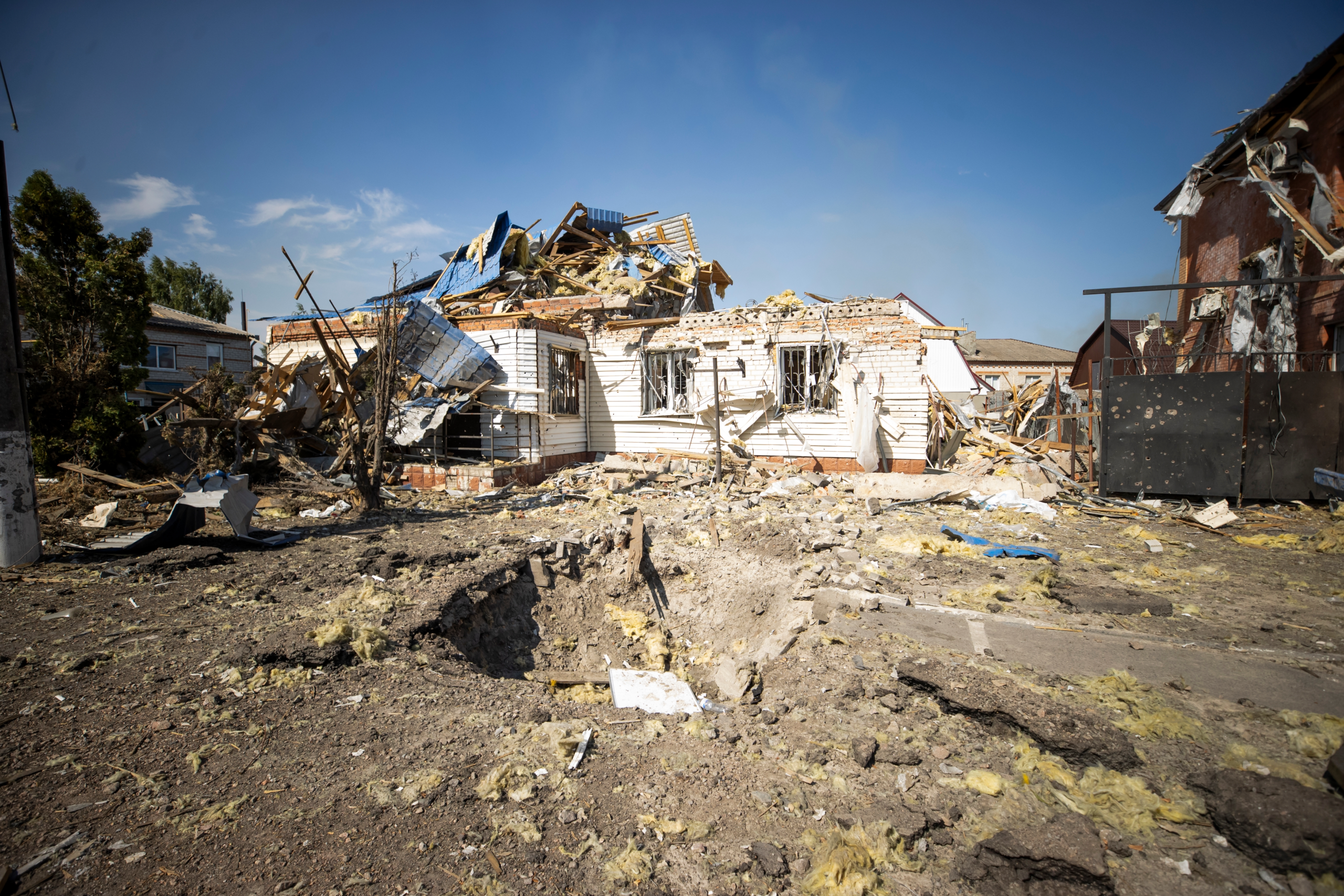
The Belgorod region is located in southwestern Russia and borders the Kharkiv region of Ukraine. Before the Russo-Ukrainian war started in 2014, travelling to Kharkiv was commonplace for people living in the Belgorod region, as Kharkiv, being the second-largest city in Ukraine, was attractive for its developed entertainment and shopping infrastructure and a newly renovated international airport for the 2012 UEFA Cup. However, the region's geographical location and its administrative centre, Belgorod (72 km from Kharkiv and 40 km from the Ukrainian border), has made it “a critical focal point” in the war due to its proximity to Ukrainian territory and strategic importance.” As a result, the Belgorod region was the first in Russia to feel the war's negative consequences. After Russia announced a drastic reduction of “its military assault on the Ukrainian cities of Kyiv and Chernihiv” at the end of March 2022, Ukraine began its counterattack on Russia, including the Belgorod region. Since then, shelling of the city of Belgorod and its region has “become habitual.” For example, according to the interim governor of the Belgorod region, Alexander Shuvaev, it was attacked 132 times on August 23, 2026. Constant bombardment and the 2023 short-term cross-border incursion of Ukrainian troops into the region have impacted civilians significantly.
To provide protection, the Russian government imposed a number of measures. First, on April 11, 2022, the terrorism alert level was increased to yellow (high). According to the previous version of the Presidential Decree of June 14, 2012, № 851 (Article 8), the terrorism threat level may be set for no more than 15 days; however, because of the ongoing threats, the terrorism alert level had to be extended in the Belgorod region every fortnight. However, on February 4, 2023, the time limit was removed by another Presidential decree and, as such, the terrorism alert has been extended indefinitely.
It should be noted that the high terrorism alert level aims to prevent potential terrorist acts by allowing security forces to implement special measures, including conducting searches of any transportation vehicle and strengthening residency controls over Russian citizens and foreigners. According to Article 18 of the Russian Federal Law On Countering Terrorism (#35-FZ), victims of terrorist attacks are entitled to financial subsidies, but these do not happen automatically. Nevertheless, the then-governor of the Belgorod region, Vyacheslav Gladkov, announced regional monetary compensation for residents affected by shelling: 3 million rubles (approximately USD39,000) to the families of the deceased and 500,000 rubles (USD6,500) to the injured. Unfortunately, there is no data on how many of those payments were made to IDPs.
The second measure was the implementation of the counter-terrorism regime. Initially, it was activated on May 22, 2023, following a cross-border incursion, but it was active for only 24 hours. Then, on August 9, 2024, after Ukrainian troops crossed the border in the Kursk region, the counter-terrorism regime was imposed again and has since remained in place. However, the main purpose of this regime is the same as the high terrorism alert, which is to avert terrorist attacks. Therefore, the special forces are granted additional powers, such as checking identification documents upon request, detention if the mentioned documents are not presented, monitoring of phone calls and information exchanged via the Internet, and restrictions on vehicle and pedestrian traffic. Simultaneously, the regime allows for the temporary relocation of people from affected areas to safe places, and in such cases, temporary housing or shelter should be provided. The exact number of IDPs protected by this measure is unknown.
Finally, various states of emergency were implemented in the Belgorod region. A state of emergency is declared in accordance with the Federal Law On the Protection of Population and Territories from Natural and Man-Made Emergencies (#68-FZ). Article 1 of the law defines an emergency as “a situation in a specific area that has developed as a result of an accident, dangerous natural phenomenon, catastrophe, spread of a disease that poses a danger to others, natural disaster or other calamity that may result or has resulted in human casualties, damage to human health or the environment, significant material losses and disruption to people’s living conditions”. It can be easily noted that armed conflicts and their impacts are not listed in the abovementioned law; nevertheless, this policy was widely applied by Russian regional authorities while dealing with significant increases in the number of Ukrainian citizens seeking refuge in Russia in 2014 and 2022 and, later, to protect IDPs in the frontline regions (Bagdasaryan, 2023). In the absence of legal guidelines to protect IDPs, 68-FZ is the only policy that allows federal and regional governments to support IDPs financially. For example, from March to November 2022, a state of emergency was gradually implemented in 15 villages in the Belgorod region, meaning that residents were evacuated with no right to return. As a result, 3,700 people became IDPs. Some of these people were relocated to temporary shelters, some moved in with their family members, and others rented apartments. Only in October 2022 did the regional government decide to provide compensation to IDPs to offset housing costs, even though a state of emergency in the first two villages was implemented in March 2022. Eight hundred families were entitled to compensation of 10,000 rubles (USD130) per family and 15,000 rubles (USD195) per family with three or more children. Additionally, each family member also received a one-time payment of 10,000 rubles (USD130).
However, in July 2024, another 14 villages were closed despite no declaration of a state of emergency, though the evacuated inhabitants were also entitled to the increased rental compensation: 15,000 rubles (USD190) and 30,000 rubles (USD385) for families with three or more children, amounts which increased in November 2024 t to 20,000 rubles (USD257) and 40,000 rubles (USD515), respectively. Nevertheless, these compensations were temporary, with the announcement of these increases also stating that compensation would only be paid until March 2025, leaving IDPs in limbo.
Thus, the provision of financial assistance to IDPs is dependent upon the political will of the authorities. Moreover, it is unclear how these villages were chosen. People from several villages and small towns located near the Ukrainian border complained that they had to flee because of the ongoing shelling, but since their places of origin were on the list of closed areas or under a state of emergency, those IDPs did not receive any financial support from the government.
The most striking example is the town of Shebekino, not so long ago a thriving town located 7 km from the Ukrainian border, with a population of approximately 40,000 and around 20 plants and factories, including one producing pasta widely known in Russia (Шебекинские, or Shebekinskie). Shebekino has been constantly shelled since March 2022, but the full-scale war came to the town in June 2023, following the cross-border incursion. As a result, only 2,700 inhabitants stayed in Shebekino. Although a state of emergency was never declared in the town and only about 4,000 people were officially evacuated, most of the inhabitants had to flee without any government support.
After the Ukrainian troops crossed the border in the Kursk region on August 6, 2024, the state of emergency in the Belgorod region was expanded from the regional to the federal level. Additionally, this shift led to increased and expanded compensation for IDPs, including one-time payments of 15,000 rubles (USD190), 75,000 rubles (USD960) for partial loss of essential property, and 150,000 rubles (USD1,930) for total loss of property. The increased amounts, however, rarely covered the losses of IDPs. Also, the Telegram channel Pepel Belgorod regularly reported that receiving these payments was highly bureaucratic and time-consuming. Moreover, some families were accused of forging documents, and their right to receive compensation was revoked, while others, due to the bad conditions in shelters, preferred to return to their unsafe homes. In April 2026, the regional authorities began postponing rental compensation payments, while IDPs confirmed they had not received any payments since December 2025, despite a tranche of 2 billion rubles (USD256,750) confirmed in February 2026 from the federal budget. An additional tranche for the same amount was transferred to the Belgorod region in May 2026 to support 316 displaced families. However, the widening federal budget deficit, driven by the continued rise in Russian military spending and a decline in oil and gas earnings, may eventually lead to a reduction or even the cancellation of financial support for IPDs.
Additionally, only IDPs who stayed within the Belgorod region were eligible for these payments, as the then-governor acknowledged that he did not want educated people, such as teachers and doctors, to leave the region. It is known that in November 2022, some IDPs from the Belgorod region moved to the Moscow and Tula regions, and those regions adopted policies to support IDPs, including covering travel fares.
The Moscow region hosted 580 IDPs from the Belgorod region, who were eligible for a monthly rental compensation of 30,000 rubles (USD380) per family. The subsidy was to be paid from November 2022 for the next six months, and a search of the region’s legal database demonstrates that the compensation was not extended beyond that. Additionally, the policy supported only IDPs from the Belgorod region, not from any other region.
The Tula region also has issued a number of protection and compensatory measures intended to support IPDs, including 300 from the Belgorod region. In June 2023, those IDPs received a one-time payment of 10,000 rubles (USD130) and monthly rental compensation for those staying in shelters: 20,000 rubles (USD258) for single individuals and 30,000 rubles (USD387) for families (regional decree N416-ocн). The payments were intended to be made until March 1, 2026. Later, the payments were extended until June 1, 2026 and, later, once again to September 1, 2026, making the Tula region the only one that continues to support IDPs who arrived from the frontline regions. On May 19, 2026, the governor of the Tula region issued Resolution No. 264, which limits the right to stay in temporary shelters to people with disabilities and their family members or persons taking care of the mentioned disabled people; orphans and children left without parental care can also stay in temporary shelters. The resolution came into force on September 1, 2026, thereby making some IDPs homeless.
Furthermore, on May 27, 2026, the new Tula policy implemented rental compensation only to IDPs and refugees who were staying in temporary shelters as of May 19, 2026, and who either have three or more children, are pensioners (usually seniors 60+), or are persons with disabilities. The payments will be made until April 1, 2027. It should be noted that the limits of the mentioned policies, such as time limits, arrival dates, and categories of people entitled to payments, deprive other IPDs who do not meet the requirements of the right to receive compensation. However, the Tula policy provides protection to IDPs from all Russian frontline regions.
Another measure, announced in 2023 by the Belgorod authorities, is the replacement of lost property for IDPs. According to the interim governor, since 2022, 5,366 of the 6,490 families who lost their homes have already received new houses, apartments, or housing certificates. There are several issues with the policy's implementation. First, it heavily depends on federal tranches, which may be reduced or stopped abruptly. Second, at present, when the whole Belgorod region is under constant shelling, it is unclear how safe these residences would be for IDPs and how the region can keep up with building so many new houses amidst the war. Third, by February 2026, the number of closed-down and evacuated towns and villages had reached 43, with more that may be unsafe to live in, causing more people to flee.
Despite protection and compensation measures, people, including IDPs, have continued to leave the region. Thus, in November 2025, the then-governor announced that at least 60,000 people had departed, mostly families with children from the frontline districts, but even he could not name the exact number of people who had moved away. Meanwhile, in July 2024, the regional statistics department stated that 68,991 people left the region, but this was based only on data for 2022 (37,509 people) and 2023 (31,482 people), as there was no 2024 data yet. By the end of April, the number of IDPs staying in shelters was 1917. However, it is unclear how reliable the statistics were. Many people likely left the region without informing the authorities or applying for compensation. This assumption is indirectly confirmed by the significantly increased demand for foreign employees in the region to address labour shortages: in 2026, the regional authorities approved hiring 1,300 foreign employees, which is three times as many as in 2025 and 17 times as many as in 2024.
Bryansk region
The Bryansk region is in western Russia and is the only Russian region that borders both Ukraine (Chernihiv and Sumy regions) and Belarus (Homyel and Mahilyow regions). From 1969 to 2013, this three-border crossroad was used for the Festival of Friendship. Also, on May 3, 1975, a monument called Three Sisters was opened to symbolize “the friendship of peoples.” However, the Bryansk region's unique location was actively used by the Russian army in February 2022 to deploy troops to northern Ukraine, as it offers the shortest route to Kyiv. The residents of the Bryansk region mentioned that even before February 24, 2022, the day when the full-scale invasion started, the region was “flooded with [Russian] soldiers.” As in the Belgorod region, after Russia withdrew its troops from Kyiv and Chernihiv, the war reached the Bryansk region. The first shelling of the region occurred on April 14, 2022, and later became daily attacks, adversely affecting civilians. Moreover, the Bryansk region was the first to experience a cross-border incursion on March 2, 2023.
The following protective measures were taken by the federal and Bryansk regional authorities. Similar to the Belgorod region, the terrorism alert level was raised to yellow (high) on April 11, 2022 and was extended every 15 days until February 4, 2023, after which the high terrorist alert level was extended indefinitely. Additionally, on August 9, 2024, after the Ukrainian troops entered the Kursk region, the counter-terrorism regime was imposed in the Bryansk region and still remains active. Again, it should be mentioned that these measures aim to prevent terrorist attacks, not to protect civilians.
For the first time, a regional state of emergency was declared in a district that was shelled (on April 14, 2022), and it remained in effect until April 18, 2022. From an interview with Alexander Bogomaz, the then-governor, it is known that people who suffered from that shelling were entitled to compensation for physical injuries: minor, 200,000 rubles (USD2,550) and severe, 400,000 rubles (USD5110). It was also mentioned that the owners of damaged houses and vehicles were to be compensated, and a total of 46 million rubles (USD58,760) would be spent on that.
Subsequently, a regional state of emergency was declared on multiple occasions. A search of the regional database shows that since 2023, at least 24 decrees have declared or cancelled a state of emergency in the various districts of the Bryansk region. Shelling was the primary cause of the emergency, but in two cases, it was flooding (in April 2023 and April 2024). The latest decree of June 18, 2026 covers 77 towns, villages and even parts of highways and motorways where the state of emergency was declared. As of May 2025, people who live in the designated areas are entitled to one-time payments (15,675 rubles/USD200), compensation for partial and total property loss (78,375 rubles/USD1,003 and 156,750 rubles/USD2,006, respectively), compensation for minor injuries (313,500 rubles/≈USD4,012) and severe injuries (627,000 rubles/USD8,025), and payments to families of the deceased (1,567,500 rubles/USD20,064).
The Bryansk authorities have never evacuated any people from the areas under the state of emergency but have prepared temporary shelters for IDPs. However, in 2024, the then-governor stated that 12 shelters were ready to welcome 1,580 people and that, if necessary, it was possible to make available additional shelters for 32,000 people. However, the number of IDPs has never reached that level. By June 5, 2026, the Bryansk region hosted 184 IDPs, including 39 children, in the three temporary shelters. It should be noted that the number of IDPs includes those displaced from the Bryansk and Kursk regions as well as refugees from the occupied regions of Ukraine, as the Russian Constitution considers those as part of Russia. Therefore, it is unknown how many IDPs are from the Bryansk region and how many of them have decided to move to other regions of the country.
Since there is no independent media in the Bryansk region, it is impossible to determine the level of difficulties people face in applying for and receiving this compensation. However, even the interim governor, Egor Kovalchuk, acknowledged the high level of bureaucracy required to submit applications and the long waiting period for payments, and once again called for the process to be simplified and sped up. Additionally, since the declared states of emergency are regional, they are funded from the regional budget, whose deficit has increased to 13.5 billion rubles (USD17.2 million). To support the region financially, the federal authorities wrote down the regional debt, reducing it to 7.6 billion rubles (USD97 million), and postponed some payments on regional credits from 2026 to 2030, which demonstrates the high dependency of the region on state funding, including that supporting civilians affected by the war.
Kursk region
The Kursk region is located in western Russia and borders the Bryansk region to the north, the Belgorod region to the south, and the Sumy region to the west. Before the annexation of Crimea and Russian military support of the separatist movement in eastern Ukraine, people from the Kursk and Sumy regions were highly interconnected. The research shows that there was no physical border, and many families lived on both sides and frequently visited each other without issue. From 2014 onward, crossing the border became more challenging, with increased document checks and even bans on crossing, but it was still possible. Everything changed in the fall of 2021, when the region, especially the districts that closed the Ukrainian border, became full of Russian soldiers and military equipment (Public Sociology Laboratory, 2025). According to the Russian authorities, troop deployment was just for the purpose of “military drills”, though days later, it became a full-scale invasion of Ukraine. Like other Russian frontline regions, Kursk was used as a platform for the invasion.
The first attack on the region occurred at the end of February 2022, and by December 2024, it had been bombarded more than 1,900 times. However, the situation in the Kursk region significantly differs from that in Belgorod and Bryansk. On August 6, 2024, Ukrainian troops crossed the Russian border and took control of part of the Kursk region, causing the largest displacement in modern-day Russian history, displacing as many as 150,000 people. As this displacement event and supporting governmental measures, including housing certificates and various financial compensations, were examined in detail in the article published in May 2025, here I focus on how the situation has evolved since then.
Currently, in the Kursk region, similar to other frontline regions, the following measures have taken place:
- The yellow (high) level of the terrorist alert, which was established on April 11, 2022, was extended every 15 days until it was indefinitely extended on February 4, 2023.
- The counter-terrorism regime has been active since August 9, 2024. Moreover, the situation in the Kursk region became the model for similar regimes in the Belgorod and Bryansk regions.
- A federal state of emergency was declared on August 9, 2024, replacing the regional state of emergency that had been active only for two days.
Official statistics show that by the end of March 2026, 3,662 IDPs were housed in 45 temporary shelters, a reduction from approximately 7,000 IDPs hosted in 95 shelters in August 2024.
Also, Governor Alexander Khinstein claims that approximately 16,000 out of 112,600 entitled individuals have already received housing certificates, which allow people who lost property in the fighting to receive a certificate permitting them to purchase a new house or apartment. To fund the housing certificates and other measures, the region spent about 248 billion rubles (USD 3 billion), including 17,3 billion rubles (USD 220 million) on one-time payments, 7,8 billion rubles (≈USD 99 million) for rental compensation, and 104 billion rubles (USD 1,3 billion) on housing certificates. This amount accounts for more than the region’s annual budget and was funded by the federal government (Tass, 2026). However, the distribution of housing certificates led to a significant increase in property prices in the Kursk region.
According to the governor, there are currently 65 measures to support IDPs displaced within the Kursk region, including:
- One-time payments of 15,675 rubles (USD 200)
- Rental compensation: 20,000 rubles (USD 254) for most families and 40,000 rubles (≈USD 509) for families with three or more children
- Compensation for property loss: 78,375 rubles (USD 997) for a partial loss and 156,750 rubles (USD 1,994) for a total loss.
- Compensation for health injuries: minor 300,000 rubles (USD 3,817), severe 600,000 rubles (USD 7,635).
- Compensation for a family of deceased: 1,500,000 rubles (USD 19,089);
- One-time subsidy for IDPs who had babies born between August 6, 2024 and May 1, 2025: 150,000 rubles (USD 1,908).
Despite these measures, IDPs regularly complain about the highly bureaucratic application process and the very slow distribution of housing certificates, which is confirmed by the numbers above. The main obstacle for receiving certificates is the evaluation of the previously owned damaged property. Since 122 towns and villages in six districts of the Kursk region are still closed to civilians, it is physically impossible to send inspectors there, while using drones to take pictures or videos of ruined houses is rare. Also, IDPs are eligible to receive a certificate only once, so those who own two houses can be compensated for only one property (Maxim Katz, 2026). Therefore, it is unknown when and how fully IDPs will be compensated.
Another big issue is the significant reduction in rental compensation. The announced sums of 65,000 rubles were supposed to be paid until the termination of the counter-terrorism regime in the region. However, in December 2025, the program was cancelled, and two new programs with reduced compensation rates were introduced. IDPs protested against this change in December 2025 and March 2026, but it did not lead to any improvements. Moreover, some of the protestors reported being threatened by the local police (Vot-Tak, 2026).
It is unknown when IDPs can return to their homes, since, as mentioned before, six of Kursk’s border districts are still closed. The main obstacles are the ongoing armed conflict and mines left after the active fighting in the Kursk region from August 2024 to March 2025. The demining process is estimated to take from just over a year to 3-5 years. In substance, the demining process is quite time-consuming and expensive, but in the case of the Kursk region, it is also complicated by the active armed conflict. Even if the demining process is completed despite all the obstacles, it will still be challenging for IDPs to go back. They will have to rebuild their houses and renovate heating and sewerage systems, which require special equipment that may not be available or even usable during the ongoing war. These factors have motivated people to leave the Kursk region. Official statistics show that 32,700 people have moved to other Russian regions.
Conclusion
The absence of the category “internally displaced person” in the Russian legal system still makes the protection of IDPs highly dependent on the political will of the authorities and the capacity of the federal and regional budgets. Moreover, moving to another Russian region deprives IDPs of most support. For example, many IDPs who moved to the Tula region will become homeless after September 1, 2026, as support is withdrawn under the region’s new policy. Additionally, increased censorship and oppressive policies do not allow IDPs to stand up for their rights. The system is built in a way that IDPs can rely only on the government since no international humanitarian organisations are allowed to access those territories. Although the Russian Red Cross has distributed some compensation and basic goods, the organisation was accused of being highly affiliated with Russian government agents, who also indirectly funded those payments.
Unfortunately, there is no light at the end of the tunnel for IDPs in Russia. It is highly unlikely that the policy on IDPs will change to align with international norms in the near future. Also, the number of IDPs might increase as Ukrainians change their military tactics, affecting more and more Russian regions. Constant attacks on tankers of the Russian shadow fleet in the Black and Azov Seas, leading to oil spills, as well as on oil refineries, may cause displacement not only by war but also by the negative effects on the environment. It is doubtful that the government will be able to properly protect and support a larger number of IDPs in the current economic situation. Therefore, some fear the Russian authorities will downplay the atrocious effects of their “special military operation”, including IDPs and their needs, as acknowledging displacement and its effects would be an acknowledgement that not everything has gone according to plan.
Ekaterina Pesegova is a graduate of the master’s programme in Refugee Protection and Forced Migration Studies from the University of London and a professor at Free U (Latvia). Her academic pursuits revolve around temporary protection policies provided worldwide for Ukrainians after the full-scale Russian invasion. As an editor of the Researching Internal Displacement platform, Ekaterina focuses on informing audiences about forced displacement caused by active and frozen armed conflicts on the territory of the former Soviet Union.
KEYWORDS: IDPs, Displacement, Conflict, Russia, Ukraine
Selected bibliography
BAGDASARYAN, A., 2023. “Problematic Issues of Regulatory Regulation of the Functioning of Management Bodies and Forces of the Unified State System for the Prevention and Liquidation of Emergency Situations in the Reception of Refugees and Internally Displaced Persons and Ensuring their Livelihoods.”/ БАГДАСАРЯН А.О., “Проблемные Вопросы Нормативного Регулирования Функционирования Органов Управления и Сил Единой Государственной Системы Предупреждения и Ликвидации Чрезвычайных Ситуаций При Приёме Беженцев и Вынужденных Переселенцев и Обеспечении Их Жизнедеятельности.” https://cyberleninka.ru/article/n/problemnye-voprosy-normativnogo-regulirovaniya-funktsionirovaniya-organov-upravleniya-i-sil-edinoy-gosudarstvennoy-sistemy/viewer
FEDERAL LAW of 21.12. 1994 N 68-FZ “About Protection of the Population and the Territories against Emergency Situations of Natural and Technogenic Nature.”/Федеральный Закон от 21 декабря 1994 г. № 68-ФЗ “О Защите Населения и Территорий от Чрезвычайных Ситуаций Природного и Техногенного Характера.” https://www.consultant.ru/document/cons_doc_LAW_5295/
FEDERAL LAW of 06.03.2006 N35FZ “On Countering Terrorism.”/Федеральный закон от 06.03.2006 N 35-ФЗ "О противодействии терроризму" https://www.consultant.ru/document/cons_doc_LAW_58840/
LAW OF THE RUSSIAN FEDERATION of 19.02.1993 N4530-1 “On Forced Migrants.”/Закон РФ от 19.02.1993 N 4530-1"О вынужденных переселенцах" https://www.consultant.ru/document/cons_doc_LAW_4339/
PUBLIC SOCIOLOGY LABORATORY, 2025. Nothing Foretold Troubles. An Ethnography of the “Sudden” War in a Border Region. Analytical Report./ Лаборатория Публичной Социологии, 2025. Ничто Не Предвещало. Этнография.Аналитический отчет. https://publicsociologylab.com/reports/kursk.html
[1] According to Article 65 of the Constitution of the Russian Federation, the country consists of 89 regions, including six occupied regions of Ukraine: Donetsk People's Republic (Ukrainian – Donetsk region), Republic of Crimea, Lugansk People's Republic (Ukrainian – Lugansk region), Zaporozhye oblast (Ukrainian – Zaporizhzhia region), Kherson oblast, and Sevastopol.
[2] The term used in Russia and the former Soviet Union to define the period of WWII from the Nazi invasion of the USSR on June 22, 1941, to the capitulation of Nazi Germany on May 9, 1945.