
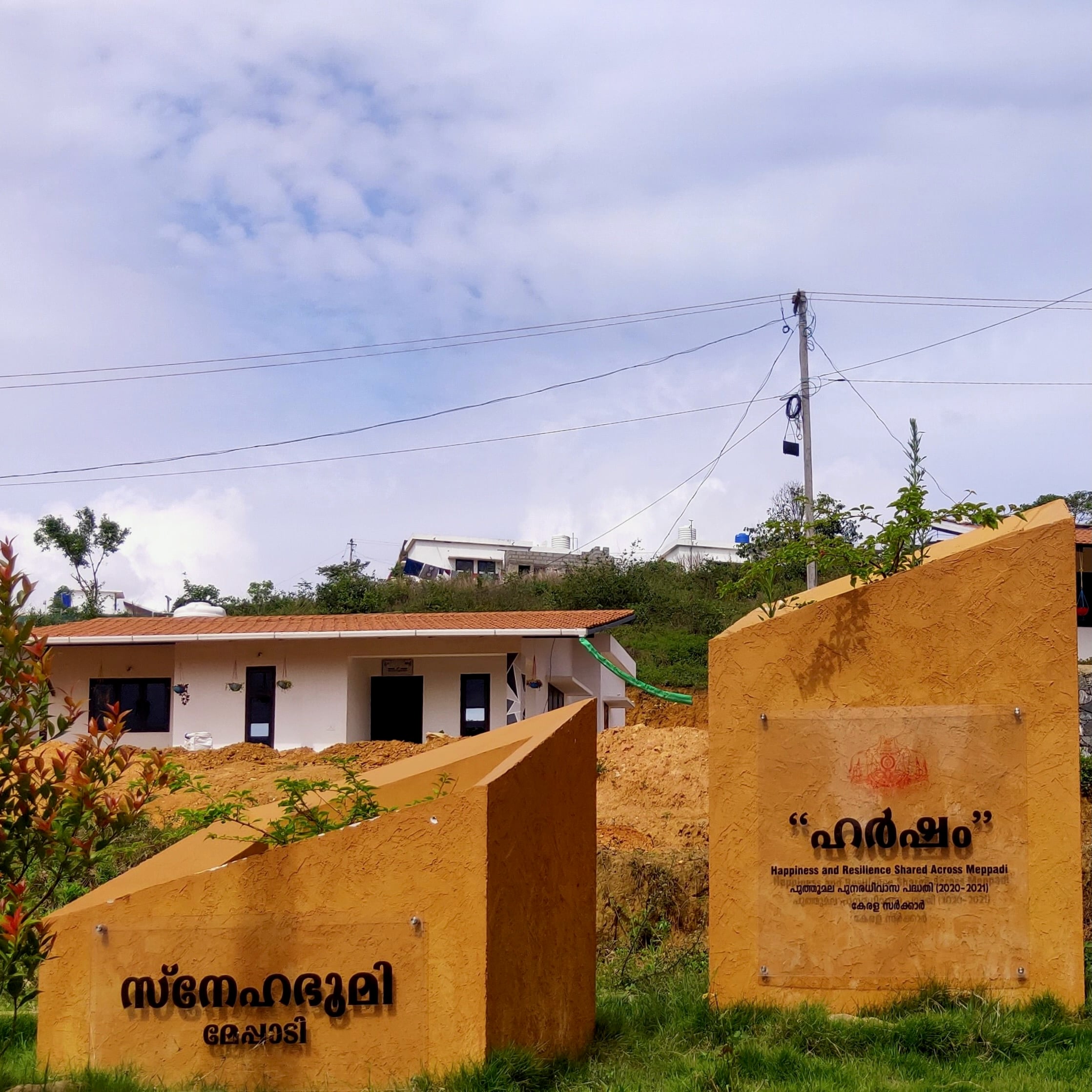
This article focuses on Project HARSHAM (Happiness and Resilience Shared Across Meppadi), the planned relocation initiative established after the Puthumala landslide of 2019 in the Wayanad district of Kerala, India. This article provides an overview of the experiences of relocated community members five years after relocation. It focuses on the relationship between the promises made, the practices implemented, and the reality of everyday life experienced by the residents. While Project HARSHAM provides permanent housing and a sense of security for many households, residents experience various challenges around housing quality, livelihood, community life and the absence of promised infrastructure. By centring community voices, this work seeks to draw lessons on how planned relocation processes can support relocated communities in the long term.
After losing their homes in the 2019 landslide, the families of Puthumala spent years in rental accommodation. For them, relocating into a permanent house in HARSHAM brought an end to a long period of uncertainty, offering relief and a renewed sense of security. However, the ground reality is rather more complicated: HARSHAM remains a reminder of what was lost, what was promised, and what remains unfinished.
Puthumala is no longer a village that its former residents remember. At around 4:30 p.m. on 8 August 2019, a debris-flow landslide swept through Puthumala village of Wayanad district, Kerala, India, destroying homes, livelihoods and much of the physical landscape in which everyday life was rooted. The disaster claimed 17 lives; 56 people were injured, and livestock was lost.
The area had experienced intense rainfall in the preceding days, with minor landslides reported before the major debris flow prompted residents to evacuate their homes and labour settlements (paddies). According to the District Disaster Management Authority (DDMA), the debris flow buried places of worship, paddies, community infrastructure, and 58 houses, while another 22 houses were damaged. In total, 105 households were affected, and approximately 170 acres of land were damaged. Once a vibrant, lush green village, Puthumala is now, for many of its former residents, only a memory.
The survivors trying to return to Puthumala realised that this was not merely a matter of rebuilding a house. The landslide had made the entire landscape unrecognisable. The government subsequently declared the village uninhabitable, since basic services and infrastructure were not restored and returning to Puthumala was not an option. This compelled the affected families to move to temporary shelters.
43 households from Puthumala received rupees 10 lakhs to seek shelter in places of their choice (1 lakh = 894 euros). The remaining displaced households expressed their desire to relocate together to one location, preserving community ties. Responding to this desire, project HARSHAM (Happiness and Resilience Shared Across Meppadi) was presented as a holistic rehabilitation program under the Rebuild Kerala Initiative (RKI) aiming to help residents rebuild their lives as a community and
create a 'new Puthumala". The name HARSHAM, meaning “happiness” in Malayalam, reflected this vision. The project was planned as a model township with shared spaces and facilities intended to support community living and nurture a sense of belonging.
Five years later, at the time of writing, HARSHAM presents a more complicated picture. The houses have been built, but some of the wider infrastructure envisioned for the township remains unrealised.
The planned relocation extended far beyond moving into new houses. The relocated community had to rebuild livelihoods, adapt to the spaces available to them, navigate gaps in everyday infrastructure and, over time, recreate the sense of community they once had in Puthumala. What unfolded between the envisioned township and the lived reality is the story of HARSHAM.
This article draws on fieldwork conducted in HARSHAM in May 2023 and through a series of field visits between July and August of 2026, including interviews, extended conversations with relocated residents, and field observations. The authors approached HARSHAM as researchers examining landslide-induced planned relocation and were not involved in the planning or implementation of the relocation. The two periods of field engagement provide an opportunity to reflect on how residents' experiences and the HARSHAM have evolved over time.
From Puthumala to HARSHAM: the promise of a new beginning and practices
Soon after the landslide, several proposals emerged for the rehabilitation of households displaced by the Puthumala landslide. The initial site identified by the Kerala government for the relocation was Vazhakkala Estate at Kalladi, close to Puthumala, with the aim of rehabilitating 103 households. The plan envisaged an eco-friendly township spreading across 11.4 acres, incorporating solar power and rainwater harvesting. The Meppadi local self-government also proposed building a memorial garden with bamboo groves in Puthumala, and the committee formed to coordinate rehabilitation secured sponsorships for many houses. However, the proposed township did not proceed because of disputes over estate land ownership and issues concerning the reclassification of estate land.
The relocation proposal subsequently shifted to Poothakolli, Mukkilpeedika, Meppadi, approximately 12 km away from Puthumala. The Mathrubhumi Charitable Trust purchased seven acres of tea plantation at the site, named it ‘Snehabhoomi’, meaning “land of love”, and donated it to the government for the relocation of 52 households. The site was subsequently cleared for township development after the land was reclassified in the revenue records from plantation to settlement.
The Government of Kerala officially launched project HARSHAM in December 2019. The project was presented as a model township, aiming to provide permanent housing, livelihood support, and other assistance to the affected families. Implementation of the project was undertaken by the Wayanad district administration, with the support of non-governmental organisations (NGOs), community-based organisations (CBOs), and other agencies. At its core was the construction of 52 houses, each measuring 650 square feet in seven-cent plots across seven acres of land donated by the Mathrubhumi Charitable Trust.
The housing component was financed through the government’s LIFE Mission (Livelihood, Inclusion and Financial Empowerment), which provided rupees 4 lakh per house, while sponsors covered the remaining costs, bringing the estimated cost of each house to approximately rupees 9–10 lakh.
Alongside the houses, the plan included a library, health centre, Anganwadi (nursery school), playground, and community centre for the elderly population, which can also be utilised as a shelter during emergencies in monsoon seasons. The Kozhikode chapter of the Architect Association designed the houses, providing a uniform design for all houses at the time of handover: a tiled roof over the living room, kitchen and sit-out, and concrete slabs over the two bedrooms.
The COVID pandemic restrictions had delayed the construction of ‘HARSHAM’, and COVID-19- inflicted financial losses led to the loss of some sponsors. The construction was inaugurated in June 2020 and completed in October 2021, with some households moving into HARSHAM that month, most in 2022, and one family in 2023. Although 52 plots were demarcated, sponsorship was secured for only 50 houses, and ultimately 49 houses were constructed.
For the families, the period between displacement and relocation to the new site involved living in rental accommodation, where the difficulties extended beyond the financial burden of rent. Loss of income, limited space and privacy, poor maintenance, accessibility issues, and concerns about security added to the challenges. Many families faced multiple displacements and had to find new rental accommodations because of evictions, rental hikes, or safety concerns. The planned relocation to HARSHAM carried particular significance for these reasons. HARSHAM offered a permanent house and a greater sense of control over domestic life, something that temporary rental accommodations never offered them.
One resident shared her thoughts: “I am grateful to God for sparing us from the landslide, and to the government that gave us this house. I feel relieved that I can call it mine despite having some flaws. Most importantly, my family feels relieved that we don’t have to live in a rental house anymore.”
The collaboration between government, NGOs, charity organisations, and individual sponsors was a major highlight of project HARSHAM. This arrangement allowed the project to secure resources beyond the state and enabled the construction of houses within a relatively short time.
The government specified a uniform design for the houses, reducing the scope for individual households to modify the structure according to their needs during the construction. Residents recall that the demands for modification were not accommodated. For instance, one of the families wanted a concrete roof instead of a roof with sloped tiles in the design. But they were informed that altering the approved design could affect the allocation of a house number and the electricity connection. The standard two-bedroom layout also seemed difficult for some large families.
The uniformity of the houses maintained during construction gradually gave way to the different financial capacities of the families. Those who could afford it started modifying houses soon after moving in. Some extended the house, converted the kitchen into a bedroom, sometimes adding an attached bathroom and building a smaller kitchen. Some installed interlocking tiles in their front yards, while others built compound walls for privacy. For families with greater financial resources, adaptation could mean making permanent improvements to their homes. For others, it meant improvisation. Some households continued to use makeshift kitchens covered with tarpaulin sheets. Others covered leaking roofs with tarpaulin rather than undertaking more expensive repairs.
The differences between houses also reflect what happened during and after the organisations completed their work. One organisation responsible for five houses experienced financial difficulties during the COVID-19 pandemic and failed to complete all the work initially committed. The affected households were left to finish the unfinished components themselves. What had initially appeared to be a collectively supported housing intervention therefore became, for the household concerned, an additional financial burden.
Another challenge is that most organisations did not maintain a continuing relationship with households after handover. Residents described difficulty contacting some of the organisations after construction, particularly when problems emerged later. People Foundation, which constructed ten houses, was a notable exception: they remained in contact with residents and recently provided financial assistance of up to rupees 1 lakh for repairs or modifications. Households had to cover the remaining expenses required out of pocket. In this sense, the collaborative model that had enabled the houses to be built did not necessarily translate into a shared system of responsibility after the physical move.
Residents themselves became active participants in making the new settlement viable. They sought to create a sense of familiarity within an environment that was physically and socially different from Puthumala. Planting vegetation around their houses was an expression of this process through which residents reinterpret and negotiate the spaces provided to them. In doing so, they have gradually transformed a planned relocation site into a lived environment. HARSHAM, therefore, has two histories: the history of how it was planned and constructed, and the history of how its residents have subsequently inhabited, adapted, and made it work.
The Realities: Living in HARSHAM
HARSHAM was planned with an Anganwadi, health centre, library, playground,34 and community centre, but none of these facilities has been completed, even after 5 years. Residents themselves have also attempted to fill some of the gaps, pooling money to construct a small structure intended as a library, though it remains incomplete. This demonstrates residents' willingness to invest in HARSHAM but also highlights the extent to which responsibility for completing shared infrastructure has gradually shifted towards the community
This situation has been further complicated by the subsequent allocation of plots to 21 extremely poor families in HARSHAM that had originally been designated for this promised shared infrastructure. For residents, this also means additional pressure on limited water resources and waste management services, while outstanding service gaps remain unresolved.
Housing conditions remain one of the most pressing issues five years after relocation. Residents across the HARSHAM reported leaking roofs, while some shared issues regarding structural weaknesses, electrical problems, and other construction defects. The problems weren’t necessarily attributed to the uniform design of the houses alone. Many attributed it to shortcomings in construction, pointing to the quality of materials, workmanship, and not following proper construction procedures.
One resident said: “The planning is faulty. They promised that the plan would be best for us, but it turned out like this. At the same time, we weren’t in a position to note it then; we were eagerly waiting to relocate to HARSHAM, and happy to be saved from rent burden and to have a permanent shelter”.
At the same time, these criticisms coexist with recognition that HARSHAM provided a permanent place to live. Another resident said, “We are grateful to god that we were saved from the landslide; we would have been happy, even if we were to get a house anywhere; HARSHAM is a blessing for us”.
These accounts illustrate a recurring ambivalence in residents' assessments of HARSHAM. Criticism of the planning and construction did not necessarily negate appreciation for the security of having a permanent home. For some, the HARSHAM is a flawed but meaningful recovery; for others, persistent housing problems remain a source of anxiety, mainly during the monsoon. The WhatsApp group of HARSHAM residents becomes active during the monsoon as many residents share photographs and videos of leaking roofs and filled buckets. The sound of heavy rain hitting the tiles and sheets still inflicts fear of landslides in many residents, and leaking roofs aggravate this anxiety.
For some residents, the meaning of home ownership remains incomplete. The ownership of all houses in HARSHAM is vested with the District Collector and will be transferred to families only after 25 years, limiting the option to sell or take equity loans. As one resident explained: “We were left with nothing after the landslide. We thought we could take a loan on the house and start some business. This mandate of 25 years prevents us from doing that. We have young children. If we want to do something for them, we need something in our hands.”
Livelihood and employment opportunities
Livelihood and employment opportunities remain relatively limited in HARSHAM. Before the landslide, many households owned agricultural land and relied on multiple sources of income, including the cultivation of coffee, cardamom, pepper, livestock rearing, poultry, estate work, and other daily wage work. One way or the other, they were able to generate income from their surroundings. Households that had previously depended on multiple sources of income now rely on fewer sources. The planned relocation has therefore not only altered where people live but also narrowed the economic opportunities through which households sustain themselves.
One female resident described the change in everyday terms: “We only had to purchase rice, fish, sugar and salt. Almost everything else came from our farm. We had some coffee and pepper, more cardamom plants, a few cows, goats and chickens. Here, even if we want to, it is not possible. There is no space for all of that, and eventually there could be neighbourhood conflicts, even if I were to raise just a few chickens.”
The loss of access to land therefore affected more than agricultural income. It also reduced households' ability to produce food for themselves and maintain the combination of small-scale activities that had previously supported everyday lives. Nonetheless, some households have also attempted small-scale cultivation, including cardamom, within the limited space available around their homes.
Another consequence of the planned relocation to HARSHAM is that many families now require multiple breadwinners to remain financially afloat. Many women who were previously homemakers have taken up daily-wage jobs, as have older residents who continue to work despite their age. Many residents continue to travel regularly to Puthumala to maintain their agricultural land or to work in tea and cardamom estates.
The continued employment of older residents and the entry of women into wage labour also illustrate how the economic burden of recovery can be distributed across generations and household members long after relocation has taken place.
A 73-year-old male resident explained: “Our house and some area of agricultural land in Puthumala is almost intact. So, every day I travel to Puthumala to take care of my cardamom plantation. I have installed a small solar panel as there is no electricity supply in the area. It’s enough to light two bulbs and to run a motor pump for watering.”
But maintaining these connections with Puthumala comes with additional costs. The same resident continued: “Our expenses are rising here; we have to pay 200 rupees for water, 300 rupees to the mosque committee; daily commuting by bus to Puthumala and back is getting expensive and time-consuming as well. And, during monsoon season, if it rains heavily, we avoid going back to Puthumala as it is risky. We are left with no choice but to work. Anyways, being active at this age is good for my health too”.
For some, maintaining their previous livelihoods was not an option, and they had to seek new employment near HARSHAM. The economic consequences have extended well beyond the loss of houses. Relocation to HARSHAM has changed the spatial conditions within which livelihoods had previously been organised, requiring households to reconstruct their economic lives with different combinations of land, employment, and skills.
Community, Belonging and Collective Action
For many of HARSHAM residents, living close to the families from Puthumala provides a sense of continuity. Even if they weren’t necessarily immediate neighbours before the landslide, the familiarity within the wider community has helped to ease the social uncertainty of relocation. At the same time, residents described political affiliations as an occasional barrier to expressing collective concerns such as leaking roofs, particularly when it could be perceived as criticism of the political leadership associated with the HARSHAM project.
Despite these differences, residents have demonstrated a capacity for collective action. They jointly addressed concerns that arose from anti-social activities by some members of the local population in vacant areas of HARSHAM. Recently, when soil excavation began on land allocated for 21 additional houses, residents succeeded in stopping the work temporarily through protest. On 8th of August, 2026, the seventh memorial day of the Puthumala landslide, HARSHAM residents protested against the unfulfilled promises and leaking roofs, compelled by the continued apathy from the relevant authorities.
The Burden of Repeatedly Telling the Story
One of the most striking accounts from HARSHAM was the exhaustion from repeatedly voicing the same grievances without seeing meaningful change. One resident said: “We are tired to the bone. There isn’t any door we haven’t knocked on. Media comes often, covers everything, and goes. Then some other channels come. Everyone comes, hears everything, promises change, then… the same.” She said that the mere sight of cameras makes her angry these days, believing that their experiences were repeatedly being documented by media houses without being translated into action.
“Everyone is selling our stories. I am tired of repeating them over the years,” she said. Her account reveals that being heard does not necessarily mean influencing what happens next. Residents have raised concerns with officials, the sponsors, organisations, and media repeatedly for the past 5 years. But when these attempts result in little to no changes, participation itself can become a source of fatigue. It turns this repeated act of telling their stories into another burden of relocation.
From HARSHAM to Mundakkai - Chooralmala township and beyond: Lessons for future relocations
The experience of HARSHAM is therefore neither simply a model to be replicated elsewhere, nor is it a story of what went wrong. Its significance lies in what we can learn by following planned relocation beyond the point at which houses are handed over. Five years after moving to HARSHAM, residents are still adapting to their settlement, finding ways to make it a viable habitat, and have become an important source of knowledge for communities undergoing relocations in the future.
When plans for the township for survivors of the 2024 Mundakkai–Chooralmala landslide in Wayanad, India were announced, HARSHAM residents came forward to share their experiences of planned relocation. Having lived with leaking roofs, construction defects, the limitations of standardised housing designs, and the lack of promised community infrastructure, they urged that families moving to the new township should receive structurally sound houses. They specifically called for concrete roofs rather than tiled roofs, which had become one of the recurring problems at HARSHAM.
Their concerns extended beyond HARSHAM; they did not want another community to experience the same difficulties. Their experiences point to several lessons for future planned relocations.
- The collaboration between government, NGOs, charitable organisations and individual sponsors was a major strength of HARSHAM in mobilising resources beyond the state and was constructed within a relatively short period. However, such collaboration should not end at handover. Continued institutional and partner engagement is needed for post-relocation support, including addressing grievances and resolving emerging problems
- Quality assurance must continue through and beyond construction. The urgency of housing after disaster shouldn’t come at the expense of construction quality. Problems reported by residents, including leaking roofs, dampness, and other construction-related deficiencies, highlight the need for quality-control mechanisms during construction, continued inspections, and an accessible system for addressing defects after handover.
- Shared infrastructure and basic services are essential for long-term functionality and sustainability of a relocated community. Such facilities should be planned, funded and delivered alongside housing with clear responsibility rather than treated as secondary or future additions.
- Responsibility for shared infrastructure should remain with implementing institutions. The attempt of HARSHAM residents to pool their own resources to construct a library reveals the limits of relying on community resources to compensate for incomplete infrastructure. Relocating communities shouldn’t be left to assume responsibility for delivering facilities that were part of the original relocation plan.
- Relocation should support social and livelihood continuity of relocated communities. There should be opportunities to sustain livelihoods, rebuild their social and economic lives, and access employment, markets, and transport alongside the provision of housing.
- Grievance and feedback mechanisms should be present, accessible, continuous, and responsive to relocated communities. HARSHAM shows the need for having an accessible grievance platform for relocated communities to raise their concerns and issues to be addressed promptly, rather than being burdened by repeatedly voicing the same concerns and experiences without receiving a meaningful response.
- Recognising planned relocation as a ongoing process is important. The HARSHAM experience shows that relocation does not end when houses are handed over. Housing conditions, infrastructure, services, livelihoods, and residents’ needs continue to evolve. Relocation therefore should be understood and assessed as a long-term process of settlement and community adaptation rather than a one-time transfer of households to a safer location. Future relocations therefore need mechanisms for sustained monitoring, engagement. and adaptation over time.
Rahmath Beevi Kunnummal is a Doctoral Researcher in Natural Hazards and Disaster Risk Reduction at the School of Advanced Studies, University of Camerino, in Italy. Drawing on field-based research with relocated and relocating communities in Italy and India, her work centres on the socio-economic outcomes, perceptions, experiences, aspirations and responses of respective communities to planned relocation in the aftermath of landslides.
Mohammed Firoz C is the Chairperson of the Centre for Climate Resilience and Disaster Management (CCRDM) and an Associate Professor in the Department of Architecture and Planning at the National Institute of Technology Calicut, India. He was the former Head of the Department of Architecture and Planning.
Sarah Koeltzow and Erica Bower, co-facilitators of the Coalition on Dignified Climate Relocation, are guest editors of this miniseries: Towards Dignified Climate Relocation: Community Perspectives from around the Globe. The series brings together the experiences of relocating community leaders, researchers, advocates and practitioners from across the Coalition to examine diverse case studies and identify lessons about what rights-respecting, community-led relocation looks like in practice and how national policy should enable it.
The Coalition on Dignified Climate Relocation was formed in 2025 to work towards two goals: foster knowledge and experience exchange across contexts, and advocate for countries to develop and implement rights-respecting policy frameworks on planned relocation that put communities at the center.'
KEYWORDS: Planned relocation, climate change, human rights, displacement, India
Selected references
Amiya Meethal. (2020, August 8). Puthumala tragedy: A year after Kerala village was wiped out, residents still in distress. The New Indian Express. https://www.newindianexpress.com/states/kerala/2020/Aug/08/puthumala-tragedy-a-year-after-kerala-village-was-wiped-out-residents-still-in-distress-2180841.html
Muhammed Sabith. (2026). In Kerala, an entire village uprooted by landslide – the wire science. Thewire.In. https://science.thewire.in/politics/rights/kerala-puthumala-wayanad-rains-landslide/
Onmanorama Staff. (2026, August 8). Seven years after Puthumala landslide, rehabilitation colony residents protest over leaking, unsafe houses. Onmanorama. Onmanorama. https://www.onmanorama.com/news/kerala/2026/08/08/seven-years-after-puthumala-landslide-rehabilitation-colony-residents-protest.html
Rajeev, K. R. (2019, August 23). Rehabilitation plan for Puthumala moves ahead. Times Of India. The Times of India. https://timesofindia.indiatimes.com/city/kozhikode/rehabilitation-plan-for-puthumala-moves-ahead/articleshow/70795110.cms
The Times Of India. (2026, February 19). Landslide survivors protest lack of promised facilities. The Times Of India. The Times of India. https://timesofindia.indiatimes.com/city/kozhikode/landslide-survivors-protest-lack-of-promised-facilities/articleshow/128523567.cms
Victor, A. (2019, October 18). Kerala to build a new township for Puthumala landslide victims. Latest Real Estate News, Articles, Property Insights. https://www.99acres.com/articles/kerala-to-build-a-new-township-for-puthumala-landslide-victims-nid.html