Asylum and Internal Displacement: The Intertwining of Migrations in Colombia

This paper analyses what different forms of forced migration have in common, beyond the distinctions made in law through a study of how the internal displacement of Colombians due to the armed conflict overlaps and intertwines with the displacement of Venezuelans arriving in Colombia on the other
Published on March 21, 2022
Carolina Moreno V. | lanid, IDPs, Refugees, Conflict, Violence, Protection, Americas (inc Caribbean)
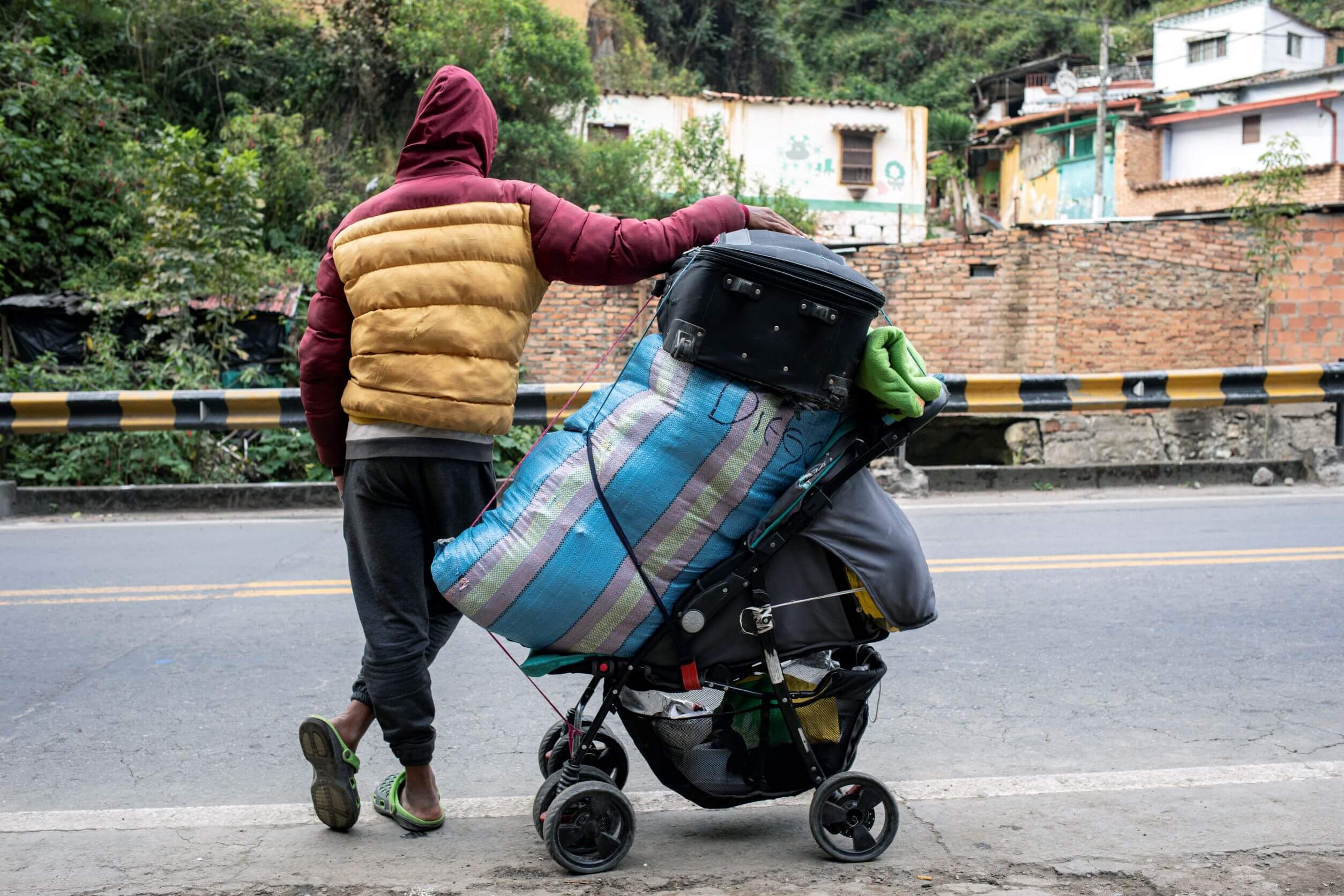
Photo credit: Colombia. Venezuelans prepare their luggage to continue their journey through the mountains. 2019 © UNHCR/Hélène Caux

Photo credit: Colombia. Venezuelans prepare their luggage to continue their journey through the mountains. 2019 © UNHCR/Hélène Caux

This paper explores asylum and internal displacement as ways of migration or human mobility. It focus particularly on the consequences resulting from each of the legal frameworks governing each expression of mobility in order to narrow down the scope in which they apply, as well as the gaps in protection resulting in each case. This work is additionally structured around the preexisting literature that has studied the relation between internal displacement and asylum. This paper thus explores how the Colombian State responds to the internal and external migrant population; and from that point on, it analyzes how compartmentalizing law explains the different degrees of protection, according to the type of mobility or migration. It is thus that the law defines categories, sets boundaries, legitimizes certain actors and disregards others, creating protection regimes and gaps in protection.

Carolina Moreno V. is Associate Professor of the School of Law, Los Andes University (Bogotá, Colombia), Director of the Center for Migration Studies (CEM) and co-founder of the Legal Clinic for Migrants, Universidad de los Andes, and a Member of the Latin American Network on Internal Displacement (LANID).

LANID Special Issue: “Critical Approaches to Internal Displacement”

The Latin America Network on Internal Displacement (LANID) brings together academics, activists, artists, and practitioners with the aim of reflecting critically on internal displacement. This LANID Special Issue aims to extend knowledge and promote debate on this phenomenon. Although each Paper has been written from a different perspective, they all share the key feature that they delve into the multidimensional nature, diverse causes and complex dynamics of this kind of forced migration, as well as into the search for new ways to achieve durable solutions that allow those affected by internal displacement to overcome their vulnerability.

This paper was written by the author in the framework of the “Interdisciplinary Network on Internal Displacement, Conflict and Protection” project (AH/T005351/1), supported by the Arts and Humanities Research Council, on behalf of the UKRI Global Challenge Research Fund.

HOW TO CONTRIBUTE

Researching Internal Displacement publishes engaging and insightful short pieces of writing, artistic and research outputs, policy briefings and think pieces on internal displacement.

We welcome contributions from academics, practitioners, researchers, officials, artists, poets, writers, musicians, dancers, postgraduate students and people affected by internal displacement.

By Gabriela Malo | Jul 22, 2026
En el Ecuador ha aumentado en la década de 2020 la actividad de grupos criminales dedicados al narcotráfico transnacional, minería ilegal y actividades complementarias. Ante la ausencia de respuestas estatales a sus problemas, un número creciente de habitantes opta por escapar. En un contexto del que se tiene escasa información, este trabajo aporta a la comprensión de un fenómeno en el que las familias dependen de su propia iniciativa y capital social para decidir si desplazarse y a dónde ir. Se analizan las responsabilidades del Estado ante el desplazamiento interno, constatando que con pocas excepciones, no existe una respuesta nacional ante este fenómeno. También se describe uno de los pocos casos de desplazamiento masivo que han tenido visibilidad pública: el caso de los indígenas Chachi en la provincia de Esmeraldas.
By Kadidjatou Sawadogo | Jun 30, 2026
The working paper examines the impact of humanitarian funding contractions on the realisation of economic and social rights of internally displaced persons (IDPs) in Haiti and South Sudan. Drawing on a human rights-based framework, documentary analysis, and key informant interviews, it analyses how reductions in humanitarian assistance affected access to adequate food and healthcare in contexts of protracted displacement, institutional fragility, and humanitarian dependence. The findings show that funding cuts reduced food assistance, disrupted health services, suspended mobile clinics, and weakened nutrition coverage for displaced populations. Humanitarian actors adopted hyper-prioritisation approaches that focused on life‑saving interventions but left significant protection and socio‑economic needs unaddressed.
By German Kim, Ekaterina Pesegova (transl.) | Jun 4, 2026
This working paper highlights the relatively unknown deportation of Soviet Koreans, the first of several state deportations based on ethnicity carried out by the Soviet Union. The forced displacement, mainly to Central Asian republics of the former Soviet Union, was highly classified during Soviet times, leading to misunderstandings and subsequent misrepresentations of the event by Western scholars and the creation of multiple inaccurate narratives, including that of ethnic cleansing. By conducting an interdisciplinary study, the author critically analyses widespread misconceptions about the deportation of the Soviet Koreans and provides objective data on the issue and its long-lasting effects on the Soviet Koreans who survived deportation and their descendants.