
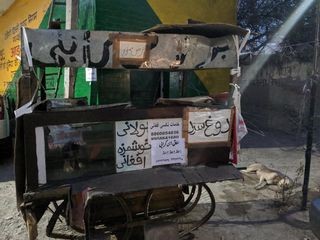
Finding themselves in a country that is not their own, asylum-seekers and asylees from Afghanistan encountered what may be described as ‘cascading displacement’ as they went about negotiating a series of lockdowns imposed in India because of the ongoing COVID-19 pandemic. Having crossed into India largely on account of the unabating political crises in Afghanistan, the experiences of the Afghan asylum-seekers and asylees demonstrate that (their) displacement did not necessarily end with movement into relatively safer spaces like those offered by India. Instead, cross-border displacement is often accompanied and followed by experiences of internal displacement that occur within the borders of a given nation-state.
At the same time, not all experiences of displacement entail a physical movement away from places of familiarity. Instead, some individuals and communities experience effective (legal) and emotional displacement, while being in places where they ordinarily reside. By throwing light on such aspects, this paper highlights the complex, layered reality of cross-border and internal displacement. It argues that it is more than just a (forced) movement away from one’s home region and is instead an experiential condition that is encountered in place both across and within borders. In so doing, this paper uses an emergent methodology called ‘patchwork ethnography’, which combines existing academic literature on displacement with in-situ ethnographic vignettes, and creative and imaginative inputs including the author’s literary flights.
Chayanika Saxena is a President’s Graduate Fellow and PhD candidate at the Department of Geography, National University of Singapore. She has worked for over seven years on the geopolitical and domestic dynamics concerning Afghanistan. She is fluent in Hindi, English and Urdu, has working knowledge of Dari-Persian and beginner’s linguistic proficiency in Arabic.
This paper was written by the author during her Summer Fellowship on Internal Displacement at the Internal Displacement Research Programme at the Refugee Law Initiative. The Fellowship was supported by the Arts and Humanities Research Council, on behalf of the UKRI Global Challenge Research Fund, as part of the funded project “Interdisciplinary Network on Internal Displacement, Conflict and Protection” (AH/T005351/1).
