Bi-Watan, Bi-Khaaneh: ‘Internal’ Displacement, Afghan Refugees, and the COVID-19 Pandemic

Asylum-seekers and asylees from Afghanistan encountered ‘cascading displacement’ as they went about negotiating COVID-19 lockdowns in India
Published on October 27, 2021
Chayanika Saxena | all, IDPs, Refugees, Disaster, Conflict, Asia-Pacific
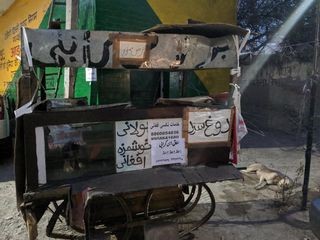
India, Makeshift Food Stall Run by an Afghan Refugee in Lajpat Nagar, New Delhi

India. Makeshift Food Stall Run by an Afghan Refugee in Lajpat Nagar, New Delhi © Chayanika Saxena

Finding themselves in a country that is not their own, asylum-seekers and asylees from Afghanistan encountered what may be described as ‘cascading displacement’ as they went about negotiating a series of lockdowns imposed in India because of the ongoing COVID-19 pandemic. Having crossed into India largely on account of the unabating political crises in Afghanistan, the experiences of the Afghan asylum-seekers and asylees demonstrate that (their) displacement did not necessarily end with movement into relatively safer spaces like those offered by India. Instead, cross-border displacement is often accompanied and followed by experiences of internal displacement that occur within the borders of a given nation-state.

At the same time, not all experiences of displacement entail a physical movement away from places of familiarity. Instead, some individuals and communities experience effective (legal) and emotional displacement, while being in places where they ordinarily reside. By throwing light on such aspects, this paper highlights the complex, layered reality of cross-border and internal displacement. It argues that it is more than just a (forced) movement away from one’s home region and is instead an experiential condition that is encountered in place both across and within borders. In so doing, this paper uses an emergent methodology called ‘patchwork ethnography’, which combines existing academic literature on displacement with in-situ ethnographic vignettes, and creative and imaginative inputs including the author’s literary flights.

Chayanika Saxena is a President’s Graduate Fellow and PhD candidate at the Department of Geography, National University of Singapore. She has worked for over seven years on the geopolitical and domestic dynamics concerning Afghanistan. She is fluent in Hindi, English and Urdu, has working knowledge of Dari-Persian and beginner’s linguistic proficiency in Arabic.

This paper was written by the author during her Summer Fellowship on Internal Displacement at the Internal Displacement Research Programme at the Refugee Law Initiative. The Fellowship was supported by the Arts and Humanities Research Council, on behalf of the UKRI Global Challenge Research Fund, as part of the funded project “Interdisciplinary Network on Internal Displacement, Conflict and Protection” (AH/T005351/1).

HOW TO CONTRIBUTE

Researching Internal Displacement publishes engaging and insightful short pieces of writing, artistic and research outputs, policy briefings and think pieces on internal displacement.

We welcome contributions from academics, practitioners, researchers, officials, artists, poets, writers, musicians, dancers, postgraduate students and people affected by internal displacement.

By Gabriela Malo | Jul 22, 2026
En el Ecuador ha aumentado en la década de 2020 la actividad de grupos criminales dedicados al narcotráfico transnacional, minería ilegal y actividades complementarias. Ante la ausencia de respuestas estatales a sus problemas, un número creciente de habitantes opta por escapar. En un contexto del que se tiene escasa información, este trabajo aporta a la comprensión de un fenómeno en el que las familias dependen de su propia iniciativa y capital social para decidir si desplazarse y a dónde ir. Se analizan las responsabilidades del Estado ante el desplazamiento interno, constatando que con pocas excepciones, no existe una respuesta nacional ante este fenómeno. También se describe uno de los pocos casos de desplazamiento masivo que han tenido visibilidad pública: el caso de los indígenas Chachi en la provincia de Esmeraldas.
By Kadidjatou Sawadogo | Jun 30, 2026
The working paper examines the impact of humanitarian funding contractions on the realisation of economic and social rights of internally displaced persons (IDPs) in Haiti and South Sudan. Drawing on a human rights-based framework, documentary analysis, and key informant interviews, it analyses how reductions in humanitarian assistance affected access to adequate food and healthcare in contexts of protracted displacement, institutional fragility, and humanitarian dependence. The findings show that funding cuts reduced food assistance, disrupted health services, suspended mobile clinics, and weakened nutrition coverage for displaced populations. Humanitarian actors adopted hyper-prioritisation approaches that focused on life‑saving interventions but left significant protection and socio‑economic needs unaddressed.
By German Kim, Ekaterina Pesegova (transl.) | Jun 4, 2026
This working paper highlights the relatively unknown deportation of Soviet Koreans, the first of several state deportations based on ethnicity carried out by the Soviet Union. The forced displacement, mainly to Central Asian republics of the former Soviet Union, was highly classified during Soviet times, leading to misunderstandings and subsequent misrepresentations of the event by Western scholars and the creation of multiple inaccurate narratives, including that of ethnic cleansing. By conducting an interdisciplinary study, the author critically analyses widespread misconceptions about the deportation of the Soviet Koreans and provides objective data on the issue and its long-lasting effects on the Soviet Koreans who survived deportation and their descendants.