Disjunction of Borders, Who Is the Outsider?

This paper explores how the interaction of citizenship and nationhood boundaries shapes 'belonging' and 'membership' for two different ethnic groups of internal migrants/displaced persons in the Kurdistan region of Iraq
Published on January 19, 2022
Atefeh Ramsari | mernid, IDPs, Internal migration, Ethnicity, Non-Discrimination, Law/Policy, Social Science, Middle East
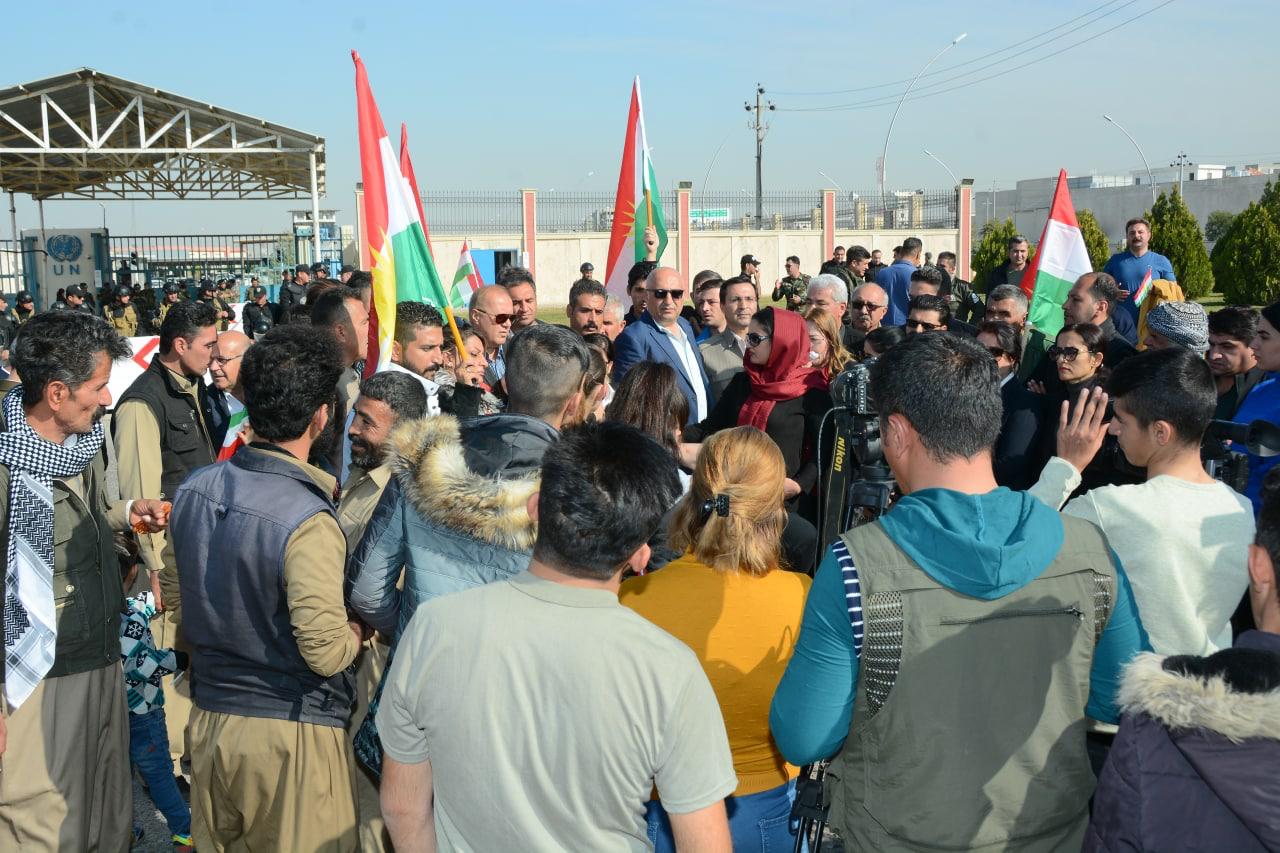
Iraq. Displaced Kurdish persons demanding their rights in front of the UN compound in Kurdistan © Mansour Elyasi

Iraq. Displaced Kurdish persons demanding their rights in front of the UN compound in Kurdistan © Mansour Elyasi

This study investigates how in multinational states the implementation of the dynamic interaction between citizenship and nationhood boundaries generates different levels of belonging and membership, and consequently, many in-between levels of inclusion and exclusion of migrants with different ethnic backgrounds By taking the case of the Kurdistan Region, a federal semi-autonomous subject of Iraq, this research aims to answer how two displaced groups including Iraqi Arabs, holding the citizenship of Iraq, comparing to non-Iraqi Kurds, who are nominally citizens of neighboring countries, experience exclusion through defining their membership. The intersection of citizenship and national boundary emerges as a critical issue in the Kurdistan region, where state-internally displaced Arabs traverse the Kurdish national boundaries and the nation-internally migrant Kurds from Turkey, Iran, and Syria, move across the Iraqi nation-state borders.

This work is built on a body of literature that purposefully identifies and reflects on the disjunction of citizenship and nationhood. By delving into various views, four emphasized characteristics of the citizenship concept are figured out: legal status, rights, political participation, and a sense of belonging. In regards to methodology, this study is a qualitative comparative case study of two ethnic groups. For this purpose, semi-structured interviews are utilized to collect data. The results show, the Kurdish immigrants are excluded in virtue of legal boundaries as they are perceived as foreign in line with the citizenship stipulation of Iraq nation-state whiles Iraqi Arabs, due to symbolic boundaries that take them as an outsider to the Kurdish community, have been disadvantaged from getting the full access to resources and participation in the Kurdish society. Comparison of these two groups reveals how citizenship appears as a barrier and insufficient status for granting rights to internally displaced people.

Atefeh Ramsari is currently a doctoral Researcher at the Bielefeld Graduate school of History and Sociology in Germany. The focus of her project is on citizenship and ethnic conflicts in Middle Eastern societies.

This paper was written by the author during her Summer Fellowship on Internal Displacement at the Internal Displacement Research Programme at the Refugee Law Initiative. The Fellowship was supported by the Arts and Humanities Research Council, on behalf of the UKRI Global Challenge Research Fund, as part of the funded project “Interdisciplinary Network on Internal Displacement, Conflict and Protection” (AH/T005351/1).

HOW TO CONTRIBUTE

Researching Internal Displacement publishes engaging and insightful short pieces of writing, artistic and research outputs, policy briefings and think pieces on internal displacement.

We welcome contributions from academics, practitioners, researchers, officials, artists, poets, writers, musicians, dancers, postgraduate students and people affected by internal displacement.

By Steven Miron, Dyuti Tasnuva Rifat, Tanjib Islam | Oct 21, 2025
Foregrounding the voices of people living in three different communities of displacement in Bangladesh, this field research and advocacy report examines the nexus of climate change, loss and damage and displacement. This comprehensive report highlights promising interventions by Bangladeshi civil society organisations that have helped internally displaced people (IDPs) living in protracted displacement move toward durable solutions. It also examines positive developments on the policy front, including Bangladesh's fledgling National Strategy on Internal Displacement Management (NSIDM). At the same time, it calls attention to how Bangladesh's protracted displacement crisis remains under acknowledged and therefore under addressed in national policy and programming. The findings and recommendations in this report are intended to inform the UNFCCC's Loss and Damage mechanism – the Fund for Responding to Loss and Damage (FRLD), the Santiago Network for Loss and Damage (SNLD) and the Warsaw International Mechanism (WIM) ExCom, including its Taskforce on Displacement. Each must urgently demonstrate its commitment to addressing the growing displacement crisis and supporting durable solution programming. The report's findings and recommendations are also relevant to intergovernmental, governmental and civil society organisations working in and outside Bangladesh. Furthermore, the report suggests how conventional durable solutions approaches to displacement must evolve to remain relevant in a world of escalating losses and damages resulting from climate change.
By Ana Paredes Marín y Alejandra Barrios Ariano | Jul 3, 2025
Este documento de trabajo muestra que las experiencias de desplazamiento forzado interno de mujeres en el Corredor Seco de Guatemala evidencian cómo los eventos hidrometeorológicos, como huracanes y sequías, agravan las desigualdades estructurales entre esas, la de género.