Disjunction of Borders, Who Is the Outsider?

This paper explores how the interaction of citizenship and nationhood boundaries shapes 'belonging' and 'membership' for two different ethnic groups of internal migrants/displaced persons in the Kurdistan region of Iraq
Published on January 19, 2022
Atefeh Ramsari | mernid, IDPs, Internal migration, Ethnicity, Non-Discrimination, Law/Policy, Social Science, Middle East
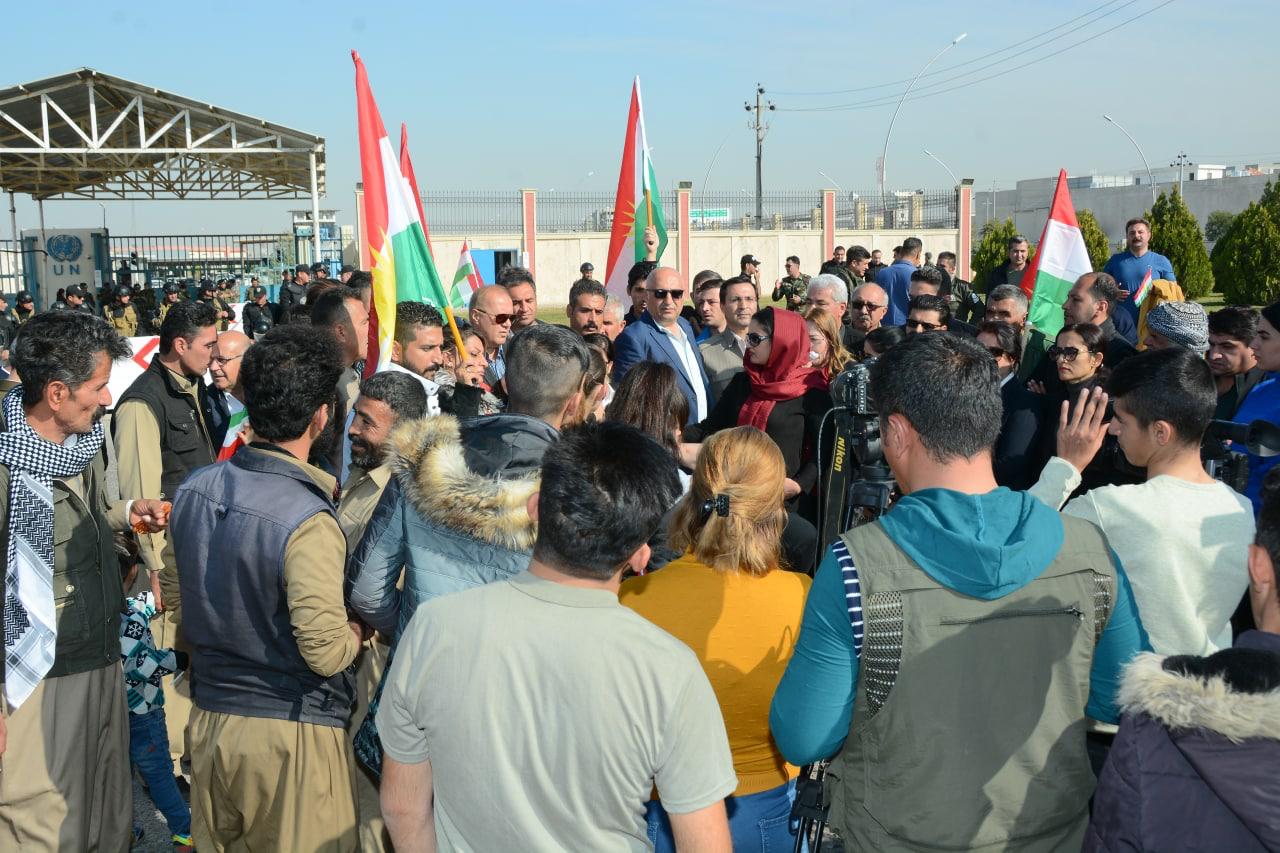
Iraq. Displaced Kurdish persons demanding their rights in front of the UN compound in Kurdistan © Mansour Elyasi

Iraq. Displaced Kurdish persons demanding their rights in front of the UN compound in Kurdistan © Mansour Elyasi

This study investigates how in multinational states the implementation of the dynamic interaction between citizenship and nationhood boundaries generates different levels of belonging and membership, and consequently, many in-between levels of inclusion and exclusion of migrants with different ethnic backgrounds By taking the case of the Kurdistan Region, a federal semi-autonomous subject of Iraq, this research aims to answer how two displaced groups including Iraqi Arabs, holding the citizenship of Iraq, comparing to non-Iraqi Kurds, who are nominally citizens of neighboring countries, experience exclusion through defining their membership. The intersection of citizenship and national boundary emerges as a critical issue in the Kurdistan region, where state-internally displaced Arabs traverse the Kurdish national boundaries and the nation-internally migrant Kurds from Turkey, Iran, and Syria, move across the Iraqi nation-state borders.

This work is built on a body of literature that purposefully identifies and reflects on the disjunction of citizenship and nationhood. By delving into various views, four emphasized characteristics of the citizenship concept are figured out: legal status, rights, political participation, and a sense of belonging. In regards to methodology, this study is a qualitative comparative case study of two ethnic groups. For this purpose, semi-structured interviews are utilized to collect data. The results show, the Kurdish immigrants are excluded in virtue of legal boundaries as they are perceived as foreign in line with the citizenship stipulation of Iraq nation-state whiles Iraqi Arabs, due to symbolic boundaries that take them as an outsider to the Kurdish community, have been disadvantaged from getting the full access to resources and participation in the Kurdish society. Comparison of these two groups reveals how citizenship appears as a barrier and insufficient status for granting rights to internally displaced people.

Atefeh Ramsari is currently a doctoral Researcher at the Bielefeld Graduate school of History and Sociology in Germany. The focus of her project is on citizenship and ethnic conflicts in Middle Eastern societies.

This paper was written by the author during her Summer Fellowship on Internal Displacement at the Internal Displacement Research Programme at the Refugee Law Initiative. The Fellowship was supported by the Arts and Humanities Research Council, on behalf of the UKRI Global Challenge Research Fund, as part of the funded project “Interdisciplinary Network on Internal Displacement, Conflict and Protection” (AH/T005351/1).

HOW TO CONTRIBUTE

Researching Internal Displacement publishes engaging and insightful short pieces of writing, artistic and research outputs, policy briefings and think pieces on internal displacement.

We welcome contributions from academics, practitioners, researchers, officials, artists, poets, writers, musicians, dancers, postgraduate students and people affected by internal displacement.

By Kadidjatou Sawadogo | Jun 30, 2026
The working paper examines the impact of humanitarian funding contractions on the realisation of economic and social rights of internally displaced persons (IDPs) in Haiti and South Sudan. Drawing on a human rights-based framework, documentary analysis, and key informant interviews, it analyses how reductions in humanitarian assistance affected access to adequate food and healthcare in contexts of protracted displacement, institutional fragility, and humanitarian dependence. The findings show that funding cuts reduced food assistance, disrupted health services, suspended mobile clinics, and weakened nutrition coverage for displaced populations. Humanitarian actors adopted hyper-prioritisation approaches that focused on life‑saving interventions but left significant protection and socio‑economic needs unaddressed.
By German Kim, Ekaterina Pesegova (transl.) | Jun 4, 2026
This working paper highlights the relatively unknown deportation of Soviet Koreans, the first of several state deportations based on ethnicity carried out by the Soviet Union. The forced displacement, mainly to Central Asian republics of the former Soviet Union, was highly classified during Soviet times, leading to misunderstandings and subsequent misrepresentations of the event by Western scholars and the creation of multiple inaccurate narratives, including that of ethnic cleansing. By conducting an interdisciplinary study, the author critically analyses widespread misconceptions about the deportation of the Soviet Koreans and provides objective data on the issue and its long-lasting effects on the Soviet Koreans who survived deportation and their descendants.
By Tomy Ncube and Una Murray | Mar 12, 2026
As climate impacts intensify, planned relocation is increasingly deployed as an adaptation strategy, yet outcomes for relocated communities remain consistently adverse. This paper argues that these failures stem from the treatment of planned relocation as a short-term, projectised disaster response rather than as a long-term developmental intervention. Drawing on social protection theory, this paper reconceptualises planned relocation as a form of social assistance, capable of delivering durable solutions. It demonstrates that planned relocation inherently performs preventive, protective, promotive, and potentially transformative social protection functions by minimising future climate risks, providing non-contributory transfers such as land and housing, and enabling livelihood reconstruction. However, when implemented outside formal social protection systems, these functions may collapse, often resulting in impoverishment and protracted displacement.