On Refuge and Displacement: Challenges to the Provision of Rights and Protection for Syrians Inside and Outside Syrian Borders

This paper challenges notions of protection and displacement through a comparative study of the Syrian population's experience of, respectively, internal displacement and displacement across borders as refugees
Published on December 13, 2021
Jasmin Lilian Diab | mernid, IDPs, Refugees, Conflict, Protection, Assistance, Middle East

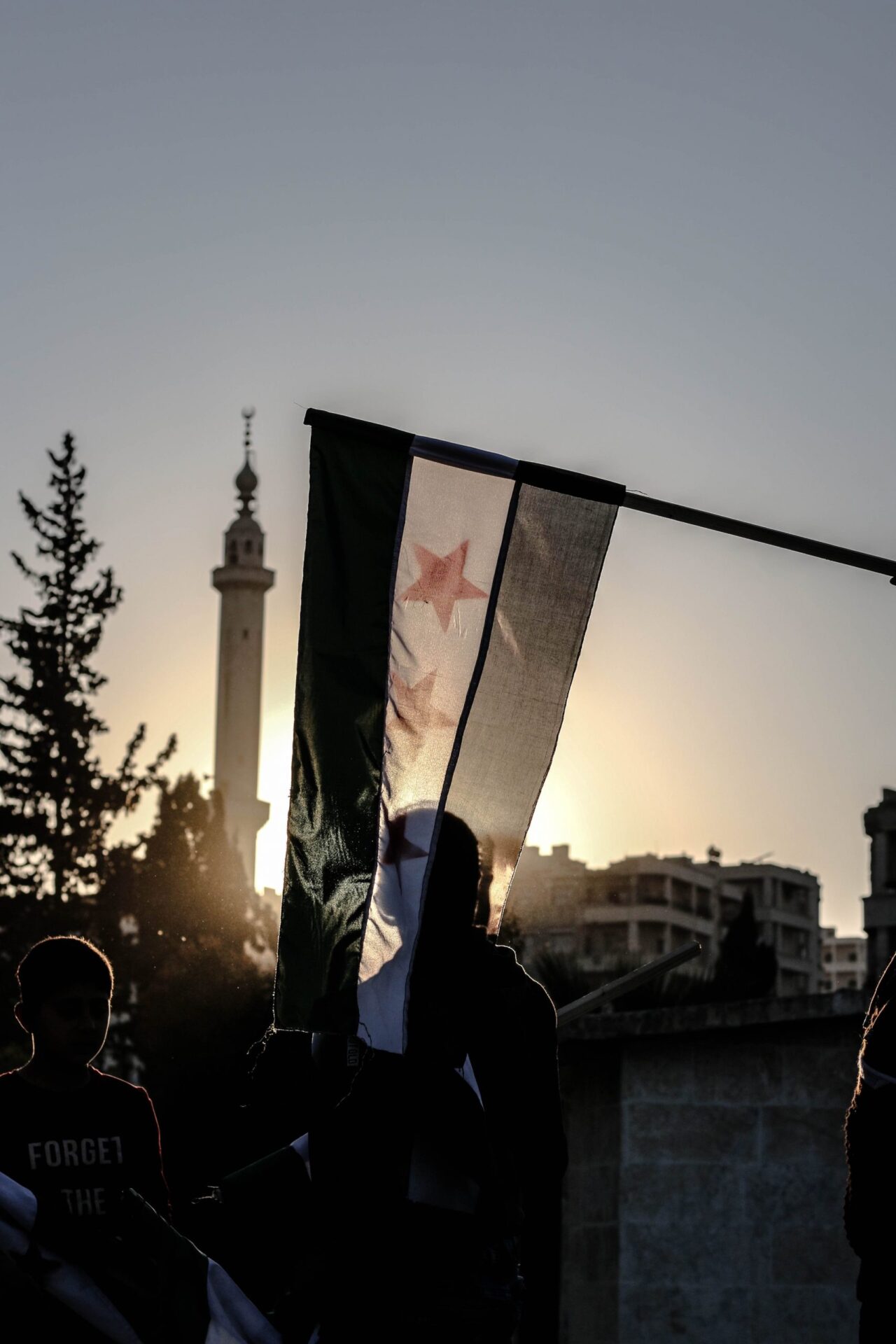
Syria. Men in a City and Syrian Flag 2021 © Ahmed Akacha

Since the outbreak of the Syrian conflict close to one decade ago (2011-present), more than one quarter of its population have fled the country to neighboring Lebanon, Jordan, Iraq and Turkey. Another 25% of the population has been internally displaced. By the conflict’s seventh year, more than 12 million Syrians were forcibly displaced, half of which were now refugees, and the other half of which became internally displaced (IDPs). Lebanon hosts the largest proportion of refugees compared to its population worldwide, with an estimated 1.5 million refugees between those registered and unregistered. IDPs from Syria are among the world’s most vulnerable people. Unlike Syrian refugees in neighboring countries, these IDPs have not crossed an international border to receive the humanitarian protection they need, but have remained inside Syria as the conflict goes on. Even though they have fled from the same conflict, IDPs in Syria remain under the protection of the Syrian government. As citizens, though they do not have access to their rights or any form of protection from their government, they are considered entitled to their rights and protection under both human rights and international humanitarian law, and thus have a different legal standing to refugees from Syria who reside in Lebanon. Interestingly, both these populations (refugees and IDPs) are assisted by UNHCR.

The paper discusses the two types of displacement the Syrian population has experienced (across borders and internally) through a comparative approach. The paper intends to challenge the notions of protection and displacement, through shedding light on the Syrian case, while also discussing definitions of refugee and IDP in contemporary conflicts and how these “labels” affect access to labor, citizenship, mobility and rights for the same population.

Dr. Jasmin Lilian Diab (she/her) is a Canadian-Lebanese expert in Migration, Gender and Conflict Studies. Dr. Diab is the Director of the Institute for Migration Studies at the Lebanese American University, where she also serves as an Assistant Professor of Migration Studies at the Department of Social and Education Sciences. She is a Research Affiliate at the Centre for Refugee Studies at York University, a Global Fellow at Brown University’s Center for Human Rights and Humanitarian Studies, a Scholar in Forced Displacement at University of Ottawa’s Human Rights Research and Education Centre, and the Lead of the Global Research Network’s ‘Gender and Migration Research Group.

This paper was written by the author during her Summer Fellowship on Internal Displacement at the Internal Displacement Research Programme at the Refugee Law Initiative. The Fellowship was supported by the Arts and Humanities Research Council, on behalf of the UKRI Global Challenge Research Fund, as part of the funded project “Interdisciplinary Network on Internal Displacement, Conflict and Protection” (AH/T005351/1).

HOW TO CONTRIBUTE

Researching Internal Displacement publishes engaging and insightful short pieces of writing, artistic and research outputs, policy briefings and think pieces on internal displacement.

We welcome contributions from academics, practitioners, researchers, officials, artists, poets, writers, musicians, dancers, postgraduate students and people affected by internal displacement.

By German Kim, Ekaterina Pesegova (transl.) | Jun 4, 2026
This working paper highlights the relatively unknown deportation of Soviet Koreans, the first of several state deportations based on ethnicity carried out by the Soviet Union. The forced displacement, mainly to Central Asian republics of the former Soviet Union, was highly classified during Soviet times, leading to misunderstandings and subsequent misrepresentations of the event by Western scholars and the creation of multiple inaccurate narratives, including that of ethnic cleansing. By conducting an interdisciplinary study, the author critically analyses widespread misconceptions about the deportation of the Soviet Koreans and provides objective data on the issue and its long-lasting effects on the Soviet Koreans who survived deportation and their descendants.
By Tomy Ncube and Una Murray | Mar 12, 2026
As climate impacts intensify, planned relocation is increasingly deployed as an adaptation strategy, yet outcomes for relocated communities remain consistently adverse. This paper argues that these failures stem from the treatment of planned relocation as a short-term, projectised disaster response rather than as a long-term developmental intervention. Drawing on social protection theory, this paper reconceptualises planned relocation as a form of social assistance, capable of delivering durable solutions. It demonstrates that planned relocation inherently performs preventive, protective, promotive, and potentially transformative social protection functions by minimising future climate risks, providing non-contributory transfers such as land and housing, and enabling livelihood reconstruction. However, when implemented outside formal social protection systems, these functions may collapse, often resulting in impoverishment and protracted displacement.
By Steve Miron, Dyuti Tasnuva Rifat, Tanjib Islam | Feb 25, 2026
Researching Internal Displacement is pleased to make this case study available as a stand-alone publication. Excerpted from a recent research and advocacy report by the Refugee Law Initiative, this case study of an urban informal settlement in Tongi, Bangladesh, examines the lived experience of loss and damage among people displaced in the context of climate change and left behind in climate action. Encouragingly, the case study also highlights a promising 'good practice' development intervention by the SAJIDA Foundation. In the case study, programme participants describe how Sajida’s multifaceted approach, which empowers women and girls, encourages positive behaviour change and prioritises psychosocial wellbeing across multiple programme workstreams, has helped restore agency, self-sufficiency and hope. SAJIDA’s programme shows how protracted displacement and associated losses and damages can be addressed and are not inevitable.