
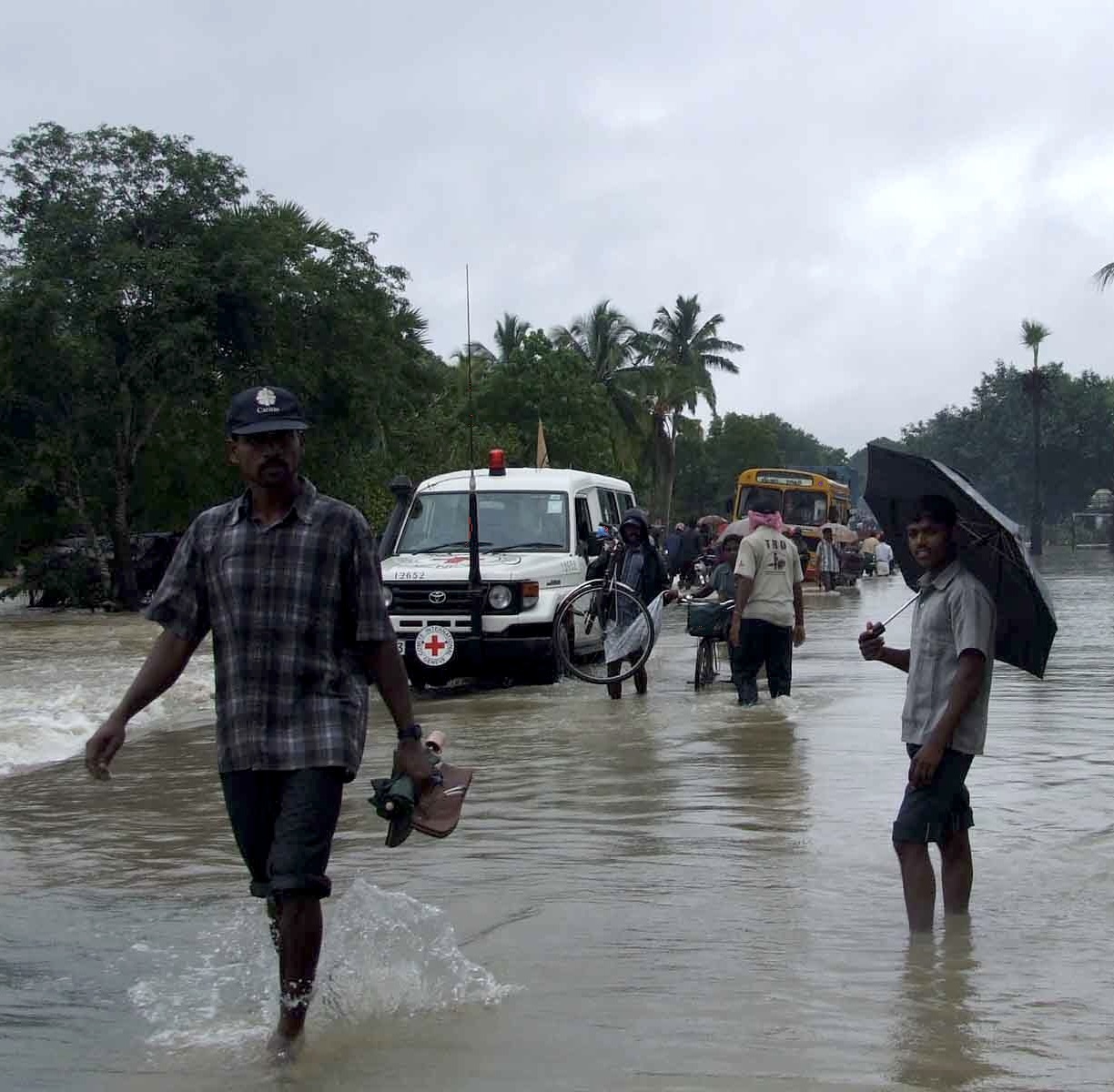
As noted in the 2025 Global Report on Internal Displacement (GRID) by the Internal Displacement Monitoring Centre (IDMC), human-induced climate change may be driving more severe and frequent hazards that force people from their homes, even though other factors such as poverty, informal urban expansion and inadequate infrastructure also play a role, considering the often-present overlap with conflicts and their vulnerability- and displacement-aggravating impacts as well. The number of recorded disaster displacements in 2024 (45.8 million), of which the vast majority were caused by storms and floods, was nearly double the annual average of the past decade. The Report notes that low- and middle-income countries continued to bear the brunt of disaster displacement impacts, and vulnerable communities were unevenly affected. Typically, most of these countries traditionally also have weak social protection systems, impacting on their ability to garner an adequate social protection response.
Social protection challenges and shortcomings
The conventional logic suggests that the extant social protection framework should be extended and applied to climate change-induced internally displaced persons. After all, social protection rights holders are entitled to the same social protection treatment irrespective of where they are located in the country. Yet, this is a simplistic view that does not fully account for the complexities and distinct context(s) of displacement occasioned by climate change.
The one critical area that requires interrogation concerns the narrowness of the traditional understanding of the social risk areas meant to be covered by the social protection concept – with specific reference to the nine (life-cycle based) social risk benefit categories (old age, unemployment, occupational injuries and diseases, health care, sickness, maternity, disability, family/child support and dependants’ domains), provided in particular in ILO instruments (notably the ILO Minimum Standards (Social Security) Convention (102 of 1952)).
From a social risk perspective, especially when read with economic and climate risks which IDPs exposed to climate change events may experience, social protection should also be able to respond to occupational safety and health (OSH) hazards and risks, loss of assets and livelihood opportunities, food insecurity and malnutrition, especially of children, shelter and housing needs, medical care needs, psychosocial support, widespread poverty, and lack of access to health services, basic social services and productive services such as micro-credit. Regard should be had to the differentiated needs of exceptionally vulnerable IDP population categories, including the aged, persons with disabilities, women and children, migrant workers, workers in the informal economy, and those engaged in outdoor and labour-intensive sectors, particularly in agriculture, construction, utilities, transport, emergency response and tourism.
Climate change frequently acts as a "threat multiplier" for social protection systems, increasing demand, complexity, and cost. To this should be added the need to appreciate, contextually, the potential, prevalence and impact of these risks at different stages of the displacement reality – the risks prompting displacement, the risks experienced in the process of becoming displaced, the differentiated risks arising at the location of displacement, and the risks associated with the various solutions considered in response to displacement. Rather than a definitive or fixed risk catalogue, flexibility in designing an evidence-based framework responding to the realities of the multi-staged displacement context, would have to be considered and should be translated in policy proposals of value to practitioners and policymakers as well.
A recent publication reflected on this, as follows (Costella & McCord, 2023, p. 63):
'The current conceptualisation of social protection – globally and in the region – needs to be reconsidered in response to the vast economic and social transformations that climate change will bring about in the coming decades. The sector’s strategic vision and programming needs to be climate informed and accommodate the profound implications of climate change in terms of scale, type, duration, and spatial distribution of social protection needs. Large-scale increases in the size of populations unable to meet their basic needs without external support will have implications for the scale of social protection coverage and the type of instruments adopted. Different, more complex and dynamic risks will have implications for the duration of provision required and extending coverage to new groups such as vulnerable urban populations, internal and transboundary migrants and those affected by the green transition. Adapting the geographic and spatial distribution of provision to accommodate climate-induced needs will necessitate rethinking the way in which social protection can be effective in contexts of mobility and displacement.'
The issue of treatment of affected populations is of particular importance, in social protection terms. Care must be taken to ensure that treatment of affected communities, whether migrant or host, is finely balanced and reflects considerations of equity and equality. Otherwise, the risk of conflict and dissatisfaction may be real, especially if host populations may have the impression that special treatment is given to displaced populations, considering also the often weak and fragile social protection provisioning that may be available in low-income affected countries in particular. In essence, this may require equality of social protection responses, irrespective of (displaced) mobility categorisation. In particular, and despite the specialised treaty-based regime applicable to refugees in terms of international law, it should be interrogated whether it is just and equitable to provide differential social protection treatment to refugees vis-à-vis internally and transboundary populations displaced as a result of climate change.
Therefore, the scope and nature of the social protection interventions needed should be largely determined by the context. On the one hand, displaced populations may be in need of urgent non-contributory support to meet consumption needs for some time – i.e., humanitarian assistance interventions. This may also be the case in the event of a purely temporary sojourn in the area of destination, if conditions would allow them to return to the area of origin in a short space of time. On the other hand, however, especially in the event that their stay in the area of destination becomes protracted or even permanent, there should be a decisive focus on moving beyond short-term non-contributory support, including cash transfers, to longer-term sustainable social protection interventions. Ideally, to the extent possible, linking non-contributory humanitarian interventions to graduate toward longer-term, including self-sustaining interventions, should be supported.
This may require innovation. Investment in livelihood opportunities is therefore particularly pertinent. This includes investment in integrated, purposely designed national public safety net responses (with specific reference to public works programmes), which could provide a pathway for vulnerable migrants to formally enter the labour market and hence participate in contributory social security schemes. In addition, consideration should be given to involve public works participants directly in national, contributory social programme interventions, as is already the case in some jurisdictions (e.g., South Africa). Generally, however, there is currently little evidence of this shift in focus towards embracing a developmental paradigm. Yet, for the reasons advanced above, but also in light of the freefall in traditional humanitarian resources and systems, an imperative for a new approach is clearly apparent – which requires moving beyond humanitarian approaches to embrace sustainable human development, in particular sustainable social protection interventions.
Selected key pointers in support of an enhanced social protection response
As climate-related risks intensify, social protection plays a transformative role in mitigating the adverse impacts on affected displaced populations and accentuating national ownership of prevention, management and solutions in displacement situations. Among others, this would require investment in initiatives that could strengthen preventive measures, rehabilitative and integrative interventions, as well as – as indicated above – initiatives focused on providing access to immediate and ongoing income and livelihood strengthening, but also enabling those affected to participate in contributory social protection arrangements.
In addition, social protection in its multi-functional role and various capacity-strengthening modalities may help to inform responses tailored particularly to climate change-induced displacement contexts. Social protection is meant to strengthen:
- Anticipatory capacity – requiring preparedness and planning, early warning information, and regular and predictable social protection;
- Absorptive capacity – e.g., by relying on short-term consumption needs interventions and reliance on long-term (conditional) cash transfers and other modalities to absorb the negative impacts of climate change; and
- Adaptive capacity – i.e., the ability to adapt to multiple, long-term and future climate change risks, to adjust after a disaster, for example, through livelihood options diversification, and to address the underlying, structural causes of vulnerability.
In essence, displacement should be seen in the context and as a catalyst to global and localised human development challenges such as urbanisation (and rural-urban drift), transformation of livelihoods and climate-induced human mobility and its socio-political consequences, prompting a holistic and dedicated social protection response.
Furthermore, social protection interventions in the context of climate change should be designed to ensure their integration with just and green transition objectives. This includes promoting green jobs and addressing the implications of job losses in so-called brown sectors, particularly where such jobs cannot be transformed into other viable employment opportunities. To this end, social protection interventions should be integrated from the outset into climate-related transition strategies and linked with broader efforts on decent work and skills development. Moreover, social protection responses are essential to addressing the disparities, inequalities, and inequities exacerbated by climate change events. These challenges call for gender-responsive and inclusive social protection mechanisms that cater to the specific needs of vulnerable groups.
From a broader social protection system perspective, a redesign of the risk and vulnerability framework informing social protection responses is imperative and is of critical consequence for the adjustment of key social protection schemes, including amongst others employment injury, unemployment, maternity (in particular, maternal health) and pension schemes. For example, to ensure that the employment injury system is appropriately responsive, a redefinition of the scope and range of occupational injuries and diseases would be required, amongst others by the dedicated inclusion of OSH-related hazards and risks caused or accentuated by climate change events. Moreover, investment of the employment injury system in labour market and societal rehabilitation and integration must be adjusted to ensure close correlation with the OSH dimensions of climate change, while compensatory mechanisms have to respond to extended disability and income security support needs occasioned by the impact of climate change on workers and their dependants.
Cumulatively, this has an evident impact on social protection funding arrangements, as reliance purely on traditional funding sources (e.g., employer and worker contributions; government-provided funding) may be insufficient, causing consideration to be given to a revamped social protection funding framework. Funding arrangements should reflect the need to move from short-term humanitarian approaches towards HDP Nexus-inspired sustainable development angles, which would naturally open up different funding and financing windows and invoke interest of different stakeholders such as the private sector and development banks.
Reappraisal also calls for a well-coordinated social protection system, institutional (including regulatory) and operational frameworks, as the nature, range, scope and scale of climate change-induced and -aggravated risks, hazards and vulnerabilities would require enhanced levels of alignment.
In fact, it is imperative to align social protection policies with climate change mitigation and disaster risk management policies, as well as with a wide range of associated sectoral policies, for example on food security, livelihoods, poverty reduction and labour markets, as well as conflict prevention and management, and to ensure that, where relevant, social protection policies are well-integrated with just and green transition objectives. Conversely, these objectives should be mainstreamed in, among others, active labour market policies, public works programmes, and a calibrated contributory and non-contributory social protection system design.
Finally, as indicated above, social protection may well serve as an innovative and sustainable mechanism to replace traditional, reactive humanitarian systems. This is the most appropriate time for such a new consideration to be made.
Marius Olivier is an Adjunct-professor in the School of Law, University of Western Australia, Honorary Professor in the Faculty of Law, Nelson Mandela University, South Africa and Extraordinary Professor in the Faculty of Law, Northwest University (South Africa), Visiting Fellow: Refugee Law Initiative, School of Advanced Study, University of London (UK); and Fellow of the Stellenbosch Institute for Advanced Study (STIAS). As an academic but also as policy specialist, Marius has been specialising in, advising on, and speaking and writing on social security, social protection, labour law and migration, with a focus also on the social protection position of IDPs.
This topical paper is part of the special series on ‘Internal Displacement in a Changing World Order’, led by the Internal Displacement Research Programmeat the RLI. The experts contributing to this series assess how rapid shifts in contemporary politics, plummeting levels of humanitarian aid and escalating global crises are impacting displacement-affected communities. The series ties into a recently-launched 45-chapter ‘Handbook of Internal Displacement‘ (2026) that comprehensively addresses this issue.
KEYWORDS: Internal displacement, IDPs, social protection, climate, disasters
Selected bibliography
Bharadwaj, R., Mitchell, T., Karthikeyan, N., Raj, N., Chaliha , S., Abhilashi, R., Chinnaswamy, K., B, R., Deulgaonkar, I., Chakravarti, D. & T. McCabe, Delivering anticipatory social protection: country readiness assessment (IIED, London, 2023), https://www.iied.org/21896iied.
Costella, C. & A. McCord, Rethinking Social Protection and Climate Change: The medium-term implications of climate change for social protection policy and programming in the Asia-Pacific Region (Report, Australia Department of Foreign Affairs and Trade, DFAT, 2023) https://www.dfat.gov.au/sites/default/files/rethinking-social-protection-climate-change.pdf.
IDMC, Global Report on Internal Displacement (GRID) 2025
Olivier, M. & P. de Clercq, "Internal displacement, human mobility and climate change: The need for an integrated and comprehensive social protection approach" in V. Tandrayen Ragoobur, M. Olivier & G. Dafuleya (eds) Assessing a Decade of Social Protection in SADC: Evidence to Inform Systems Strengthening (University of Mauritius & SASPEN, 2025) 324-358.
Tenzing, J. "Integrating social protection and climate change adaptation: A review" WIRE's Clim Change, 2020, 11, e626.
Ulrichs, M. Increasing people's resilience through social protection (ODI, 2016), https://cdn.odi.org/media/documents/10555.pdf.
UNDP, Anticipatory Social Protection Index for Resilience – ASPIRE (Toolkit) (IIED, UNDP, 2023), https://www.iied.org/21901iied.
UNDP, Tackling climate change loss and damage by strengthening anticipatory risk response under social protection programmes, https://www.iied.org/tackling-climate-change-loss-damage-strengthening-anticipatory-risk-response-under-social