
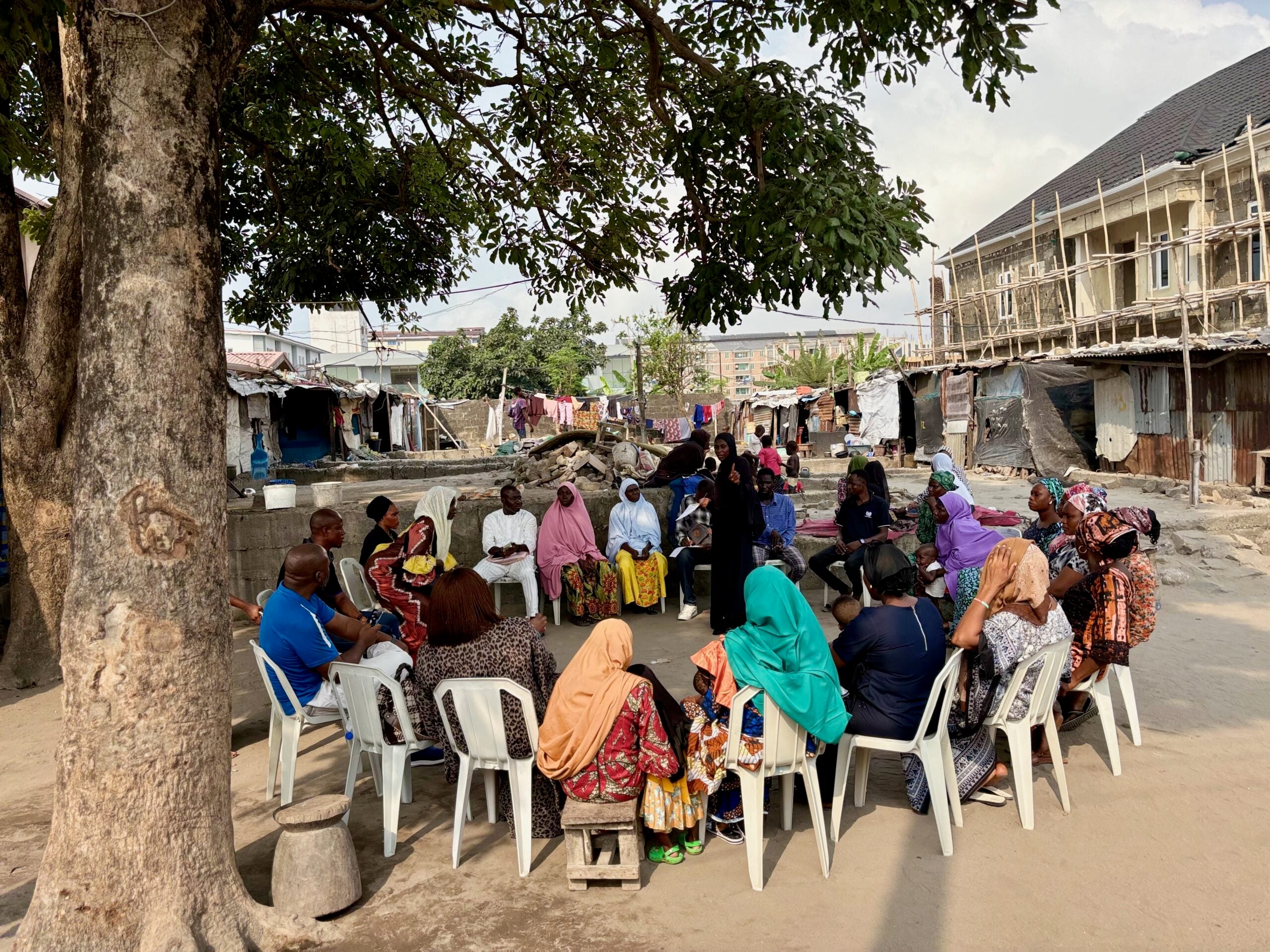
Since 2003, Nigeria's increasingly protracted conflict- and insurgency-driven displacement crisis has remained geographically anchored within the humanitarian architecture of the North-East. Humanitarian coordination systems, donor financing, emergency registration mechanisms, protection interventions and displacement governance have largely concentrated on camps and conflict-affected areas, particularly in Borno, Adamawa and Yobe. Yet beyond these formal humanitarian landscapes, a profound transformation has been unfolding across Nigeria's urban system. Increasingly, internally displaced persons (IDPs) are no longer settling primarily within camps or conflict zones, but are moving through complex, multi-stage mobility trajectories before rebuilding their lives in cities across the country.
Drawing on a seven-year interdisciplinary research programme that I led with an interdisciplinary team, which mapped protracted displacement trajectories across Lagos, Abuja, Port Harcourt, Onitsha, Ibadan, Abeokuta, Kaduna, Maiduguri, Lokoja and Jos, and this article buildings on the recently released abridged report Cities in Transition: Displacement Urbanisation and the Urgency of Inclusive Policy Reform in Nigeria, this article arguing that displacement in Nigeria can no longer be understood primarily as a temporary humanitarian crisis confined to camps or conflict-affected areas in the North-East. Instead, displacement increasingly unfolds through long-term processes of urban settlement, repeated mobility and self-settlement, reshaping neighbourhoods, labour systems, social relations and everyday urban life across Nigerian cities.
Furthermore, although internal displacement in Nigeria has evolved into a fundamentally urban condition, governance and humanitarian systems designed to respond to internal displacement remain largely camp-centred and focused on conflict zones, territorially fixed and institutionally fragmented. Not reflecting the shift in the geography of displacement, they inadequately recognise internally displaced urban migrants as forced migrants requiring long-term protection. Moreover, municipal planning systems rarely acknowledge self-settled displaced communities as distinct urban populations with displacement-related needs. As a result, millions of displaced households remain physically present within Nigerian cities but institutionally absent from the governance systems responsible for planning, protection and service delivery. This governance gap has considerable consequences, which this article will also explore before suggesting the reforms required to build more inclusive approaches to displacement governance.
The Problem: Displacement Has Become Urban
The empirical evidence reveals that displacement in Nigeria no longer follows a linear trajectory from conflict to temporary refuge. Instead, it is characterised by prolonged and repeated mobility through multiple locations before displaced households gradually establish long-term residence in cities. This challenges conventional assumptions that internal displacement is a singular event followed by temporary humanitarian assistance and eventual return. Rather, displacement emerges as an ongoing process of movement, adaptation and settlement in which cities increasingly function as spaces of long-term reconstruction rather than temporary refuge. Across all ten cities, IDPs overwhelmingly rely on self-settlement rather than formal humanitarian assistance. Many navigate complex, multi-stage mobility trajectories, moving repeatedly before gradually establishing themselves in cities, where informal labour opportunities, ethnic networks and rental arrangements become the primary mechanisms of survival and long-term urban settlement.
Protracted and repeated displacement, dating back to at least 2003, emerged as one of the defining characteristics of displacement urbanisation in Nigeria. Rather than representing a single episode of forced movement, the empirical evidence demonstrates that displacement unfolds through prolonged and recurrent cycles of mobility, adaptation and resettlement across Nigeria's urban system. Significant proportions of respondents across the sampled cities reported experiencing more than three episodes of displacement, including 35 percent of IDPs in Jos, 30 percent in Maiduguri, 22 percent in Lagos, 20 percent in Abeokuta and 17 percent in Onitsha. Even cities reporting comparatively lower rates, including Kaduna (6 percent), Port Harcourt (7 percent) and Abuja (7 percent), nevertheless reflected recurring mobility.
As one participant explained, movement typically begins close to places of origin before extending outward:
"The city is not our first preference, we first move to villages, and then towns close; similar to us culturally, where we have connection and access to continue our normal lives."
Onward mobility is subsequently shaped by secondary uprooting resulting from insecurity, livelihood collapse and failed settlement attempts elsewhere. These patterns demonstrate that displacement is rarely a single event; rather, it is an extensive and iterative process unfolding across multiple urban and regional spaces before households eventually establish themselves within cities.
Across the ten-cities, self-settlement consistently emerged as the dominant pathway through which displaced households establish themselves within urban areas. Rather than relying upon stable humanitarian structures, survival depends on informal urban systems. Settlement occurs through subdivided rooms, caretaker arrangements, residency in unfinished buildings, roadside occupations, waterfront settlements and peripheral land negotiated through ethnic, religious and social networks. These forms of accommodation are embedded within the existing urban fabric rather than separated into dedicated humanitarian spaces, illustrating how displacement has become increasingly integrated into the everyday production of Nigerian cities.
Women and children constituted the majority of displaced arrivals into cities, reflecting the gendered dynamics of insurgency and prolonged conflict in northern Nigeria. As one respondent explained:
"Boko Haram kills men, takes women and girls hostage because they want to expand the terrorist population through forced birthing farms in the north. Many women are left without husbands and sons; this is why many of our people you see in cities are mostly women and children."
Within these highly precarious settings, women, girls, children born in displacement, youth displaced during childhood, older adults and persons living with disabilities emerged as the most vulnerable sub-populations. For many women-headed households and unaccompanied women, survival within porous informal settlements began with exposure to violence, coercion and sexual exploitation. In several communities, women described how gangs, informal gatekeepers and predatory actors controlled access to sleeping spaces beneath bridges, roadside corridors and abandoned structures. One woman explained:
"We lived under the bridge for a long time, and as a mother, even though I didn't want to, the gangs in charge of that area made me give very young girls under my care for sexual violation as a condition for letting us live there for six years."
Another recurring pattern across the study was the early marriage of girls as a family coping strategy linked to deepening poverty and protection failures. As one participant noted:
"Many of our young girls are married off because their families can't take care of them."
Youth displaced during childhood also described lives shaped by prolonged instability, interrupted education and repeated mobility across multiple cities. One respondent reflected:
"I was displaced as a child at age seven. Today I am 27 years old. I have never been to school, and I have lived in these temporary conditions from Abuja, which was very hostile, to Benin, to now in Onitsha. After so many years, I still don't feel settled and keep moving constantly from place to place here in Onitsha because of flooding, evictions and other problems."
These testimonies demonstrate that protracted displacement produces not only immediate humanitarian need but also enduring forms of intergenerational vulnerability shaped by insecure shelter, interrupted education, multidimensional exclusion, violence and repeated mobility. Across sampled cities, communities occupy multiple peripheral spaces, forming dispersed yet enduring geographies of displacement. Evidence shows similar livelihood adaptation patterns. Rural farming and pastoralist IDPs are now engaged in a variety of informal urban jobs, including street and petty trading, plastic waste picking for recycling, domestic labour, informal transport and casual construction. These livelihoods are unstable due to the mismatch between rural skills and urban labour market demands, low literacy, disrupted education and exclusion from formal work. Despite these restrictions, most IDPs continue sending remittances to families and communities in their home states, demonstrating strong economic and social links between southern urban settlers and northern home states.
The findings also reveal overlooked policy opportunities. Many displaced households continue small-scale farming and animal-rearing activities, cultivating vegetables, cassava and other crops on vacant plots, wetlands and informal land margins while raising poultry, goats and other small livestock where conditions permit. These practices remain unsupported and structurally disconnected from urban food systems despite their potential contribution to food security in rapidly growing cities. With targeted support, including access to land, irrigation, cooperatives, veterinary services and urban agriculture programmes, the existing agricultural and livestock-rearing knowledge of displaced populations could be integrated more productively into urban economies, strengthening livelihoods and contributing to local food resilience.
Across all ten cities, long-term survival depends less on formal humanitarian assistance than on social networks, rotational savings groups, religious institutions and highly precarious informal markets. In many settlements, displaced households have remained in place for years and, in some cases, for more than a decade, gradually constructing neighbourhood systems, governance structures and economic pathways that reflect permanence rather than temporary refuge. These findings point to a broader structural transformation in the geography of displacement. Although camps remain symbolically central within humanitarian responses, empirical evidence across the sampled cities indicates that official camps primarily function as emergency points of initial recovery, predominantly accommodating older persons, persons with disabilities, women and children, many of whom eventually pursue alternative recovery pathways, including urban migration, as displacement becomes increasingly protracted. Consequently, the majority of internally displaced households now survive outside formal protection structures.
Cities have become spaces of prolonged settlement, adaptation and reconstruction, repeatedly emerging within displacement trajectories as destinations of last resort following multiple failed attempts to rebuild elsewhere. The findings further demonstrate that displacement urbanisation is reshaping the social fabric of receiving cities. Displaced households are not settling in isolation but becoming embedded within existing neighbourhoods, labour markets and community networks. At the same time, rapid settlement is generating new forms of interaction between displaced populations and host communities. Across several cities, including Ibadan, Abeokuta, Lagos, Otta, Lokoja and Jos, local participants associated growing displacement settlements with rising insecurity, criminal activity and fears of insurgent infiltration linked to some displacement corridors. As one local host community actor in Ibadan explained:
"Before these northerns got here, we were living in peace, now our communities are no longer safe as they bring insecurity to the south."
Host community members frequently described anxieties surrounding attacks and kidnapping by Fulani herdsmen, potential Boko Haram infiltration, informal arms circulation, the growth of youth gangs and the perceived presence of criminal networks operating within or around rapidly expanding displacement settlements. IDP participants similarly reported landlord refusal, informal evictions, surveillance by vigilante groups and growing hostility towards Hausa-speaking or visibly northern populations. At the same time, displaced households described internal tensions shaped by memories of violence in the North, including distrust between Christian and Muslim co-displaced groups. Together, these findings demonstrate that displacement urbanisation is reshaping not only settlement patterns and livelihoods but also neighbourhood relations, perceptions of security and the everyday politics of belonging across Nigerian cities.
Taken together, the evidence demonstrates that internal displacement in Nigeria has undergone a profound urban transformation. What was once understood primarily as a humanitarian emergency concentrated within camps and conflict zones has increasingly evolved into a long-term process of urban settlement, repeated mobility and community formation embedded within the everyday life of Nigerian cities. The empirical findings presented here establish the foundation for examining why governance systems have struggled to respond to this changing geography of displacement.
Why the System Fails in Cities
The empirical findings presented in the preceding section reveal that internal displacement in Nigeria has undergone a profound spatial transformation. Yet despite these changing realities, the governance architectures responsible for displacement have remained largely unchanged. Humanitarian, migration and urban governance systems continue to operate according to institutional assumptions that no longer correspond with the lived geographies of displacement documented across the ten-city study.
At the international level, humanitarian governance continues to privilege emergency response, temporary protection and geographically bounded crisis theatres. Donor financing mechanisms, humanitarian appeals, displacement monitoring systems and protection frameworks remain overwhelmingly organised around camps and recognised conflict zones where displaced populations are visible, countable and more easily administered through conventional emergency-response models. In Nigeria, this institutional logic has concentrated humanitarian financing, coordination structures and protection programming within the BAY states of Borno, Adamawa and Yobe, reinforcing a protection geography that remains territorially anchored to the North-East despite mounting evidence that displacement increasingly unfolds through prolonged urban settlement across the country.
This humanitarian architecture continues to shape national response priorities. As displaced households move beyond recognised humanitarian theatres into cities, they frequently lose the institutional visibility required to access humanitarian programming, protection mechanisms and long-term recovery support. Consequently, protection remains geographically tied to conflict territories rather than following the actual trajectories of displacement documented throughout the ten-city study. Cities such as Lagos, Ibadan, Port Harcourt, Onitsha, Abeokuta and Abuja increasingly function as major destinations for displaced populations while remaining peripheral to humanitarian assistance systems.
Migration governance reproduces similar institutional limitations. Existing protection frameworks continue to distinguish sharply between refugees crossing international borders and internally displaced populations moving within national territory, despite both frequently experiencing prolonged forced migration, repeated mobility and the absence of durable solutions. As explained by a state government official, refugees arriving from neighbouring countries may access internationally recognised protection mechanisms for a maximum period of 12 months, during which they receive a range of protection and recovery support, including a departure and reintegration package to facilitate settlement in cities of arrival. In contrast, Nigerian IDPs arriving from Borno, Zamfara or Adamawa remain largely excluded from equivalent recognition and protection despite experiencing comparable forms of prolonged displacement. This institutional distinction continues to frame internal displacement as a temporary domestic emergency rather than an ongoing process of forced migration that is increasingly reshaping urban space.
These national governance limitations intersect with fragmented international governance arrangements in two important ways. First, national responses are significantly shaped by international donor funding structures, within which refugees are prioritised while internally displaced persons (IDPs) are largely treated as a domestic responsibility of comparatively lower international concern. As one institutional participant explained:
"The Cameroonian or Congolese refugees who end up in Nigeria will [be] prioritised so Nigeria can absorb them, as long as they are not potentially heading towards Europe, it's not a priority."
Second, humanitarian responsibilities remain concentrated within federal emergency institutions, while receiving states and municipal authorities increasingly absorb the demographic, infrastructural and social consequences of displacement without corresponding legal mandates, dedicated financing mechanisms or institutional authority.
I argue that this internationally structured system of containment also shapes national governance instruments. As a result, displaced populations are administratively absorbed into broader categories of urban poverty, obscuring the distinct vulnerabilities associated with repeated displacement, disrupted mobility trajectories, documentation loss and prolonged insecurity. Rather than operating as an integrated governance system, humanitarian institutions, federal agencies, state governments and municipal authorities continue to function through fragmented and often overlapping mandates that fail to respond to the increasingly urban character of displacement.
This governance gap is further reinforced through the political economy of visibility. As Ochogwu (2023) argues, social assistance and protection systems in Nigeria are shaped not only by humanitarian need but also by institutional negotiations over recognition, legitimacy and resource allocation. The ten-city study demonstrates that recognising large concentrations of self-settled IDPs in southern cities would fundamentally challenge existing humanitarian geographies by raising questions about fiscal redistribution, institutional responsibility and long-term financing for arrival cities that currently receive no displacement-specific support. As one state official explained:
“Humanitarian funding is centralised in collaboration with affected states. There is a lot of corruption and manipulation by conflict states to keep the funding in the northeast; hence, their total disregard of the huge population migration out of the north to the south. It is intentional, and states outside this coverage cannot be expected to cater to vulnerable groups because they have no budgetary, administrative, legal or constitutional mandate to do so.”
Consequently, humanitarian visibility and, by extension, access to protection and resources, remains closely tied to officially recognised conflict theatres rather than to the locations where displaced populations now live.
Data governance further reinforces the 'invisibilisation' of IDPs living outside the North-East. Nigeria's most recent national census, conducted in 2006, predates the escalation of insurgency, mass displacement and the large-scale urbanisation of internally displaced populations. During the preparations for the scheduled 2023 digital census, which was subsequently postponed, state government and National Population Commission representatives participating in our validation workshop confirmed that northern IDPs residing in southern cities would not be enumerated unless they returned to the northern places of origin. At the same time, displacement enumeration systems remain heavily camp-centred, while the collaborative validation workshops undertaken as part of this research demonstrated that institutional definitions, census procedures and political sensitivities systematically exclude self-settled IDPs dispersed across Nigerian cities. Consequently, official demographic systems capture only a fraction of the displaced population, leaving many communities physically present yet administratively absent from planning processes, infrastructure provision and social protection systems.
Taken together, these institutional dynamics reveal that the exclusion of self-settled IDPs is not the product of a single governance failure but of mutually reinforcing humanitarian, migration, demographic and urban governance systems that remain misaligned with the contemporary realities of displacement. International funding priorities, national policy frameworks, migration regimes, census practices and administrative mandates collectively reproduce forms of institutional invisibility that deny urban displacement both political recognition and policy response. The result is a persistent governance gap in which cities absorb the demographic, social and infrastructural consequences of displacement without the institutional authority, financial resources or planning frameworks required to respond. Until governance systems recognise displacement as an increasingly urban phenomenon rather than a geographically bounded humanitarian emergency, self-settled IDPs will remain systematically excluded despite becoming a permanent and integral part of Nigeria's urban landscape.
The Consequences of Urban Invisibility
The governance failures discussed above extend far beyond administrative inefficiency. They fundamentally shape how displacement is experienced and reproduced within Nigerian cities. State government representatives unanimously acknowledged that, “We cannot plan for what we do not know,” citing the absence of reliable data on urban IDP arrivals, while also emphasising that “we do not have the capacity to integrate them into the state budget; they are the Federal and their state of origin government's responsibilities.”
Displaced participants described the consequences of this governance vacuum differently:
“Even though we are so many and littered across the streets of the cities, with thousands of us arriving daily due to the ongoing and persistent crisis in the north, everyone acts like they cannot see us. Our arrival state government acts like if they ignore us, it means we don't exist.”
These accounts illustrate that the consequences of invisibility extend well beyond the absence of humanitarian assistance. Without formal recognition, self-settled IDPs remain excluded from the administrative systems through which rights, public services, infrastructure investment and urban citizenship are accessed. They become physically embedded within the city while remaining administratively invisible to the institutions responsible for governing it.
The effects of this invisibility are cumulative rather than isolated. Contemporary urban governance is organised through interconnected systems of documentation, housing, education, healthcare, employment, social protection and infrastructure provision. Exclusion from one system therefore reinforces exclusion from others, producing overlapping vulnerabilities that deepen over time. Rather than reflecting temporary humanitarian needs, these forms of exclusion become structurally embedded within the everyday functioning of the city, shaping how displaced households secure livelihoods, access opportunities and negotiate belonging within urban society.
One state government official identified the environmental consequences associated with precarious forms of shelter, explaining that: “they are taking over dumpsites and landfills, using plastic waste to reclaim wetlands, shock dams and drainages which causes severe flooding in the rainy season.” Another institutional participant highlighted the growing number of street-connected and homeless children, with respondents in Lagos, Ibadan and Onitsha identifying their cities as experiencing some of the most acute manifestations of this emerging crisis.
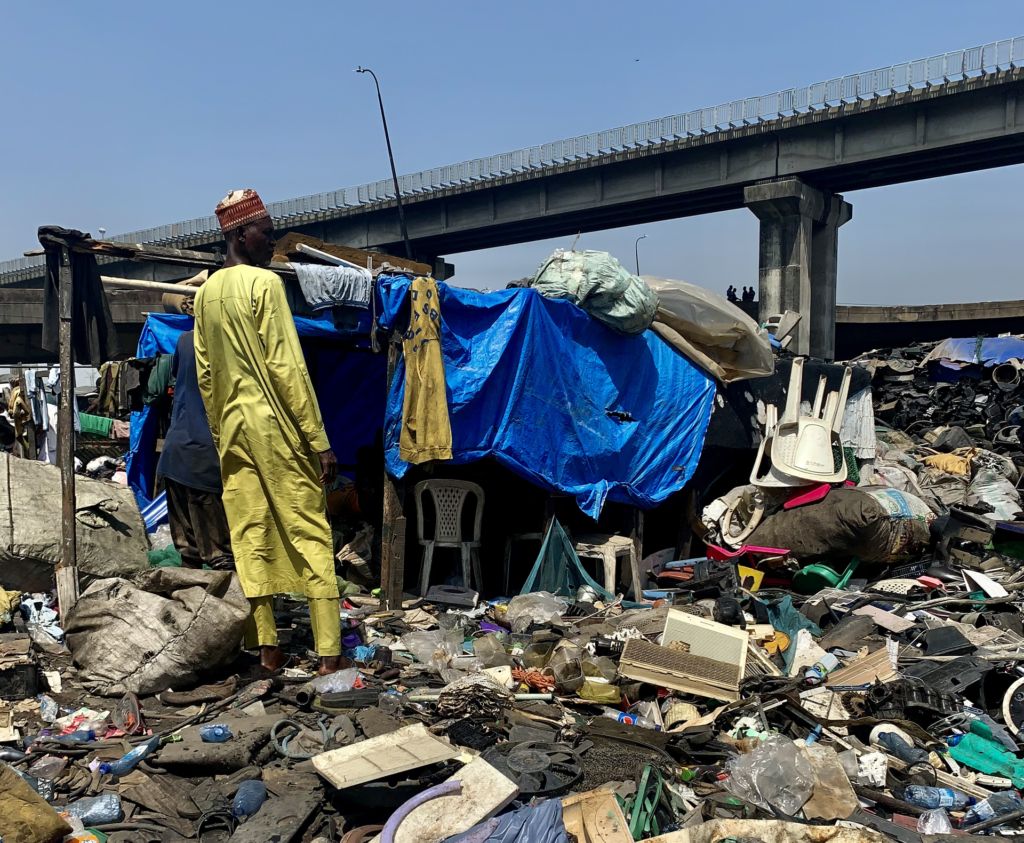
Photo: Dumpsite dwelling in Lagos. 2023 © Rebecca Enobong Roberts
Human rights concerns also emerged as a significant consequence. Community leaders indicate that state police officials now adopt efforts to curb public disorder frequently resulting in the arrest of houseless IDPs under offences relating to street trading, loitering and public nuisance. As one IDP community leader explained, “many of our young people who squat in public spaces and sell on the streets are in prison.”
The findings further demonstrate that displacement urbanisation is reshaping the nature of urban inequality. As self-settled IDPs establish permanent residence within informal settlements, the boundaries between displacement, poverty and urban marginalisation become increasingly blurred. Yet treating displaced households simply as part of the broader urban poor obscures the distinct vulnerabilities associated with repeated displacement, disrupted mobility trajectories, loss of documentation and prolonged exposure to violence. Consequently, displacement-specific needs disappear within mainstream urban policy despite remaining fundamentally different from those of other low-income urban residents.
These dynamics extend beyond humanitarian protection to shape broader processes of urban development. As demonstrated throughout the study, cities have become the principal spaces through which displacement is absorbed, yet they continue to shoulder its demographic, infrastructural, environmental and social consequences without corresponding institutional authority, financial resources or planning capacity. Responsibility is therefore progressively transferred from national governance systems to municipal governments, informal institutions, host communities and displaced households themselves, reinforcing uneven patterns of urban development while deepening existing inequalities.
Taken together, these findings demonstrate that the consequences of displacement urbanisation extend far beyond humanitarian policy. They are transforming neighbourhood formation, infrastructure demand, labour markets, environmental sustainability, social cohesion and the governance of cities themselves. The continued failure to recognise self-settled IDPs as legitimate urban residents not only reproduces their exclusion but also constrains the capacity of cities to plan for and govern demographic change. Consequently, displacement urbanisation has become both a humanitarian and an urban governance challenge, requiring a shift from emergency-centred responses towards planning frameworks capable of supporting long-term urban inclusion.
What Needs to Change
Recognising displacement urbanisation requires more than extending existing humanitarian responses into cities; it demands a fundamental reorientation of governance itself. The challenge is no longer how to manage temporary humanitarian emergencies but how to govern a permanent process of urban transformation in which displacement has become embedded within the everyday production of cities. Future policy must therefore move beyond treating internally displaced persons (IDPs) as exceptional humanitarian populations and instead recognise them as long-term urban residents whose inclusion is essential to equitable and sustainable urban development.
Achieving this shift requires embedding displacement within mainstream systems of urban governance. State and municipal authorities should be supported with the institutional mandates, financial resources and planning capacities necessary to respond to growing displaced populations, while humanitarian actors increasingly align their interventions with local governance structures rather than parallel emergency systems. At the same time, routine urban planning must incorporate settlement profiling, population enumeration and displacement-sensitive infrastructure planning so that demographic change becomes an integral component of city management rather than an exceptional humanitarian concern.
Administrative inclusion is equally critical. Documentation recovery, National Identification Number (NIN) registration, birth registration and access to education, healthcare, banking and social protection should be delivered through integrated, community-based systems that reduce the administrative barriers currently faced by self-settled households. Strengthening these systems would not only improve access to rights and public services but also enable displaced populations to participate more fully in the social, economic and political life of their cities.
More integrated governance across institutional and territorial boundaries is also required. Humanitarian agencies, federal institutions, state governments and municipal authorities must move beyond fragmented mandates towards coordinated approaches that link displacement governance with urban planning, housing, infrastructure and local development. Equally important is recognising displaced communities themselves as partners in governance. The evidence presented throughout this study demonstrates that many self-settled settlements have developed sophisticated forms of community organisation, leadership and collective action that provide an important foundation for more participatory and locally grounded approaches to urban inclusion.
Finally, international humanitarian and migration governance must adapt to the realities of displacement urbanisation. Funding mechanisms, monitoring frameworks and policy priorities should no longer remain geographically concentrated within conflict zones or institutionally centred on camps. Instead, greater emphasis should be placed on supporting municipalities, upgrading mixed settlements and strengthening the urban systems through which displacement is now predominantly accommodated.
Displacement urbanisation represents a structural transformation in the relationship between forced displacement and city-making. As displacement increasingly unfolds through prolonged mobility and urban settlement, governance systems can no longer remain organised around assumptions of temporariness, encampment and eventual return. The central challenge is therefore not simply improving humanitarian assistance but reconfiguring governance to reflect where displacement now occurs and how displaced populations rebuild their lives. Recognising self-settled IDPs as legitimate urban residents is not only essential for advancing their rights and protection; it is fundamental to building more inclusive, resilient and governable cities in an era of accelerating urban displacement.
Rebecca Enobong Roberts is a PhD candidate awaiting defence at the Habitat Unit, Technical University of Berlin, and an Elsa Neumann Stiftung Fellow specialising in displacement urbanisation, forced migration, and urban governance in African cities. With over a decade of experience across humanitarian action, migration governance, and development practice in Africa and Europe, her research examines how protracted displacement reshapes urban systems, governance, and social inclusion. She recently led the development of a city-based response framework for self-settled internally displaced persons in Nigeria and has held fellowships at the Refugee Law Initiative (University of London), the German Institute of Development and Sustainability (IDOS), and the FFVT Forced Migration and Refugee Studies Network.
The author gratefully acknowledges the support of the Elsa Neumann Stiftung, whose doctoral fellowship made this research possible, and extends sincere appreciation to the internally displaced migrants who generously shared their experiences and perspectives across the ten Nigerian cities included in this study. The author also thanks the Heinrich Böll Stiftung Abuja, participating state institutions, and their representatives, whose collaboration facilitated community access and fieldwork implementation. Finally, the author gratefully acknowledges the Centre for Housing and Sustainable Development, University of Lagos, for institutional support, and Professors Taibat Lawanson and Philipp Misselwitz for their invaluable guidance, mentorship and academic support throughout this research journey.
KEYWORDS: IDPs, Displacement, Nigeria, Urban, Self-Settlement
Selected bibliography
Alesin, P. (2021). How state dysfunction shapes humanitarian effectiveness in complex emergencies: evidence from Northeast Nigeria [PhD Dissertation, The University of Queensland Australia]. https://doi.org/10.14264/41455b9
Echevarria-Coco, J., & Gardeazabal, J. (2020). A spatial model of internal displacement and forced migration. Journal of Conflict Resolution, 65(2–3), 591–618. https://doi.org/10.1177/0022002720958470
Hunkler, C., Scharrer, T., Suerbaum, M., & Yanasmayan, Z. (2022). Spatial and social im/mobility in forced migration: revisiting class. Journal of Ethnic and Migration Studies, 48(20), 4829–4846. https://doi.org/10.1080/1369183x.2022.2123431
Ochogwu, J. (2023, May 25). Unpacking the politics of social assistance: Part 1 – Nigeria. Institute of Development studies. https://www.ids.ac.uk/opinions/unpacking-the-politics-of-social-assistance-part-1-nigeria/
Roberts, R. E., Lawanson, T., & Misselwitz, P. (2025). Cities in Transition Displacement Urbanisation and the Urgency of Inclusive Policy Reform in Nigeria. In Heinrich Boll Stiftung. Heinrich Böll Stiftung. https://ng.boell.org/en/2025/10/08/cities-transition
Roberts, R. E., Lawanson, T., Misselwitz, P., Habitat Unit/ Technical University of Berlin, & University of Lagos/ University of Liverpool. (2025). Cities in Transition: Displacement Urbanisation and the Urgency of Inclusive Policy Reform in Nigeria: A Multi-City Analysis of Protracted Displacement Urbanisation, settlement practices, and governance gaps. Heinrich Böll Stiftung (HBS) Nigeria. https://ng.boell.org/sites/default/files/2025-10/city-in-transition_abridged-version-1.pdf
United Nations Office for the Coordination of Humanitarian Affairs (OCHA). (2024). Nigeria Humanitarian Response Plan 2024. In Financial Tracking Services. https://fts.unocha.org/plans/1190/flows