
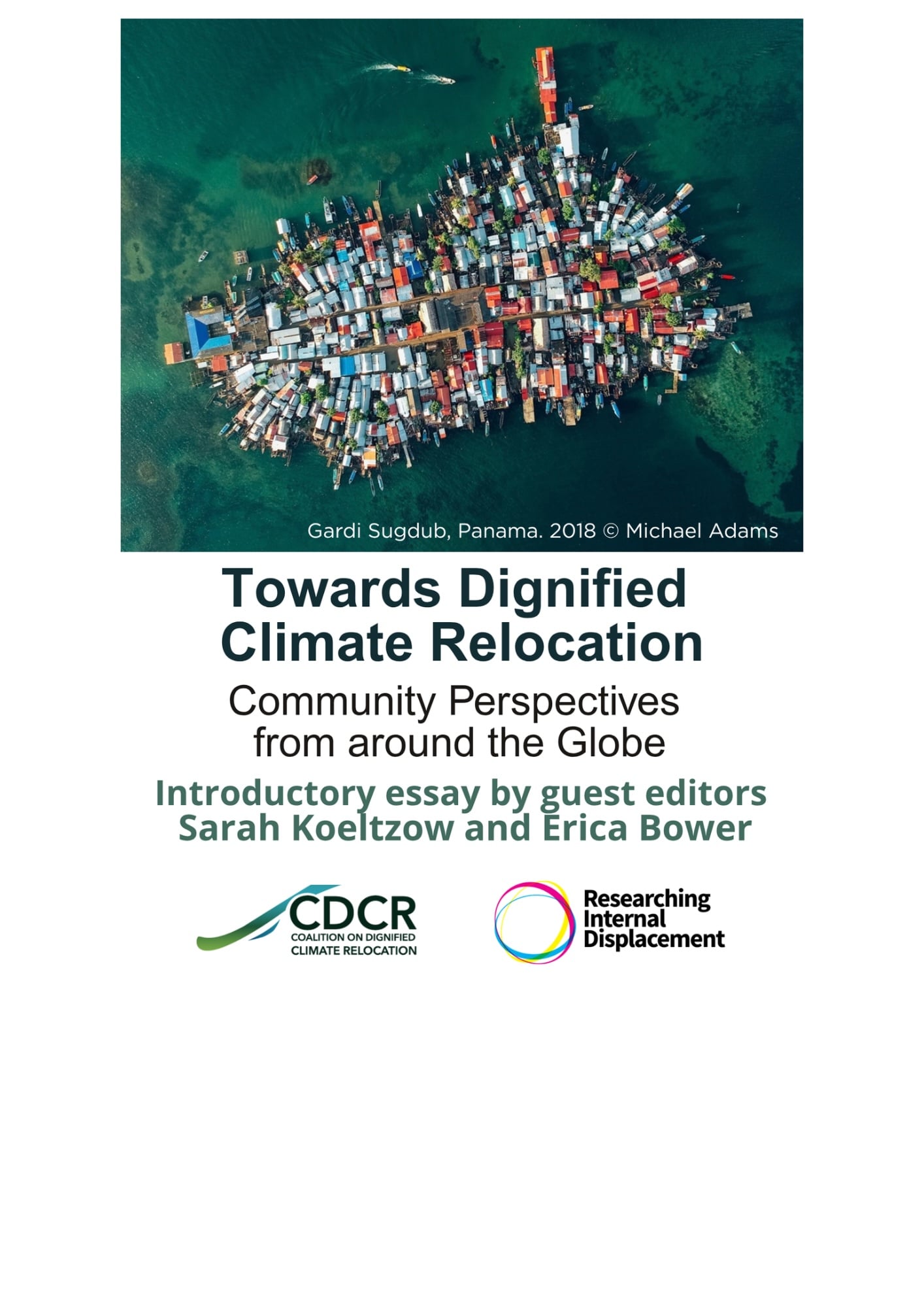
Why Community Perspectives on Planned Relocation are Critical
Climate-related planned relocations of entire communities to safer locations are already happening around the world. There is a growing literature on this unique form of human mobility, showcasing the diversity and commonalities of communities undertaking planned relocation. However, much of the research published to date is by external actors, researchers, civil society, and other advocates—often without the involvement of community members. We believe that community perspectives on planned relocation are essential because people with lived experience know the issues intimately and are best placed to enable solutions.
The Coalition on Dignified Climate Relocation brings relocating community perspectives to the fore and invites community members and their supporters to share insights about what works—and what doesn’t. This is vital information for governments, policymakers, and other actors to learn from past mistakes and ensure that future planned relocations are grounded in community experiences and protect people’s rights. The RID-CDCR collection of articles in this series is part of that work.
What is Climate-Related Planned Relocation?
Planned relocation in the context of climate change is a planned, permanent movement of a group of people to safer ground, with the goal of maintaining community cohesion in the new site. This distinguishes it from more spontaneous types of movement such as migration, generally undertaken at individual or household level and involving multiple destination sites. Unlike evacuations, the intention in planned relocation is for the village or community to settle permanently and supported with opportunities to rebuild their lives and livelihoods in the new location. The goal is to identify relocation sites that do not expose communities to new hazards and ensure that the new places, at a minimum, have adequate housing, services, and transport.
The articles in this series show that planned relocations can happen in response to, or in anticipation of, a hazard event or climate impacts. They also demonstrate that planned relocation often occurs after disaster displacement or following evacuations, with communities sometimes living (and waiting) for years in transitional shelters.
Two key principles are repeated across all existing guidance. First, planned relocation should be seen as a measure of last resort and only undertaken when all adaptation options have reasonably been, or will soon be, “exhausted in a timely manner”. Second, affected communities need to be front-and-centre in planning and decision-making. Together, these principles mean that planned relocation should only be undertaken where there is no alternative, and that it is driven and designed by the persons whose lives are affected. These two principles are derived from international human rights law. Yet governance frameworks at the national and regional levels are still scarce, and many of the frameworks developed to date have critical shortcomings regarding the extent to which they are anchored in human rights principles and consult, involve, and put communities at the centre.
Main Themes Emerging from the Miniseries
Each ‘community perspective’ featured speaks to different aspects of planned relocation processes, enumerates key challenges and lessons learned, and may have relevance across contexts. These include:
1. Community leadership and government support
Many of the planned relocations featured in this series are initiated by community members themselves, such as the perspective from Guna Yala, Panama by Elliot Brown, while others are initiated by external actors including governments, such as in the piece on Kerala, India by Rahmath Beevi Kunnummal and Mohammed Firoz C[EB1] . One of the more frequent and consequential findings from research on planned relocation to date is that processes led by communities, and with adequate support from local governments and other facilitating actors, have the greatest potential to produce results the affected people themselves regard as satisfactory.
Drawing on observations in Panama, Elliot Brown articulates this balancing act: “The Guna experience demonstrates that communities have the capacity to lead complex processes when they receive recognition, resources, and technical assistance. The state's responsibility should be to fulfill its role in guaranteeing rights, providing resources, and accompanying the process — not to complicate it or become an obstacle.”
2. “All of community” consultation and engagement
Even when researchers and policy makers agree to the two overarching principles referred to above—the “last resort” principle and the need for community involvement—there are many questions on how to effectively carry out community engagement and make it meaningful. Communities are not homogeneous and do not hold consensus views, nor is every member equally affected by the planned relocation process.
The articles on India and Tabasco, Mexico show how older persons may be particularly affected. For instance, drawing on their work with communities in Odisha, India, Ranjan Panda and Sankalpa Satapathy make the case for why “elderly persons must be actively included in decisions concerning whether, when, where and how relocation takes place. They carry invaluable historical and ecological knowledge, including knowledge of local ecosystems, water sources, disaster coping mechanisms, cultural practices and community networks. Such knowledge should inform the design of the new settlement rather than being lost through relocation.”
Throughout the series, authors shed light on the gendered impacts of planned relocations and the specific impacts on children and other ways in which specific groups may experience planned relocation processes differently. Therefore, consultation processes must be inclusive.
Drawing on the experiences in Tabasco, Silvia Cantú Bautista and co-authors further highlight how consultation has to be meaningful, engendering serious consequences when it is not: “Although the National Housing Commission held some working sessions before the relocation, these were not designed as genuine spaces for dialogue and co-creation: they generated false expectations about the houses' final appearance, barred community members from monitoring construction, and offered little accountability to residents' follow-up questions—fueling distrust, distraction, fear, and uncertainty that made community coordination around potential collective demands even more difficult.”
Together, these community perspectives make the case for why residents should be engaged inclusively and meaningfully during decision making about relocation, with mechanisms to ensure grievances are addressed.
3. More than infrastructure: A multidimensional process of economic, social and cultural rebuilding
While nearly all authors in this miniseries argue that planned relocation processes are about “more than just houses”, in practice, often very basic physical factors, such as decent-quality, culturally-appropriate housing and basic services and infrastructure, such as water, electricity, schools, health clinics, and public transport, prove difficult to obtain and maintain. Several articles, such as the pieces on Guna Yala, Panama, and Lower Shire Valley, Malawi, shine a spotlight on how even basic services such as potable water, electricity, and transport are often lacking in new sites, and how housing may be culturally inadequate, materially wanting or absent altogether. Regarding the Lower Shire Valley relocations in Malawi, Gift Richard Maloya and co-authors describe that “residents did not have houses in their new locations upon arrival and were responsible for construction themselves, continuing to use the tarps and other materials from the IDP camps as shelter in the new locations while they were building their more permanent housing.”
Other articles, such as the one from Kerala, India, spotlight the challenges of inadequate gathering spaces and shared infrastructure for the whole community in planned relocation sites. Rahmath Beevi Kunnummal and Mohammed Firoz C argue that “shared infrastructure and basic services are essential for long-term functionality and sustainability of a relocated community. Such facilities should be planned, funded and delivered alongside housing with clear responsibility rather than treated as secondary or future additions.”
4. Importance of monitoring outcomes over the long term
One of the most salient points made in all five community-perspective articles in this series is that a relocation is not finished when the new site and houses are handed over to the community. The aspiration is a permanent home, a restored livelihood, and cultural continuity for the next generation. That involves not only houses but also community centres and other infrastructure supporting economic, social and spiritual needs.
Several authors in the miniseries make the point that the outcomes of planned relocation processes can only be assessed many years later, such as in Kerala, India, or even generations later, as in Guna Yala, Panama. Rahmath Beevi Kunnummal and Mohammed Firoz C find that “housing conditions remain one of the most pressing issues five years after relocation” and go on to say that “five years after moving to HARSHAM, residents are still adapting to their settlement, finding ways to make it a viable habitat”. And Elliot Brown from Panama reflects how “a truly successful planned relocation should … be evaluated over time and across generations.”
5. Culture, grief and dimensions of loss
While planned relocations can make populations safer and benefit adaptation, the articles in this miniseries show how loss and damage is nearly always present. Besides the loss of physical housing and assets, loss is often profoundly cultural, with people feeling irrevocably removed from their ancestors, deities, and places of worship.
The cultural identity dimensions of a planned relocation are highlighted in the community perspectives of Guna Yala, Kerala and Odisha. The Guna Yala example is an interesting perspective on how planned relocation affects world views and belief systems but also self-governance arrangements of Indigenous communities. Gift Richard Maloya and co-authors report that in the Lower Shire Valley, “some community members continue to return to their previous villages on a daily or weekly basis to continue farming and collecting firewood.” Elliot Brown reflects on the “translocality” of Guna Yala community members, who travel between origin and destination sites every day and consider both Gardi Sugdub and Isberyala their “home”.
The health outcomesof planned relocation are another important dimension. Several authors refer expressly to its psychological impacts (e.g. in Tabasco, Mexico; Odisha, India and the Lower Shire Valley, Malawi). Ranjan Panda and Sankalpa Satapathy from Odisha describe the trauma of older populations as “solastalgia” – the acute distress and melancholia caused by the environmental degradation of one's home environment. Relocated communities grieve for the homelands where their ancestors lived, where they were born, and where their identities were forged in relation to the sea.”
6. The need for rules, governance frameworks and accountability mechanisms
A stark finding emerging from all five community perspectives is that almost every country and community facing planned relocation processes starts from scratch, piecing together available climate adaptation, disaster risk reduction, (local) development, and social protection laws, policies, funds, and programmes, to find the most adequate mechanisms to orchestrate, fund, and monitor such complex processes. This series demonstrates how important it is to set up regulatory frameworks and partnerships, to define roles and responsibilities in advance, clarify timelines, and set up grievance mechanisms. Such governance frameworks should be anchored in human rights principles, including the right of affected communities to participate in all stages of decision-making, and Indigenous communities’ right of self-determination. And these governance frameworks should be developed in an iterative and consultative way, with meaningful inputs from relocated communities.
The authors of the articles on Tabasco, Mexico, and Lower Shire Valley, Malawi, point to the importance of thedevelopment of laws, frameworks, policies, and guidance for planned relocation, and that those frameworks spell out how communities should be consulted and involved at all stages of the relocation process. Silvia Cantú Bautista and co-authors evoke the concept of climate justice and raise important questions on the selection, or exclusion, of community members in the process. Gift Richard Maloya and co-authors make the case for why planned relocations should be embedded in social protection frameworks.
The community perspectives of Guna Yala and Lower Shire Valley also highlight therole of national and district level authoritiesand, more generally, bureaucracies and administrations that are changing and can support, or delay, processes. When laws, policies and jointly agreed plans and timelines are firmly in place, support for relocating communities can continue with fewer disruptions during changes in administrations. Based on his community’s experience in Panama, Elliot Brown argues that “every planned relocation should have a public agreement clearly defining the responsibilities of institutions, available funding, timelines, services that must be operational, and channels for filing complaints. The community must be able to monitor progress and participate in evaluating the results”.
7. Communication of communities’ perspectives and the role of media
Community participation and accountability all rely on transparent communication and information provision. The articles in this miniseries have shown how important it is for relocating communities to share their perspectives, concerns and plans with their government and fellow citizens.
The articles from Kerala, India and Tabasco, Mexico in particular look at the importance of communication andthe role of mediabefore, during and after a planned relocation processin supporting relocating community leaders advocating for their preferred solutions.
In some cases, media attention has not helped. Rahmath Beevi Kunnummal and Mohammed Firoz C quote a community member in Kerala: “’Everyone is selling our stories. I am tired of repeating them over the years … being heard does not necessarily mean influencing what happens next.”
By contrast, in Tabasco, Mexico, Silvia Cantú Bautista and co-authors highlight how “the media pressure resulting from the communications campaign carried out by the community and the three organisations…were crucial to enabling their relocation…. Due to the media attention the case received, the relocation process began...when former Mexican President...ordered during a press conference that the situation in El Bosque be addressed.” The contrast in experiences shows that media attention can be a critical catalyst for support to relocating communities but should be used wisely—as part of a coordinated campaign that centers community views and requests.
Looking Forward
Planned relocations of entire communities are already taking place around the world and will increase. We are extremely pleased that members of the Coalition on Dignified Climate Relocation, including researchers, members, and supporters of communities from Mexico, Panama, Malawi, and India have shared their experiences, lessons, and recommendations in this miniseries.
This is one of many tools through which the Coalition on Dignified Climate Relocation seeks to support the understanding, exchange of experiences, and development of solutions to planned relocation challenges, with a spotlight on community perspectives and leadership. Going forward, there is a need for more knowledge sharing across geographical and cultural contexts so that communities, their supporters, and authorities preparing to relocate can benefit from the experiences of others—for example, in areas such as assessments and the formulation of guidance and protocols—rather than starting from zero.
These articles, whilst not a comprehensive sample, are revealing. Read together, they advance the discussion of how planned relocation is a distinct governance challenge and illustrate the disproportionate occurrence of planned relocations in coastal communities due to sea level rise. Many articles in this series describe the realities of poor rural populations who are disproportionately affected, such as farmers and fisherfolk, but it is important to note that planned relocations are also happening in high income contexts and are likely to increase in the years to come. For this reason, the Coalition on Dignified Climate Relocation advocates that all countries, starting with “every country with a coastline”, should develop and implement rights-respecting national policy frameworks on planned relocation.
Participation in the Coalition and Building the Evidence Base
People accompanying or experiencing a community-wide climate-related planned relocation and who would like to contribute a perspective on the theme ‘Towards Dignified Climate Relocation: Community Perspectives from around the Globe’ may contact the editorial team at Researching Internal Displacement. To be part of this global movement for community-centered and dignified planned relocation, visit the CDCR at www.climaterelocation.org and join the Coalition!
Sarah Koeltzow and Erica Bower, co-facilitators of the Coalition on Dignified Climate Relocation, are guest editors of this miniseries: Towards Dignified Climate Relocation: Community Perspectives from around the Globe. The series brings together the experiences of relocating community leaders, researchers, advocates and practitioners from across the Coalition to examine diverse case studies and identify lessons about what rights-respecting, community-led relocation looks like in practice and how national policy should enable it.
The Coalition on Dignified Climate Relocation was formed in 2025 to work towards two goals: foster knowledge and experience exchange across contexts, and advocate for countries to develop and implement rights-respecting policy frameworks on planned relocation that put communities at the center.
KEYWORDS: Planned relocation, climate change, human rights, displacement, solutions
Other articles in the miniseries
El Bosque, Mexico: Cantú Bautista, Silvia, María Maldonado Antillón, Daniela Chapuz Osorio, and Juan Manuel Orozco Moreno. 2026. More than Just Housing: Human-rights-based Planned Relocation Lessons from El Bosque, Mexico. Researching Internal Displacement.
Wayanad, India: Kunnummal, Rahmath Beevi, and Mohammed Firoz C. 2026. More Than a Roof: Promises, Practices, and the Realities of Project HARSHAM in Wayanad, India. Researching Internal Displacement.
Gardi Sugdub, Panama: Brown Rivera, Elliot. 2026. From Our Home in Gardi Sugdub and Isberyala: A Community Perspective on Planned Relocation in Panama. Translated by Sarah Koeltzow. Researching Internal Displacement.
Odisha, India: Panda, Ranjan, and Sankalpa Satapathy. 2026. Age and Justice Considerations: Insights from Planned Relocation in Odisha, India. Researching Internal Displacement.
Lower Shire Valley, Malawi: Maloya, Gift Richard, Gertrude Masangwi, Beatrice Tholyna Mtika, Simeon Bondera Nyirenda, and Jocelyn Perry. 2026. Cash Assistance and Social Protection: Considerations for More Dignified Planned Relocation in Malawi. Researching Internal Displacement.
Selected bibliography
Bower, Erica, David Durand-Delacre, Annah Piggott-McKellar, Giovanna Gini, and Rachel Harrington-Abrams. "Priorities for Consent-Based and Well-Supported Climate Relocations". Nature Communications 16, no. 1 (2025): 1–5. https://doi.org/10.1038/s41467-025-61285-0.
Bower, Erica, and Sanjula Weerasinghe. Leaving Place, Restoring Home: Enhancing the Evidence Base on Planned Relocation Cases in the Context of Hazards, Disasters, and Climate Change. Geneva and Sydney: Platform on Disaster Displacement (PDD) and Andrew & Renata Kaldor Centre for International Refugee Law, 2021. https://disasterdisplacement.org/portfolio-item/leaving-place-restoring-home/.
Brookings Institution, Georgetown University Institute for the Study of International Migration (ISIM), and United Nations High Commissioner for Refugees (UNHCR). Guidance on Protecting People from Disasters and Environmental Change through Planned Relocation. Geneva: Brookings, Georgetown University, and UNHCR, 2015. https://www.refworld.org/policy/opguidance/unhcr/2015/117656.
Bronen, Robin. "Rights, Resilience and Community-Led Relocation: Creating a National Governance Framework". N.Y.U. Review of Law & Social Change: The Harbinger 45 (2021): 25–45. https://socialchangenyu.com/harbinger/rights-resilience-and-community-led-relocation/.
Gaviria Betancur, Paula. Planned Relocations of People in the Context of the Adverse Effects of Climate Change and Disasters: Report of the Special Rapporteur on the Human Rights of Internally Displaced Persons. UN Doc. A/HRC/56/47, July 1, 2024. https://www.ohchr.org/en/documents/thematic-reports/ahrc5647-planned-relocations-people-context-adverse-effects-climate.
Koeltzow, Sarah, and Erica Bower. "Planned Relocation in the Context of Climate Change and Disasters: Conceptualising an Increasingly Salient Form of Human Mobility for Policy and Practice". In Handbook on Climate Mobility, edited by Bayes Ahmed and Bishawjit Mallick, 583–600. Cheltenham, UK: Edward Elgar Publishing, 2026. https://doi.org/10.4337/9781035329939.00047.