
Introduction
This article focuses on the planned relocation process (2022-present) of the coastal community of El Bosque, Tabasco, the first community officially recognized in Mexico as displaced due to the effects of climate change. Drawing on the experiences of the community and the accompanying team from Nuestro Futuro, A.C., a women-led Mexican nonprofit working at the intersection of climate justice, human rights, and nature protection, we explore the challenges faced before, during, and after the relocation process, including the loss of territory and housing, the transformation of livelihoods, and institutional barriers to community participation in pre-relocation decision-making. The relocation constitutes an achievement in community organizing, strategic communication, and legal accompaniment, as 51 families now have a new home provided by the Mexican Government outside the area experiencing coastal erosion. At the same time, El Bosque continues to undergo complex processes of adaptation and integration at their new location, which we propose can inform future plans, programs, and policies on planned relocation and loss and damage in Mexico and around the world.
The Community of El Bosque and Climate Change
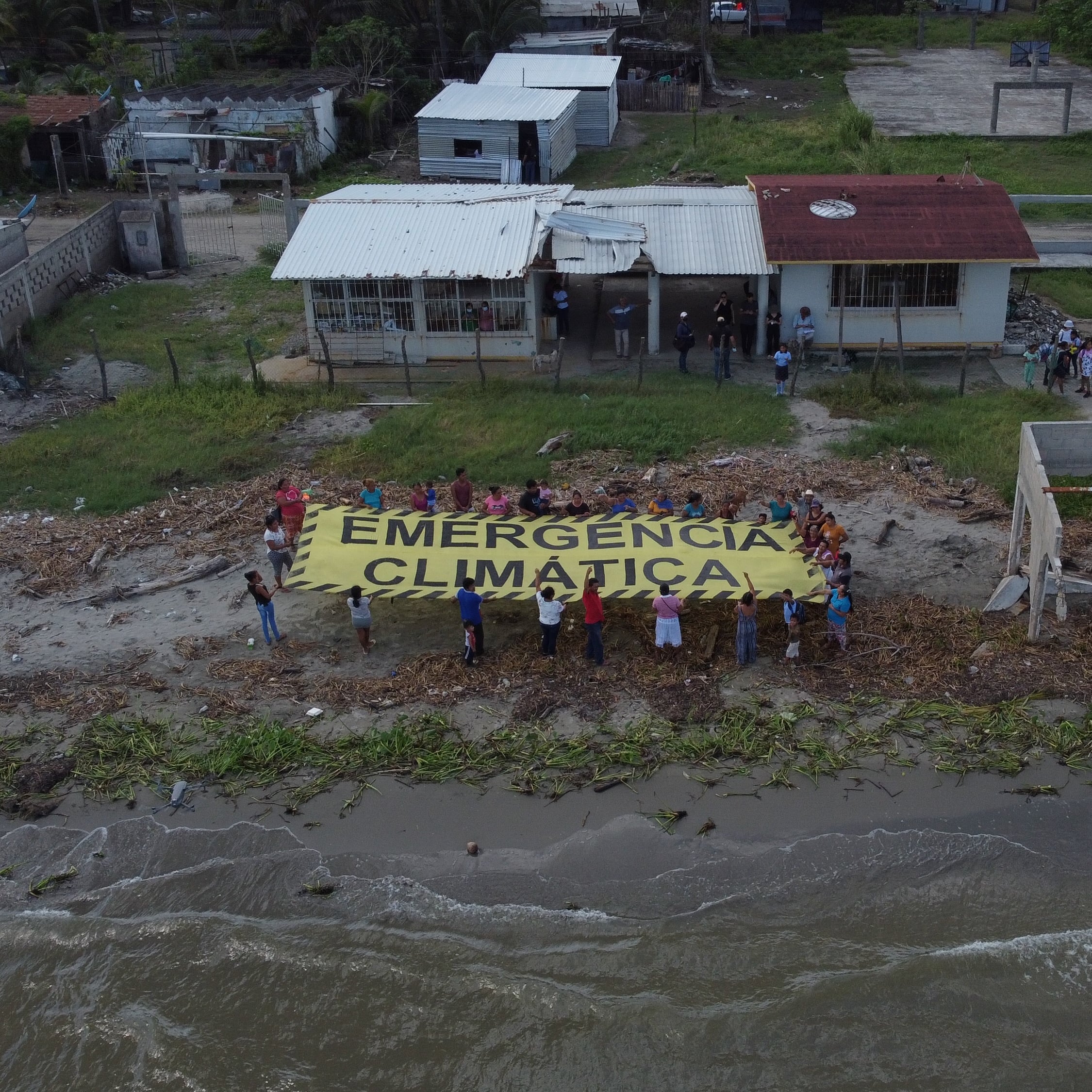
El Bosque is a fishing community located next to the mouth of the Grijalva River in the municipality of Centla, in the State of Tabasco. While the community is currently made up of approximately 200 inhabitants, records from the past decade indicate a previous population of up to 300 inhabitants and more than 75 houses. Before the coastal erosion swallowed most of the territory, the community also had an elementary school with a dining hall, several paved streets, drainage services, drinking water, telephone service, and electricity. However, the community has now been devastated by accelerated coastal erosion and intensified storm surges associated with cold fronts (“norte”), mixed phenomena which scientists have attributed to climate change.
El Bosque is highly exposed to natural hydrometeorological events, given that the winds coming from the Gulf of Mexico, the Pacific Ocean, and the Caribbean Sea converge in the coastal area of Tabasco. These phenomena are becoming increasingly stronger and more frequent due to climate change. Since 2019, a single norte has been enough to completely flood their homes and erode up to 10 meters of coast in one night.
The consequences have been devastating: the sea took the first house in 2017; 18 more by February 2021; and 43 homes at the start of 2022. By the end of 2022, storm surges had destroyed the school's dining hall and swept away a fourth row of homes and part of the preschool — 18 additional houses in total. In all, these events destroyed three to four full rows of streets, the beach, the preschool and elementary school, community gathering spaces, and public services (water, electricity, telephone, drainage). As of today, only a few houses remain standing.
It is estimated that, from 2005 to the present, more than 500 meters of coastline have been lost. As each norte markedly intensified the flooding and the loss of coastline, 65 families struggled to leave their homes overnight, searching for a safe space to temporarily relocate.
Mexican Legislation and Public Policy on Climate Displacement
El Bosque is not the only community affected by climate-driven displacement in Mexico, but legislation on planned relocation in this context is virtually nonexistent, making it difficult for citizens and civil society to activate the few, limited mechanisms the law provides.
Article 4 of the Political Constitution of the United Mexican States recognizes every person’s right to a healthy environment, which the UN Special Rapporteur on the issue of human rights obligations relating to the enjoyment of a safe, clean, healthy and sustainable environment has linked the impacts of climate change on the rights to “life, health, water, food, housing, development and self-determination.”
More recently, the Inter-American Court of Human Rights’ Advisory Opinion OC-32/2025, established that the climate crisis imposes enhanced obligations of prevention and protection for vulnerable persons and communities, it recognized the right to a healthy climate—linked to the right to a healthy environment—and called for the adoption of concrete adaptation measures, including adequate housing solutions, effective participation by affected persons, and timely responses based on the best available scientific evidence.
The Advisory Opinion is relevant because the Inter-American Court recognized that disasters resulting from climate change “may directly generate involuntary migration and displacement, or may do so indirectly when combined with situations of vulnerability and pre-existing drivers of displacement, such as conflict, violence, poverty, food insecurity, or inequalities.” Additionally, it expressly recognized that El Bosque was displaced due to sea-level rise caused by climate change.
In its updated Nationally Determined Contribution (NDC 3.0, November 2025), a national climate action plan called for under the Paris Agreement designed to cut greenhouse gas emissions and adapt to climate impacts, the Mexican government established novel lines of action on adaptation and loss and damage and committed to developing a National Planned Relocation Program for communities and settlements in high-risk areas. Notably, it explicitly cited El Bosque as an example of how “the loss of habitable territories is irreversible in various coastal areas” in Mexico due to climate change. Furthermore, the General Climate Change Law recognizes that internal displacement is a consequence of climate change. In turn, it recognizes relocation as a measure to guarantee the human rights of affected persons. Additionally, both the General Climate Change Law and the General Civil Protection Law require authorities to map climate risk and fund the relocation of the most vulnerable settlements.
Despite these obligations and the fact that NDC 3.0 requires the creation of programs and strategies to address the problem of climate change displacement through planned relocation, none of these legal and public policy instruments are currently being implemented or enforced. While the proposal for a National Planned Relocation Program is mentioned in the NDC 3.0, the mechanism does not currently exist, and no budget has been allocated to it. Therefore, even though the laws recognize that climate change can displace communities like El Bosque, there is currently no actual mechanism through which communities can request planned relocation support.
The Relocation Process – Challenges Faced
The community of El Bosque has faced many challenges over the past decade, from the loss of their houses and ways of living, to the bureaucratic hurdles of the relocation process and the challenges of adapting to a new location far away from the sea. All of this has occurred without a clear, comprehensive, inclusive, and effective response from the government. The challenges faced by the community before, during, and after the relocation process are detailed below, with the aim of documenting them so that they may inform future plans, programs, and policies on planned relocation and loss and damage in Mexico and around the world.
Challenges Faced Prior to Relocation
Before being relocated, the community of El Bosque suffered the consequences of climate change in different ways. The most important was the loss of their homes: losing their housing, belongings, important documents, and thousands of memories, now beneath the sea.
Aurea Sánchez, a woman from the community, recounts that she has lost three homes as a result of coastal erosion. In her testimony, given before the relocation had taken place, she stated:
In my case, I have already lost three homes as a result of coastal erosion. The sea has continued advancing and I have continued moving from place to place, but it seems as though the sea follows me. We are losing space in the community and in our own homes. There are seven members of my family, and today we are simply looking for somewhere to shelter from the rain. Although my last little house is still standing, the sea is already very close, and there is no longer any way to reach where my house is.
Where we are staying now does not have a proper floor, the walls are made of sheet metal, and there are no partitions. I do not have a home that is adequate for my family. We no longer have water either, and because of the most recent cold front, we also lost electricity. Being left in the dark is a constant risk, because when the sea comes in, without electricity, it is much more complicated and terrifying to have to evacuate at night, in the darkness, just as it happened to us during the last evacuation.
Similarly, Yesenia Albino, a young woman from the community of El Bosque, has described what it has been like to lose their homes as a result of climate change:
Our right to adequate housing has been violated because today we no longer have a home of our own. The last time we were displaced because of the storm, the seven members of my family rented a house together, because we do not have the financial means for each of us to rent a larger place. It has been very exhausting to keep leaving and returning to your home, for us and for the children, waiting for someone to help us when bad weather comes. No longer having a house, a place to return to, is very sad for us and for our children. The children begin asking very sad questions that you cannot answer, such as, ‘Mom, where are we going to live now?’ or ‘Mom, am I going to have a bed?’ or ‘Were we able to recover our things?’ It is very sad and very frustrating to lose your home and have nowhere to go.
However, this is not the only impact suffered by the community. Yesenia recounts that the impacts on older persons have been even greater:
For older people who cannot walk, the impacts of climate change have been even greater. We have an uncle who cannot walk, and during the last evacuation we had to take him out of the community in a wheelbarrow. And it is also very difficult for older people; they are not properly cared for because they are forced to move in and out of the community. It is difficult and exhausting for them to have to move every time bad weather comes.
Finally, the children of the community were also severely affected by the climate crisis. Guadalupe Cobos, a woman from the community, describes how her children have suffered as a result of climate change:
How climate change affects our children is very complicated, because by not having a school, by having nothing, their rights have been violated, and their physical integrity has been put at risk; they have been in danger. For example, the night they took us out [to evacuate us on November 1, 2023]. They did not evacuate us in a timely and proper manner before the storm surge. Because of that, with the rain, the physical integrity of our children was put at risk; their lives were in danger. It was very difficult. […] Psychologically, the children have also been affected. The children are more worried, sadder; I have seen them cry. It is difficult for the children to continue living in this situation. It is very difficult and painful for them to continue watching the sea destroy their homes.
As Yesenia describes, the children’s right to education has been disproportionately affected:
My children have also been affected psychologically. Being shut in and not talking to anyone, not being able to go out. Also, for the children, it is very complicated not to be attending school; they only attend online [...] They need their classrooms, they need their school. Not learning directly from a professional, from a teacher, takes a heavy toll on the children, because we often do not understand or do not know how to teach them. The children’s education becomes stagnant and does not progress.
Aurea Sánchez also shares that:
The children have been greatly affected [by the climate crisis and the loss of their homes and educational facilities] because the sea has already destroyed the preschool and the secondary school. They no longer have anywhere to study, they do not have the necessary space, much less an adequate one, to receive classes, and this is greatly affecting their education.
These are only some of the many impacts that the community has suffered because of climate change, and only a few of the many testimonies that members of the community have given. As can be seen, the community had an urgent need to be relocated in order to escape the danger posed by the sea entering their homes and taking everything away.
Initiating the Relocation
In 2022, three civil society organizations—Nuestro Futuro, A.C., Conexiones Climáticas, and Greenpeace México—began working with El Bosque, providing legal, community, and strategic communications support to the people living in El Bosque and requesting that the Mexican authorities carry out the planned, just, and dignified relocation of their community. A challenge stood out: how do you relocate a community when there are no plans, programs, or policies requiring the authorities to do so?
The media pressure resulting from the communications campaign carried out by the community and the three organizations, together with the formal activation of existing Federal Government mechanisms adapted to the particular circumstances of El Bosque, were crucial to enabling their relocation. The community collectively made its public request for action on this issue on November 7, 2022, when it held a press conference as a community of climate-displaced persons, calling on the Mexican Government to provide immediate relocation. Due to the media attention the case received, the relocation process began on February 6, 2023, when former Mexican President Andrés Manuel López Obrador ordered during a press conference that the situation in El Bosque be addressed.
After several months of researching different options, Nuestro Futuro found an existing social program that could be used to relocate the community: the Social Housing Program. The Social Housing Program is a program of the Ministry of Agrarian, Territorial and Urban Development (“SEDATU”), implemented through the National Housing Commission, which provides housing subsidies to low-income populations that need housing and do not have access to sufficient resources or financing to obtain adequate housing. The program is also intended to assist populations affected by disruptive natural phenomena and reduce the housing deficit through comprehensive housing measures.
Although the main objective of this program is not to address displacement caused by climate change, it is an existing mechanism with management programs, clear guidelines, and, most importantly, an allocated budget for its implementation. Having identified this alternative as the one provision in Mexican legislation that is closest to a relocation program, on April 14, 2023, 60 families from the community of El Bosque submitted applications to be incorporated into the 2023 Social Housing Program under the Housing Relocation modality.
Challenges faced during the relocation process
Once these relocation applications were submitted, dialogue began with the Mexican federal authorities, particularly the Ministry of Agrarian, Territorial and Urban Development, so that the families could be relocated through the Social Housing Program. After extensive advocacy with the federal authorities and an ongoing communications campaign reporting on the relocation process, at the end of 2023 SEDATU established a registry of the families that would be relocated.
The community of El Bosque faced several challenges during this process. The first was the uncertainty of not knowing when or where they would be relocated. For those who had already lost their homes or were about to lose them, this wait represented an extremely difficult period of physical, psychological, and economic insecurity, because the government was not maintaining adequate communication with the community, leaving them without necessary updates for long periods of time. This is particularly important considering that approximately a year and a half passed between the submission of the relocation applications and the inauguration of their homes in the new community.
The community also faced a lack of consultation at every stage. Federal and state authorities selected a vacant property in the same municipality where El Bosque was located which belonged to the State of Tabasco —chosen for being the most convenient and economical option — without consulting the community, even though most members would have preferred a location closer to the sea. Families were similarly unable to influence the design of their houses, either in terms of their appearance or the construction materials.
Although the National Housing Commission held some working sessions before the relocation, these were not designed as genuine spaces for dialogue and co-creation: they generated false expectations about the houses' final appearance, barred community members from monitoring construction, and offered little accountability to residents' follow-up questions — fueling distrust, distraction, fear, and uncertainty that made community coordination around potential collective demands even more difficult. While the sessions served to present updates on the project in general, they were not intentionally designed as spaces for open dialogue and consultation with clear and accessible instructions, thereby preventing the co-creation of the housing project. Together with the issues mentioned above, this represented a key institutional barrier to community participation in decision-making prior to the relocation.
On November 20, 2024, the Mexican authorities carried out the physical relocation of 51 families from the community of El Bosque to the property located in Frontera, municipality of Centla, Tabasco, where they were provided with their new houses. The new locality is called El Nuevo Bosque (The New El Bosque).
Current Challenges Facing the Community After Relocation
After many years of waiting for a response from the government, the community had finally received their new houses. Once the families began inhabiting the houses, new challenges arose. The first and most important challenge was the transformation of their livelihoods and the loss of artisanal fishing as a source of income. In El Bosque, the community was located in a privileged area for fishing; its territory lay between the Grijalva River and the Gulf of Mexico. However, when they were relocated, they were moved away from the river and the sea and, therefore, from their primary source of income. This new distance demands a very difficult process of adaptation for the families in the community, as most of them still choose to travel to El Bosque to continue their fishing activities.
Second, the community recognizes that interpersonal relationships have been seriously affected. An important factor is the housing model, as the houses are very small and located very close together, leading to emergent tensions and conflicts. Amid these neighborhood conflicts, community gathering spaces have been lost, and the dynamics of organization and decision-making have eroded over time.
The community is also grieving the loss of their territory and their homes, involving a series of profound economic and non-economic losses and damages. Most of the families that were relocated had lived in El Bosque for more than 25 years, and they report that grieving the loss of the home they inhabited for many years has been difficult. Since the relocation, Nuestro Futuro has continued working with the community to promote group and individual therapy activities to help them name and work through the grief caused by the loss of their territory and livelihoods as part of their adaptation process.
Recently, the community benefited from the construction of a park that allows children, adolescents, and young people to engage in recreational and sports activities. During the first year of adaptation, they faced the stress of living in a completely new place, confined indoors, without places to play and without activities to occupy their time. Children and adolescents describe how difficult it has been going from playing on the breezy seashore to playing on the hot pavement.
In addition, children’s access to education was also markedly affected by the loss of their homes and the relocation process. Unlike El Bosque, where there was a local school that children attended, there is currently only a temporary mobile school in Nuevo Bosque. This has prevented children from receiving a complete education in adequate and permanent facilities, with schools that are not single-teacher schools, to guarantee educational quality. In terms of insecurity, children face the risk of living on the urban periphery, where they frequently witness criminal activity and are exposed to the use of psychoactive substances.
Finally, another major challenge currently faced by some members of the community is that at least eleven families were excluded from the relocation process, without any explanation from the federal authorities. This means that eleven families that form part of the community still do not have a home in which to live. In response to this serious problem, Nuestro Futuro is actively representing these families in legal proceedings to demand that the State relocate them, as they are also climate-displaced persons recognized as such by the Mexican Government itself.
The National Adaptation Policy – Next Steps in Mexico
National Adaptation Plans or Policies (NAPs) are instruments submitted to the United Nations Framework Convention on Climate Change (UNFCCC) by developing countries. These instruments allow countries to identify their medium- and long-term adaptation needs and develop and implement strategies and programs to address them. Mexico is currently preparing its first NAP, though the process has fallen behind schedule and publication is now expected in 2027. In May 2025, Mexico’s National Institute of Ecology and Climate Change (INECC) began this work with US$2.8 million from the Green Climate Fund (GCF) and technical support from the Global Green Growth Institute (GGGI). Mexico intends to share substantial progress on the NAP design at COP 31 in Turkey. Nuestro Futuro has participated in the NAP’s diagnostic and gender workshops together with two women from El Bosque.
We consider that Mexico’s NAP can build significantly on the lines of action previously set out in the Adaptation and Loss and Damage components of NDC 3.0, providing greater detail regarding their specific scope and the competent authorities responsible for implementing and overseeing each proposed action, while incorporating territorial perspectives and more detailed regional assessments updated to 2026–2027. The NAP represents a unique opportunity for the Mexican Government to reaffirm its commitment to improving approaches to planned relocation, moving from commitments on paper that lack specific allocations of authority to detailed implementation plans involving all three levels of government.
Nuestro Futuro and the community of El Bosque will be at the forefront of the effort to create and implement a National Planned Relocation Program based on territorial evidence and a human rights perspective. We understand that a dignified and planned relocation is not simply a matter of physically moving housing, but rather of co-governance in planned relocation and new housing construction, the restoration of livelihoods and intangible cultural heritage, and reparations when and to the extent possible.
Conclusion
The planned relocation of El Bosque has had an important impact on the relocated community’s struggle for climate justice. On the one hand, 51 families recognized as climate displaced now have new housing guaranteed by the Mexican Government, something that had never previously been achieved in the country. This constitutes a major collective achievement by the community and the civil society organizations that have organized over the past four years. In addition, this case is now being used as an example for the creation of plans, programs, and policies on planned relocation and loss and damage in Mexico.
Despite the above, Mexico still lacks the legal, budgetary, and institutional mechanisms necessary to address the displacement crisis that climate change is causing and that will become increasingly severe unless urgent and adequate action is taken from a human rights perspective. In addition, El Bosque continues to undergo complex processes of adaptation and integration, and there are still families that have not been relocated. The Mexican Government and other governments around the world can learn a lot from the case of El Bosque, what was done well and what must be done better, to develop a planned relocation policy that can be implemented jointly with the affected communities.
In summary, the case of El Bosque highlights key components to a dignified planned relocation: community participation during all stages of a relocation project, transparent and constant communication between affected communities and governmental institutions, coordinated efforts for the preservation of means of living and prior economic activities, the guarantee of a right to education and access to health services before, during, and after relocation, integration programs involving host communities, and the adequate documentation of losses and damages, both economic and non-economic. These components and recommendations will be further developed in a series of reports on El Bosque, which Nuestro Futuro will publish throughout 2027.
Silvia Cantú Bautista (Public Policy and Advocacy Lead), María Maldonado Antillón (Head of Litigation), and Daniela Chapuz Osorio (Community Organizer) are part of the team at Nuestro Futuro A.C., a women-led Mexican nonprofit working at the intersection of climate justice, human rights, and nature protection. Through strategic litigation, community accompaniment, public policy advocacy, and powerful public narratives, they work alongside the communities and ecosystems most affected by the climate crisis. Since 2022, Nuestro Futuro has supported El Bosque's relocation case and, to this day, continues to provide legal support and community accompaniment, documenting the community's experiences and needs with regards to the relocation process.
Juan Manuel Orozco Moreno is a community organizer and projects officer at Conexiones Climáticas, an organization working at the intersection of climate communication and grassroots territorial resistance, combining digital campaigns, community education, and direct advocacy to defend local ecosystems and address the climate crisis. Together with Nuestro Futuro and Greenpeace México, Conexiones Climáticas supported El Bosque in its relocation case.
Sarah Koeltzow and Erica Bower, co-facilitators of the Coalition on Dignified Climate Relocation, are guest editors of this miniseries: Towards Dignified Climate Relocation: Community Perspectives from around the Globe. The series brings together the experiences of relocating community leaders, researchers, advocates and practitioners from across the Coalition to examine diverse case studies and identify lessons about what rights-respecting, community-led relocation looks like in practice and how national policy should enable it.
The Coalition on Dignified Climate Relocation was formed in 2025 to work towards two goals: foster knowledge and experience exchange across contexts, and advocate for countries to develop and implement rights-respecting policy frameworks on planned relocation that put communities at the center.
KEYWORDS: Planned relocation, climate change, human rights, displacement, Mexico
Selected Bibliography
Bonnett, Nicole L., y S. Jeff Birchall. 2025. “Local planning for climate induced relocation: A systematic review”. International Journal of Disaster Risk Reduction 117 (febrero): 105094. https://doi.org/10.1016/j.ijdrr.2024.105094.
Gama Campillo, Lilia, Hilda María Díaz López, Ricardo Collado Torres, et al. 2023. “Implicaciones de la potencial elevación del nivel del mar para la población costera de Tabasco, México”. Estudios demográficos y urbanos 38 (1): 283–320. https://doi.org/10.24201/edu.v38i1.1999
Gouritin, Armelle. 2021. Migrantes climáticos en México. 1a ed. FLACSO-México. https://doi.org/10.2307/j.ctv21hrdgd.
Neusner, Julia; Ama Francis. 2024. “Public Health and Human Health Implications of Climate Mobility”. Sabin Center for Climate Change Law, https://scholarship.law.columbia.edu/sabin_climate_change/227.
Unicef. 2023. Children Displaced in a Changing Climate: Preparing for a Future Already Underway. Book. In United Nations Children's Fund, The (UNICEF). https://openlibrary.org/books/OL49617183M.