
Introduction
Despite growing investments in durable solutions across the Horn of Africa, displacement caused by conflict, disasters, and the interaction of both continues to persist at alarming levels. Governments, humanitarian agencies, development partners, and regional institutions have increasingly embraced durable solutions as a pathway from humanitarian dependency toward self-reliance, stability, and inclusion for people displaced by these crises. Yet the region continues to experience recurring cycles of displacement and vulnerability. This raises an important question: why do durable solutions remain so difficult to achieve despite increasing policy commitment and financial investment?
One explanation lies in a growing contradiction at the heart of displacement governance. While durable solutions frameworks are designed around the assumption that recovery can gradually lead to stability, recurrent drought is increasingly undermining the very conditions upon which that stability depends. In this sense, the Horn of Africa presents what may be described as a durable solutions paradox: as investments in solutions expand, climate shocks simultaneously erode the foundations required for those solutions to endure.
The Rise of the Durable Solutions Agenda
Across the Horn of Africa, the durable solutions agenda has become a central pillar of displacement governance, reflecting an important shift from short-term humanitarian response toward longer-term approaches that aim to support displaced populations in achieving self-reliance, dignity, and stability. Governments, humanitarian actors, development partners, and regional institutions have increasingly aligned around the principle that displacement is not only a humanitarian concern but also a structural development and governance challenge requiring integrated, multi-year responses. Yet despite this convergence of policy intent, displacement across the Horn remains persistently high, raising a fundamental question about the conditions under which durable solutions can realistically be achieved.
Drought as a Structural Driver of Displacement
At the heart of this challenge is the increasingly visible role of recurrent drought as a structural driver of displacement and a persistent constraint on recovery processes. Between 2020 and 2023, the Horn of Africa experienced one of the most severe and prolonged drought cycles in recent history, characterized by consecutive failed rainy seasons and compounding climate shocks. At its peak, more than 22 million people across the region faced acute food insecurity, reflecting not only immediate humanitarian need but also deeper systemic stress on livelihoods and coping systems (WFP, 2023). This drought cycle was not an isolated environmental event but part of a broader pattern of increasing climate variability in Eastern Africa, where drought frequency and intensity have become more pronounced over time.
While drought is a significant driver of displacement, it rarely operates in isolation. Across the Horn of Africa, climate stress frequently interacts with conflict, resource competition, weak governance, and economic vulnerability. Drought can intensify competition over grazing land and water resources, exacerbate local tensions, and increase pressure on already fragile institutions. Consequently, displacement outcomes often emerge from the interaction of climatic and socio-political factors rather than from environmental shocks alone. Understanding this relationship is critical for designing durable solutions that address both immediate climate risks and the broader structural conditions that contribute to displacement.
When Livelihood Collapse Becomes a Displacement Crisis
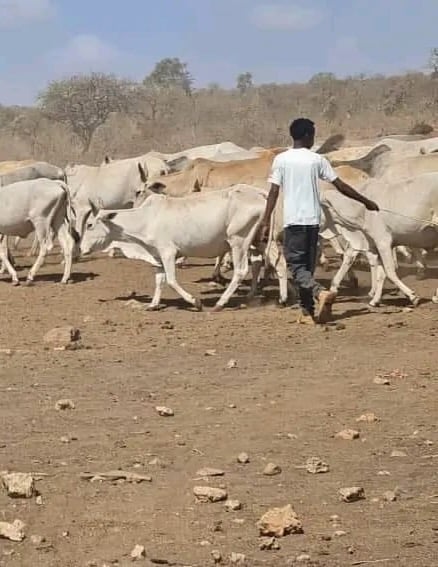
The impacts of this climate stress are most visible in the collapse of livelihood systems that traditionally underpin resilience in the region. In pastoral and agro-pastoral areas, livestock losses have been particularly devastating, with the Food and Agriculture Organization highlighting large-scale mortality and asset depletion across the Horn of Africa (FAO, 2023). These losses are not merely economic; they represent the erosion of social safety nets, savings mechanisms, and adaptive capacity that households rely on to withstand future shocks. When these systems collapse, vulnerability is not only immediate but also cumulative, reducing the ability of households to recover even when conditions temporarily improve.
The cyclical nature of drought-induced displacement is evident across multiple contexts in the Horn of Africa. In Somalia, repeated droughts have contributed not only to large-scale livelihood losses and displacement but also to severe humanitarian consequences, including excess mortality and prolonged recovery challenges. A joint assessment by UNICEF, WHO, and the Federal Government of Somalia estimated approximately 71,100 excess deaths associated with drought conditions between 2022 and 2024, with children disproportionately affected (UNICEF Somalia, 2025). Similar patterns are visible in Ethiopia, where recurrent drought in the Somali Region and pastoral areas of Oromia has devastated livestock-based livelihoods, displaced communities, and left millions dependent on humanitarian assistance. During the 2022 drought crisis alone, more than three million people in Ethiopia's Somali Region were affected, with widespread livestock losses and growing displacement pressures. In northern Kenya, particularly in Turkana and Marsabit counties, successive droughts have repeatedly undermined pastoral livelihoods and household resilience. Research from Kenya shows that pastoral households often require three to four years to rebuild livestock herds following major drought events, highlighting how recovery can remain incomplete when new shocks emerge before previous losses have been fully absorbed. Taken together, these experiences suggest that displacement in drought-affected regions is rarely a one-time event. Instead, it often reflects a recurring cycle in which climate shocks repeatedly erode livelihoods, delay recovery, and undermine resilience. Consequently, communities that appear to be progressing toward self-reliance may experience renewed displacement or re-displacement when subsequent droughts undermine recovery gains.
These figures underscore an important shift in how drought must be understood in the region: it is no longer a periodic shock that interrupts development progress, but a structural stressor that reshapes demographic, economic, and social outcomes.
The practical implications of this dynamic can be observed across several countries in the region. These experiences illustrate that displacement is often not a one-time event but part of a recurring cycle of vulnerability, recovery, and renewed displacement. As climate shocks become more frequent, the distinction between temporary displacement and chronic displacement becomes increasingly blurred.
The Challenge of Sustaining Recovery
Within this context, durable solutions frameworks, whether focused on return, local integration, or resettlement. are increasingly challenged by the cyclical nature of displacement and recovery. The traditional assumption underpinning many solutions approaches is that displacement represents a break from normality, followed by a gradual return to stability through humanitarian assistance and development investment. However, in drought-affected contexts, this linear trajectory is repeatedly disrupted. Recovery gains are often short-lived, as households that have begun to rebuild livelihoods are pushed back into vulnerability by subsequent climate shocks. This results in what can be understood as development reversals, where progress toward stability is repeatedly undermined before it can be consolidated.
A key implication of this pattern is that the region is not only facing a displacement challenge but also a deeper resilience crisis. Durable solutions indicators may capture improvements in housing, access to services, or livelihood opportunities, yet these gains remain highly exposed to climate variability. IGAD has consistently emphasized that recurrent drought is one of the most significant threats to sustainable development and resilience in the Horn of Africa, particularly in arid and semi-arid regions where ecological systems are highly sensitive to climatic fluctuations. This suggests that the sustainability of durable solutions cannot be assessed independently of climate resilience, as the latter increasingly determines whether solutions endure or unravel.
The Institutional Cycle of Crisis Response
The institutional implications of this dynamic are equally significant. Recurrent drought in the Horn of Africa generates a recurring cycle of institutional reprioritization. Governments activate emergency coordination mechanisms, humanitarian agencies rapidly scale up life-saving interventions, and donors mobilize additional humanitarian financing for food assistance, water provision, nutrition, and livelihood protection. While these measures are essential for preventing humanitarian catastrophe, repeated drought emergencies often divert political attention, operational capacity, and financial resources away from longer-term recovery, resilience-building, and durable solutions initiatives, reinforcing a cycle in which crisis response repeatedly takes precedence over structural investments in sustainable solutions.
Development programming is delayed, resilience investments are interrupted, and durable solutions initiatives are frequently deprioritized in favour of urgent crisis response. Over time, this creates what can be described as a humanitarian trap, in which systems remain locked in cycles of emergency response despite recognition of the need for long-term solutions.
The World Bank has highlighted how climate shocks in fragile and conflict-affected settings contribute to cycles of vulnerability and displacement, undermining development gains and reinforcing structural fragility. This dynamic is particularly evident in the Horn of Africa, where drought not only drives displacement but also reshapes institutional behavior, reinforcing short-termism in policy and programming. In this sense, drought becomes not only a humanitarian or environmental issue but also a governance challenge that affects how priorities are set, how resources are allocated, and how solutions are defined.
Rethinking Durable Solutions in an Era of Climate Recurrence
The broader conceptual question that emerges is whether durable solutions frameworks are adequately designed for a climate reality that is increasingly defined by recurrence rather than stability. The Intergovernmental Panel on Climate Change has projected that Eastern Africa will continue to experience increasing climate variability and more frequent extreme weather events, including droughts and floods, with significant implications for livelihoods, food systems, and human mobility (IPCC AR6 WGII: https://www.ipcc.ch/report/ar6/wg2/). In such a context, the assumption that recovery leads to stability becomes increasingly difficult to sustain.
Some might argue that contemporary approaches to durable solutions increasingly take account of resilience, climate adaptation, and disaster risk reduction. More broadly, recent policy discussions have increasingly recognized the relationship between climate change and displacement. However, the persistence of repeated displacement across drought-affected areas suggests that such considerations remain insufficiently integrated into implementation systems, financing mechanisms, and measurement frameworks. Recognition of climate risk has advanced considerably; the challenge now lies in translating that recognition into effective operational systems at scale.
This does not imply that durable solutions are no longer relevant. Rather, it suggests that they require recalibration to reflect a climate reality characterized by recurrence rather than stability. Durable solutions in the Horn of Africa must increasingly be understood not as a fixed end-state achieved once displacement ceases, but as an adaptive process capable of withstanding repeated environmental shocks. Such a shift requires moving beyond recovery-oriented approaches toward resilience-centered models that strengthen adaptive capacity before crises emerge. This includes investing in climate-resilient livelihoods, anticipatory action systems, social protection mechanisms, drought preparedness, and locally driven adaptation strategies that reduce vulnerability over time. Initiatives such as anticipatory action promoted by OCHA highlight the growing recognition that acting before shocks escalate can significantly reduce humanitarian impact and displacement risks.
Ultimately, the Horn of Africa illustrates a durable solutions paradox: while policy frameworks and investments in solutions continue to expand, recurrent drought is simultaneously eroding the conditions required for those solutions to be sustained. The challenge is therefore not only to resolve displacement, but to ensure that the conditions that produce displacement are not repeatedly recreated by predictable and recurring climate stress. In this sense, the future of durable solutions will depend less on the ability to respond to displacement after it occurs, and more on the capacity to build systems of resilience that prevent displacement from becoming a recurring outcome of climate variability.
Conclusion
The experience of the Horn of Africa demonstrates that displacement cannot be understood separately from the climate realities shaping the region. Recurrent drought has evolved from an episodic humanitarian shock into a structural force that continually undermines livelihoods, resilience, and recovery processes. As a result, the assumptions that traditionally underpin durable solutions frameworks, particularly the expectation that recovery leads to stability, are increasingly challenged.
While significant progress has been made in advancing durable solutions, policies and institutional frameworks across the region, the sustainability of these efforts remains constrained by recurring climate stress. The central challenge is no longer simply enabling displaced populations to rebuild their lives, but ensuring that the conditions supporting recovery can withstand future shocks. Durable solutions therefore cannot be measured solely by the cessation of displacement; they must also be evaluated by their capacity to endure and adapt in a context of growing climate uncertainty.
The Horn of Africa’s experience suggests that the future of displacement governance will depend on how effectively resilience, climate adaptation, and risk reduction are integrated into durable solutions programming; how success is measured through more meaningful and comprehensive metrics; and how humanitarian, development, and climate financing are better aligned to support sustainable outcomes. Without this shift, displacement is likely to remain cyclical, and investments in solutions will continue to face the risk of reversal.
Guled Ali (MA, Disaster Management) is a Durable Solutions Specialist, Policy Analyst, and Forced Migration Researcher with over a decade of experience in displacement, humanitarian response, and resilience programming. Based in Ethiopia and currently with ReDSS, he specializes in displacement governance, durable solutions, climate mobility, and forced migration analysis across the East Africa and the Great lake regions, with a focus on evidence-informed policy and practice. He is also a member of the Emerging Scholars Network at the Kaldor Centre for International Refugee Law, contributing to research and policy discussions on refugee protection, internal displacement, and durable solutions.
The views and opinions expressed in this article are those of the author and do not necessarily reflect the views of ReDSS or any affiliated organization.
KEYWORDS: IDPs, Displacement, Horn of Africa, Durable Solutions, Climate Change
Selected Bibliography
Food and Agriculture Organization of the United Nations (FAO). (2023). Horn of Africa: The region is facing an unprecedented disaster. https://www.fao.org/newsroom/detail/horn-of-africa---the-region-is-facing-an-unprecedented-disaster
Intergovernmental Panel on Climate Change (IPCC). (2022). Climate Change 2022: Impacts, Adaptation and Vulnerability (AR6 Working Group II). https://www.ipcc.ch/report/ar6/wg2/
United Nations Office for the Coordination of Humanitarian Affairs (OCHA). (n.d.). Anticipatory Action. https://www.unocha.org/anticipatory-action
United Nations Children's Fund (UNICEF) Somalia. (2025). 71,000 drought-related excess deaths in Somalia. https://www.unicef.org/somalia/press-releases/71000-drought-related-excess-deaths
World Food Programme (WFP). (2023). Regional Drought Response Plan: Horn of Africa 2023. https://www.wfp.org/publications/regional-drought-response-plan-horn-africa-2023