
Locating ‘Relocation’ within History
The discourse around planned relocation has progressively carved out a significant place within the overall framework of adaptation in the face of climate change. At its heart, however, remain tensions surrounding the timing of resettlements, the complex decision of choosing a suitable location, and which stakeholders are to be involved in this process. As climate change impacts accelerate around the world and the number of internally displaced persons (IDPs) increases, international frameworks, bilateral and regional treaties and national legal and policy frameworks have begun to, often unquestioningly, adopt the term ‘planned relocation’ as a solution to the specific challenge posed by climate change and environmental hazards.
However, relocation of IDPs itself isn’t a new phenomenon. Practices of state-led relocation of peoples has been a constant feature in the history of modern nation-states and have taken place for a myriad of reasons, including conflict, war, development, famine and natural disasters. Planned relocation in the context of climate change appeared within the Cancun Adaptation Framework in 2010, after which point it became increasingly accepted that in-situ adaptation will likely not always be sufficient to allow vulnerable communities to remain in place.
Within the current discourse, however, little is said regarding the political economy of planned relocations, particularly how relocation can function as a state-making device for nascent and post-colonial nation-states. History will show that the concept of relocation raises complicated questions around issues of minoritisation within nation-states and how such processes may alter demographic composition of human settlements along ethnic and racial lines. A Foucauldian genealogy of relocation of IDPs and its implications for state-building ambitions may stand to complicate ongoing debates that situate the state at the heart of relocation initiatives.
Research by Bower and Weerasinghe shows that states have been engaged in relocation projects since the 1970s, with the authors documenting 412 cases of state-led relocation around the world as of 2021. This article focuses on one such example of relocation, which can be found within the database – that of Bangladesh’s relocation approach to poor, displaced and landless communities under its ‘Gucchagram’ (cluster village) initiative. Here, I trace the history of the Gucchagram project since its inception in 1971, including the history of Gucchagrams within the Chittagong Hill Tracts (CHT) region of Bangladesh, which has long been a contested territory replete with documented military abuses against Indigenous non-Bengali communities by the Bangladeshi Army.
Gucchagram – Relocation Under the Aegis of the State
The Bengali term ‘Gucchagram’, meaning ‘Cluster Village’, came into being around 1972, one year after Bangladesh’s war of independence. At the time, Bangladesh had just emerged from a nine-month armed conflict with the Pakistani military in the aftermath of the world’s deadliest cyclone in recorded human history, the 1970 Great Bhola Cyclone, which is estimated to have killed between 300,000 – 350,000 people and hastened the end of the East Pakistan regime. Within this context, Bangladesh had a substantial number of landless and displaced persons who had moved as a result of the disaster and the conflict. At a very early stage, the Bangladeshi government was confronted with the twin problem of a large number of displaced persons and a disaster-prone topography that would readily produce more displacement. The government took steps to limit the concentration of landholding through Presidential Order 98 of 1972, which limited the amount of land to be held by one family to 33.3 acres. Any surplus land beyond that was to be transferred as khas (government-owned) land, which the state could subsequently distribute to landless and displaced people.
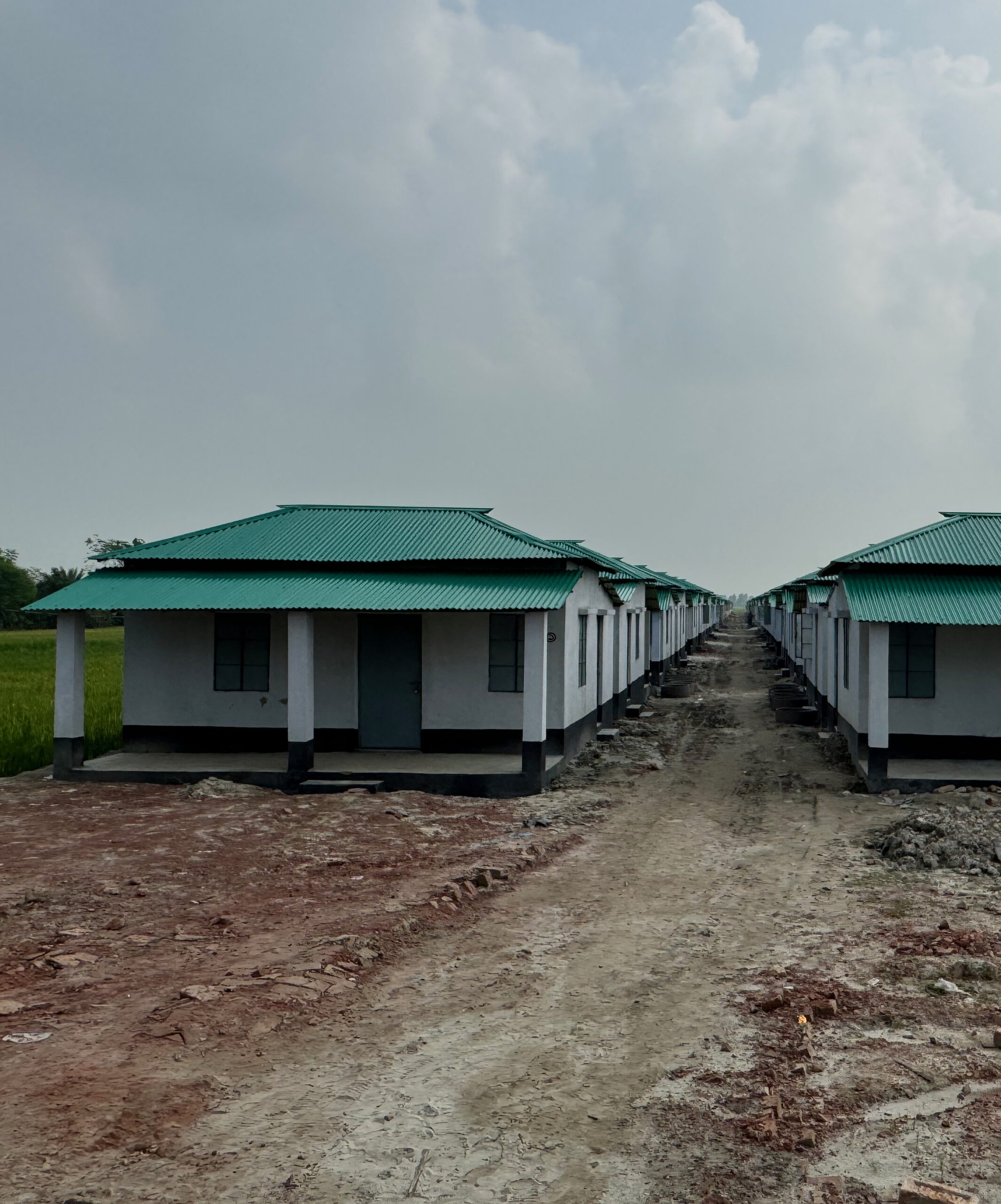
The first ‘cluster village’ project was piloted in 1972 in the Laxmipur district, where the government resettled communities displaced by tidal surges into small, uniform housing units constructed upon government-owned land. The transfer or lease of government owned non-agricultural land was later incorporated into law first by the Land Reforms Ordinance (1984), which explicitly gave priority to landless peasants in cases of redistribution, and later through the Policy for Distribution and Administration of Non-Agricultural Khas Land (1995), which provided, under Section 3(d), the mandate for the state to allocate government-owned land to people who have become landless as a result of natural disasters. The Gucchagram initiative, operated first by the Ministry of Land and later the Prime Minister’s Office, has also been referred to at different times as the Adarsha Gram (model village) and the Ashrayan (sheltering) project. It has evolved into an integrated relocation and resettlement approach that aims to relocate families, provide them with vocational and income-generating capacity building, link them to micro-loan sources, and ensure public health through free vaccination programs.
At the time of writing, the government website on the Gucchogram project claims to have relocated a total of 127,540 families throughout its history. Several iterations and variations of the project have been undertaken by the Bangladeshi government, the most recent being the ‘Gucchagram for Climate Victims Rehabilitation Project (CVRP)’,which sought to relocate and resettle approximately 50,000 families across 2550 Gucchagrams by July 2020. Under this most recent project, the CVRP transfers a minimum of 0.04 acres (4 decimals) of land per household, a 300 square foot house and sanitation facilities. The process is entirely free of cost for beneficiaries. The Ministry of Land’s CVRP project documents highlight that each resettlement is accompanied by a rehabilitation scheme, which includes training on income-generating activities for beneficiaries, easy access to micro-credit schemes for entrepreneurs and the delivery of awareness sessions and workshops on primary health care, sanitation, disaster preparedness, community leadership and social cohesion.
Numerous studies have analysed the impact of the cluster villageprojects on the resettled communities. For instance, Mallick & Sultana have highlighted that the project has had some positive impacts on the livelihoods of resettled communities, while at the same time adversely impacting[SM1] their quality of life in other ways. Among them, the primary concerns cited were the notable reduction of joint families and, as a consequence, a severing of social ties for people within their localities. Miron et al have noted that cluster villages tended to be far away from basic facilities such as schools, markets, and mosques and were not conducive to agricultural and fishing livelihoods. Given the largely homogenous nature of Bangladesh, most studies have focused on ethnic majority communities and have not considered the challenges of minority ethnic groups or Indigenous Peoples, particularly around issues of social cohesion.
Cluster Villages in the Hills
The Chittagong Hill Tracts (CHT) are located in the south-eastern region of Bangladesh and comprise three hill districts – Rangamati, Khagrachari and Bandarban. Together, the CHT accounts for roughly a tenth of the entire landmass of Bangladesh and is home to at least thirteen different Indigenous communities and groups.
During the British colonial period, this region of the Indian subcontinent remained outside the full governance control of the British. Indeed, the British colonial administration found it more beneficial to provide autonomy to the Indigenous groups and to designate the CHT as a separate district from neighbouring Chittagong, primarily as it created a security buffer against Indigenous Peoples, many of whom were considered bandits and raiders.
Crucially, Section 52 of the CHT Regulations barred the entry and residence of individuals not belonging to one of the Indigenous groups already resident within the CHT. As such, for the entire duration of the colonial period, migration of Bengalis into the hill tracts remained negligible.
The CHT region was, therefore, completely excluded from the negotiations around Partition, and by the time the Ratcliffe Commission had drawn up the lines of partition across the Indian subcontinent, the CHT chiefs were dismayed to find themselves as a part of Pakistan. The decision to place the region within East Pakistan led to the creation of an armed struggle of the Indigenous communities against the Pakistani military forces.
Following Bangladesh’s war of independence, the CHT region was again subsumed, unilaterally, within the boundaries of yet another nation-state. By the time of the 1971 war of independence, the Indigenous communities had organised themselves politically under the banner of the Parbattya Chattogram Jana Samhati Samiti (PCJSS) and had sought regional autonomy and a reversion to the CHT Regulation, after it had been abrogated by the East Pakistan government. The then president, Sheikh Mujibur Rahman, rejected the assertion and asked them to ‘forget their ethnicity and become Bengalis’. The assertion was met with fury and led to the establishment of an armed wing under the PCJSS known as the Shanti Bahini (peace force).
Following the assassination of Mujibur Rahman in 1975, the military establishment took control of Bangladesh and developed a three-pronged strategy to bring the CHT region under its control: first, through active incursions and operations by the Bangladesh Army against armed resistance in the hill tracts; second, through a process of state-led development projects that sought to assert state dominance; and third, through a secret government resettlement program that sought to skew the demographics of the region in favour of the majority Bengali population of the rest of the country.
The third prong of the army’s strategy, which involved ensuring a demographic shift within the region, included the relocation of 400,000 non-Indigenous Bengali people to the region. The primary goal was to counter Indigenous dominance in the region through a process that has been called ‘demographic engineering’. The 400,000 Bengalis that migrated through this scheme were comprised of landless families from all around the country. In particular, settlers in the CHT region recounted previous experiences of disaster induced displacement, with a survey of settlers conducted in 2020 showing that almost 56% of the respondents had migrated to the hill tracts following displacement due to a climatic event.
When Bengali families were transported to the hill tracts, they were first brought to cluster villages where they were conscripted into clearing trees for army settlements. The initial receiving areas were formally incorporated into the cluster village models but were tweaked to serve a military purpose. Scholars have likened these cluster villages to the idea of the ‘strategic hamlet’, which had been deployed by the Americans during the Vietnam War. In line with the idea of the ‘strategic hamlets’, the Gucchagrams in CHT were created in strategic locations to impede the movement of the Shanti Bahini, and mobility to and from the villages was heavily restricted by the army. A number of these cluster villages were constructed on land from which Indigenous communities had been forcibly displaced. By 1986, most of the Bengali settlers who had moved under the government relocation scheme had been rehoused within Gucchagrams, where the government spent heavily on food aid. Arens reports that between 1988 and 1991, a monthly expenditure of USD 20 million was used to purchase approximately 1800 metric tonnes of rice to provide free food rations in the cluster villages. The food aid scheme was titled, appropriately, ‘Santakaran’ (Pacification) to highlight its strategic role in the counterinsurgency and continues to this day, albeit at a more limited scale.
Later, in a bid to reduce the number of Indigenous People joining the ranks of the Shanti Bahini, the government constructed Gucchagrams for displaced Indigenous communities as well. By the 1990s, there were over 2000 Gucchagrams in the CHT region, which was inhabited by 300,000 Indigenous People and 200,000 Bengalis, accounting for more than half of the population of the CHT region at that time. The Gucchagrams were often surrounded by army sentry positions on their perimeters and were largely effective at cutting off supply lines to the Shanti Bahini, a key reason behind the armed group’s eventual disbandment.
Confronting the Colonial Legacies of Relocation
It is important to conceptualise the relocation projects through the framework of settler colonialism. The Gucchagram initiativehad been directly mobilised as a tool for settler colonialism during the 1980s in the CHT region. The practice of resettlement as part of the colonial toolkit has been analysed by McAdam, who suggests that state-led resettlement policies in the face of climate change find their origins in the way in which planned relocation and resettlement of populations was thought of in the colonial-era, as both a means of exploiting underutilised natural resources and to manage scarcity and conflict. In the case of Bangladesh’s Gucchagram model, the resettlement scheme allowed for the political and social minoritisation of a once autonomous region and operated in tandem with other forms of military and political domination.
The historical legacy of the Gucchagram project has since been ‘climate-washed’ into a program which is now aptly titled the ‘Gucchagram – Climate Victims Rehabilitation’ scheme and is closely tied to other such rehabilitation and relocation schemes such as the Ashrayan scheme, which follows the same resettlement model. The distancing of the ongoing planned relocation projects from its violent history of settler-colonialism highlights one of the dangers of a state-led approach to climate change adaptation, which can provide avenues to frame state violence on its citizens through a lens of benevolence.
What purpose does revisiting the violent history of Gucchagrams serve in the context of Bangladesh’s, and others’, response to climate change? For one, it complicates the ongoing global conversation around state-led planned relocation efforts. Scholarship and policy discourse suggest that planned relocation is becoming a key response to growing forced displacement risk. Guidelines on planned relocations have been developed by states such as Fiji and the Solomon Islands, which are extremely vulnerable to impacts of climate change. In particular, the guidelines developed by Fiji specify that in cases where relocation is taking place where other communities already exist, consultations should be carried out to manage expectations, and additional infrastructure and resources are needed for the communities to deal with the influx of populations. The issue of cultural integration and ethnic conflict among affected communities is raised again by de Sherbinin et al., who stress the need for preparing host communities prior to executing planned relocation projects and advise against resettlement plans where marginalised communities reside.
However, what seems to be missing from this discourse is a critical view of the nation-state itself and the ways in which nation-states often assert their territorial sovereignty through practices of exclusion against the non-majoritarian other. Practices of legislative exclusion, militarisation and demographic engineering are often commonplace within post-colonial states heavily dominated by ethnic or religious majorities. Within these contexts, it is crucial to adopt a critical lens on state practice when state-led approaches to countering climate change are discussed. Ethnic, religious and linguistic minorities are already understood to be highly vulnerable to climate change, particularly in situations where state-led adaptation and mitigation efforts may either overlook such groups or impact them negatively. Viewing the state’s approach to combatting climate change normatively risks erasing the ways in which states have committed violence against their own citizens and can potentially lead to the normalisation of further harm. In particular, the issue of planned relocation requires additional scrutiny because of the ways in which its implementation can have transformational effects not just on the impacted communities but also on the political and social fabric of areas where they are being resettled.
Bangladesh itself has readily advocated for processes of planned relocation. Its National Adaptation Plan (2023 – 2050) acknowledges that the intensity of climatic hazards necessitates the implementation of planned relocation, for which it has allocated BDT 124 million (MoEFCC, 2022). The Bangladesh Climate Change Strategy and Action Plan, 2009, the parent document for all climate change related activities being conducted by the country, equally acknowledges that in-situ adaptation is likely to fail in some cases and that planned relocation of communities will need to be carried out. In the long term, the strategy envisions the development of a protocol to guide rehabilitation of such communities under the pillar Programme T4P6. Its own National Strategy on Internal Displacement Management (2021) (NSIDM) places planned relocation as the third and final stage of interventions towards durable solutions for displaced persons, after efforts at return or integration in self-relocation areas fail. The NSIDM invokes the Nansen Principles and affirms the need for including host communities into implementation of planned relocation and integration activities. In the same vein, the NSIDM stresses the use of cluster villages (both in its Gucchagram and Ashrayan iterations)as a framework for climate-resilient housing for displaced persons. Guidance on how the current cluster village guidelines deviate from the NSIDM have been enumerated but not adopted by the government. However, guidelines on how host communities can be included within planned relocation projects remain absent. Also absent are considerations of how a relocation site should be selected and how issues relating to the wellbeing of religious and ethnic minorities can be taken into account when large-scale efforts, such as planned relocation, are undertaken.
Recounting the history of the Gucchagram project and its role in the CHT conflict shows the insidious ways in which interventions on internal displacement and climate change adaptation can be utilised to engage in practices of minoritisation. It is imperative, therefore, to adopt a decolonial approach to understanding the politics of climate change and to develop critical approaches to questioning state-led climate change responses, even in instances where the state in question is among the most climate-vulnerable and in need of support. Emergent 'good practices' that ensure planned relocations are well-supported and consent-based are, of course, necessary, and such practices have thus far been lacking in Bangladesh. Critically, planned relocation must also pass rigorous scrutiny as to its larger state-making ambitions before it can be reliably included in frameworks purporting to be people-centred, just responses to internal displacement.
Ahmad Ibrahim is a researcher and humanitarian practitioner working at the intersection of forced displacement, border criminologies and legal protection. He is based in Dhaka, Bangladesh and works with Bangladesh Legal Aid and Services Trust (BLAST), where he oversees legal assistance programs to Rohingya refugees in Bangladesh. He is also an editor at Researching Internal Displacement.
KEYWORDS: Planned Relocation, Minoritisation, IDPs, Displacement, Bangladesh, Chittagong Hill Tracks
Selected Bibliography
Arens, J. (1997) ‘Winning hearts and minds: Foreign aid and militarisation in the Chittagong Hill Tracts’, Economic and Political Weekly, 32(29), pp. 1811–1819. Available at: https://www.jstor.org/stable/4405649 (Accessed: 5 June 2025).
Chakma, B. (2025) ‘Demographic engineering: Population resettlement in the ethnoterritory of the Chittagong Hill Tracts, Bangladesh’, Modern Asian Studies, pp. 1–31. doi:10.1017/S0026749X25000010.
Chowdhury, R (2025). ‘Reflection on the National Strategy on Internal Displacement Management (2021) in the Ashrayan Guideline (2010-2022) of Bangladesh’, Platform on Disaster Displacement. Available at: https://pamad.disasterdisplacement.org/wp-content/uploads/sites/2/2025/07/01-Ashrayan_Guideline.pdf (accessed 4 January 2026).
Ferris, E, and Bower, E. (2023). “Planned Relocations: What we know, don’t know, and need to learn.” Researching Internal Displacement. Available at: https://researchinginternaldisplacement.org/short_pieces/planned-relocations-what-we-know-dont-know-and-need-to-learn/ (accessed: 4 November 2025).
Gini, G., Piggott-McKellar, A., Wiegel, H. et al. (2024) ‘Navigating tensions in climate change-related planned relocation’, Ambio, 53, pp. 1262–1266. Available at: https://doi.org/10.1007/s13280-024-02035-2 (Accessed: 4 June 2025).
McAdam, J. (2015) ‘Relocation and resettlement from colonisation to climate change: The perennial solution to “danger zones”’, London Review of International Law, 3(1), pp. 93–130. Available at: https://doi.org/10.1093/lril/lru015 (Accessed: 5 June 2025).
Miron, S., Rifat, D.T., Islam, T. 2025. Missing in (Climate) Action? Displaced Communities and the Search for Durable Solutions. Bangladesh as a loss and damage case study, Researching Internal Displacement. Available at: https://researchinginternaldisplacement.org/wp-content/uploads/2025/10/Miron-Missing-in-Climate-Action.pdf
Siraj, N. and Bal, E. (2017) ‘‘Hunger has brought us into this jungle’: understanding mobility and immobility of Bengali immigrants in the Chittagong Hills of Bangladesh’, Social Identities, 23(4), pp. 396–412. doi: 10.1080/13504630.2017.1281443.