
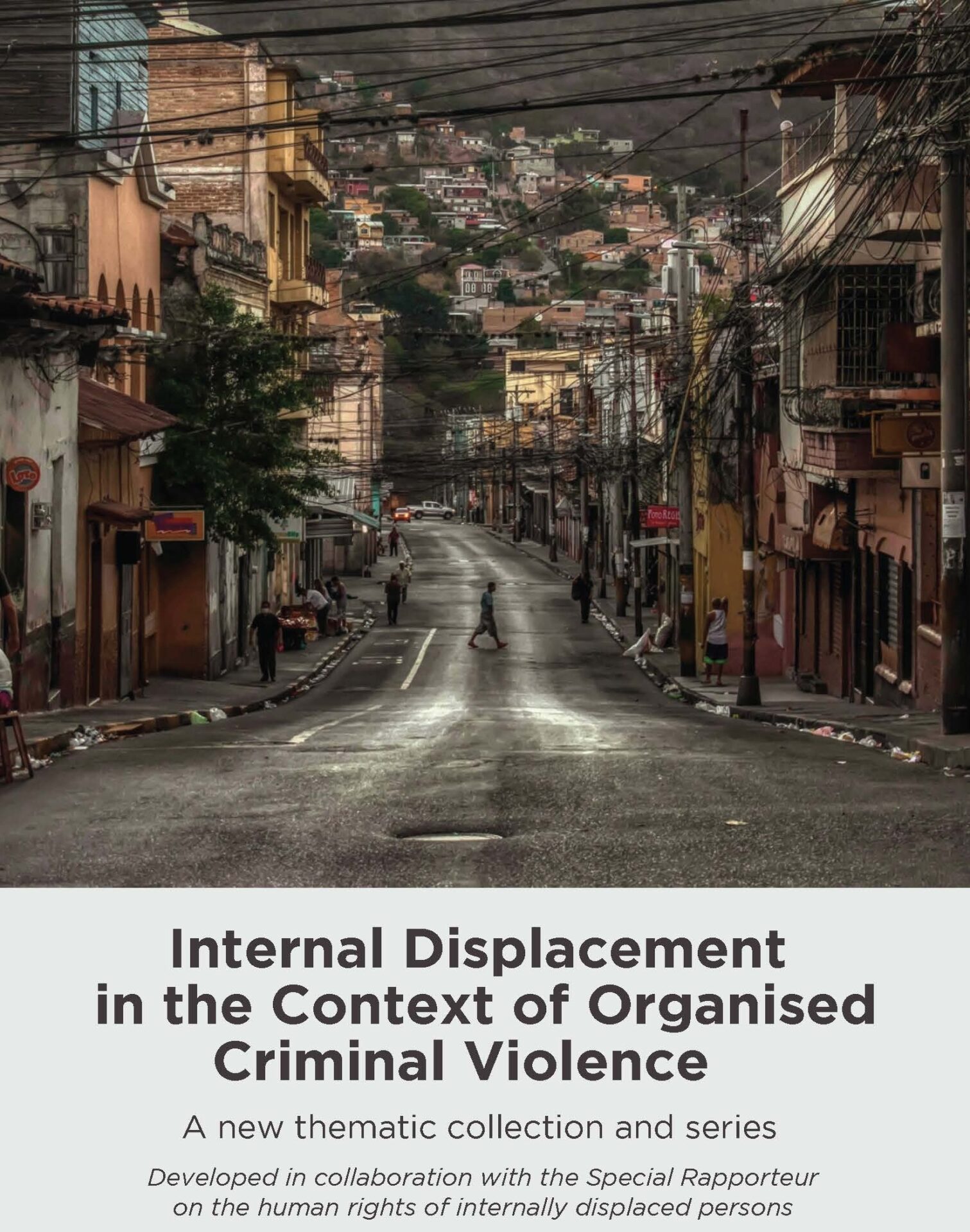
Preface and Introduction to Researching Internal Displacement’s New Thematic Collection and Series
by David Cantor and Steve Miron
Refugee lawyers had seen cases of individual asylum-seekers fleeing from violent street gangs and other criminal groups since at least the 1990s, particularly from countries in the north of Central America and from Mexico. But it was only in the 2010s that forced migration researchers and policymakers fully understood that these apparently isolated refugee cases had now become part of a wider pattern of forced displacement within societies riven by the presence of violent and organised criminal groups.
Understanding crime as a driver of displacement
Since then, research has documented the dynamics of this ‘new wave’ of displacement in Mesoamerica. Studies have shown the scale of displacement due to the violence of organised criminal groups can be significant across nations both small (e.g. El Salvador) and large (e.g. Mexico). Governments, civil society and international agencies have begun to take steps to address the dire humanitarian and security challenges facing people displaced within their own countries by criminal violence.
But, a decade later, what do we really know about crime as a driver of displacement? How widespread is the phenomenon? Where do resulting patterns and experiences of internal displacement differ from other violent contexts such as war? How can legal, policy and operational frameworks best address displacement in contexts where criminal groups hold influence? What role do States, civil society and international actors each play in this response? What are its theoretical implications?
Introducing the series
This new series of short pieces on the Researching Internal Displacement platform focuses on ‘Internal Displacement in the Context of Organised Criminal Violence’. It promotes renewed engagement by researchers and practitioners with the profound questions that remain outstanding on this issue. The series invites reflection on the state of existing research and the potential gaps in our thinking as well as stimulating new research, data and analysis on contexts where this phenomenon is observed.
The series emerges from a research collaboration between experts at the Internal Displacement Research Programme (IDRP) of the Refugee Law Initiative and the UN Special Rapporteur on the Human Rights of Internally Displaced Persons. It revolves around a thematic report being developed by the Special Rapporteur. A small team of IDRP experts has provided input regarding the call for this report and its content, and their short papers on relevant topics constitute the first five papers in this series.
Scope of initial contributions to the series
The initial five papers are now available as a collection here and via the “Download PDF Version” link below.
The five papers were published once weekly in early 2025 (now available in this collection) and draw on research by IDRP experts. The first paper, by Prof. David Cantor, reflects on what we have learnt in the past ten years about internal displacement in the context of violence by organised criminal groups in Central America. It argues that labelling these situations as ‘criminal’ should not distract us from the similarities, as well as differences, with the dynamics of displacement during armed conflicts. The piece points to the attendant implications for protecting and assisting the internally displaced in this context.
The second paper, by Dr Victorie Knox, looks at how violence involving organised criminal groups and networks causes significant displacement, above all in Latin America and the Caribbean. It examines the structural factors that underpin violence and risk from organised criminal groups and how this generates displacement, with a focus on the role of the State. The paper then considers how displacement by violence and risk from organised criminal groups plays out, describing the distinct displacement dynamics that ensue and the general lack of effective responses.
The third paper, by Dr Miriam Bradley, examines international law on the use of force in situations of violence linked to organised crime. These can reach the thresholds for armed conflict, triggering international humanitarian law (IHL) applicability, in addition to international human rights law (IHRL). While an armed conflict classification can activate international mechanisms for protection during war, , the application of IHL reduces the protections afforded under IHRL and may do more harm than good for IDPs and those at risk of displacement. International protection mechanisms must ensure fuller protection of IDPs.
The fourth paper, by Dr Gillian Kane, explores the role of the international anti-trafficking framework in addressing internal displacement resulting from organised criminal activity. In so doing, it first unpacks the definition of human trafficking before exploring the intersections with internal displacement and what this means for responses. Ultimately, the paper calls for legal and policy responses to internal displacement to incorporate anti-trafficking obligations so that effective protection can be achieved in practice.
The fifth paper, by Gabriela Malo, looks at internal displacement generated in the context of violence by criminal groups in Ecuador, describing this relatively new and little-discussed form of injustice affecting tens of thousands of Ecuadorians per year. With little government acknowledgement of the problem, the needs of people displaced by criminal gang violence remain under-resourced and unaddressed. As a result, the paper argues that most affected people have little recourse to assistance, lacking knowledge of how and where to seek protections and solutions.
The papers in this series sit alongside a more extensive body of work on the topic developed by other authors on the Researching Internal Displacement platform over the past few years. Most of this work concerns internal displacement in the context of organised criminal violence in Latin American countries. It includes short pieces like those in this series, longer working papers and video documentaries – mostly produced by researchers and practitioners from that region (with some in Spanish). You will find those in our blog and working paper collections (see links below)
Looking to the future: contribute to the series!
Internal displacement due to organised criminal violence raises pressing questions for researchers (alongside those for practitioners identified by the Special Rapporteur). The initial papers in the series address some of them, but many others require resolution. It is notable also that most research and policy on this issue is concentrated in the region of the Americas, particularly in Mesoamerica and Colombia. It is imperative that we broaden the understanding of this theme to other countries and regions. Organised criminal violence has led to displacement and other humanitarian effects in many other settings.
We welcome new contributions to this series on ‘Internal Displacement in the Context of Organised Criminal Violence’. They can be on any theme, region or country relevant to this topic – and can take the form of original short pieces, longer Working Papers or artistic creations. They must not be published elsewhere. For the Researching Internal Displacement guidelines for contributing authors, please see relevant sections of the Blog and Working Paper pages on the site. For any other questions, or to propose or discuss a submission, please contact the editorial team via the rid@sas.ac.uk mailbox.
David Cantor is Professor and Director of the Refugee Law Initiative and its Internal Displacement Research Programme.
Steven Miron is Joint Editor-in-Chief of Researching Internal Displacement
KEYWORDS: IDPs, Displacement, Americas, Organised Violence, Criminal Groups
Bibliography
Other resources relevant to the theme of criminal violence on the site include:
Janet Bowstead. ‘IDPs in the Global North: Women’s Journeys to Escape Domestic Violence’, Researching Internal Displacement (30 March 2023)
Leticia Calderón Chelius and May-ek, ‘Mexico and the Exiles Displaced by the Violence of the New Century’, Researching Internal Displacement Working Papers, No. 39 (25 January 2024) [Spanish]
Norma Adriana Garduño Salazar, ‘Leaving Our Dreams Behind: A Perspective on Forced Internal Displacement in Mexico’, Researching Internal Displacement Working Papers, No. 21 (10 May 2022) [Spanish]
Inés Giménez Delgado, ‘Visual Footprints and Voices: Silence and Presence in the Media and Audiovisual Representation of Forced Displacement in Guerrero, Mexico’, Researching Internal Displacement Working Papers, No. 2 (4 November 2021) [Spanish]
Jesús Medina Aguilar, ‘“Silenced Zones” – Displaced Journalists in Mexico’, Researching Internal Displacement (21 February 2022) [Spanish]
Francesca Randazzo Eisemann, ‘Experiencing Internal Displacement: Poetic Artistic Work of Collective Action based on Narrative Testimonial Material’, Researching Internal Displacement (17 November 2021) [Spanish]
Ana María Ríos Laverde, ‘Transformation in the Dynamics of Internal Displacement in Colombia in Times of Migration’, Researching Internal Displacement Working Papers, No. 29 (21 July 2022) [Spanish]